


AI automation is helping businesses save money and work smarter in 2025. Rising costs and tighter budgets make efficiency critical, and AI tools are stepping in to handle repetitive tasks, customer interactions, and operational processes. Here’s how businesses are cutting expenses and boosting productivity:
- AI Receptionists: Reduce customer service costs by up to 30% with 24/7 automated support.
- Lead Management: AI captures and follows up on leads instantly, saving time and improving conversion rates.
- Back-Office Automation: Tasks like data entry and invoicing are handled faster and with fewer errors.
- AI Marketing Tools: Automate content creation and audience targeting at lower costs.
- Email Automation: AI manages inboxes, organizes messages, and drafts responses efficiently.
- Predictive Analytics: Smarter resource allocation avoids waste and improves decision-making.
- Scaling Without Hiring: AI enables growth without increasing labor costs, handling more work with the same team.
Key takeaway: AI automation allows small and medium-sized businesses to cut costs, save time, and scale operations without adding staff. Tools like AI receptionists, marketing systems, and predictive analytics are making business operations faster and more efficient.
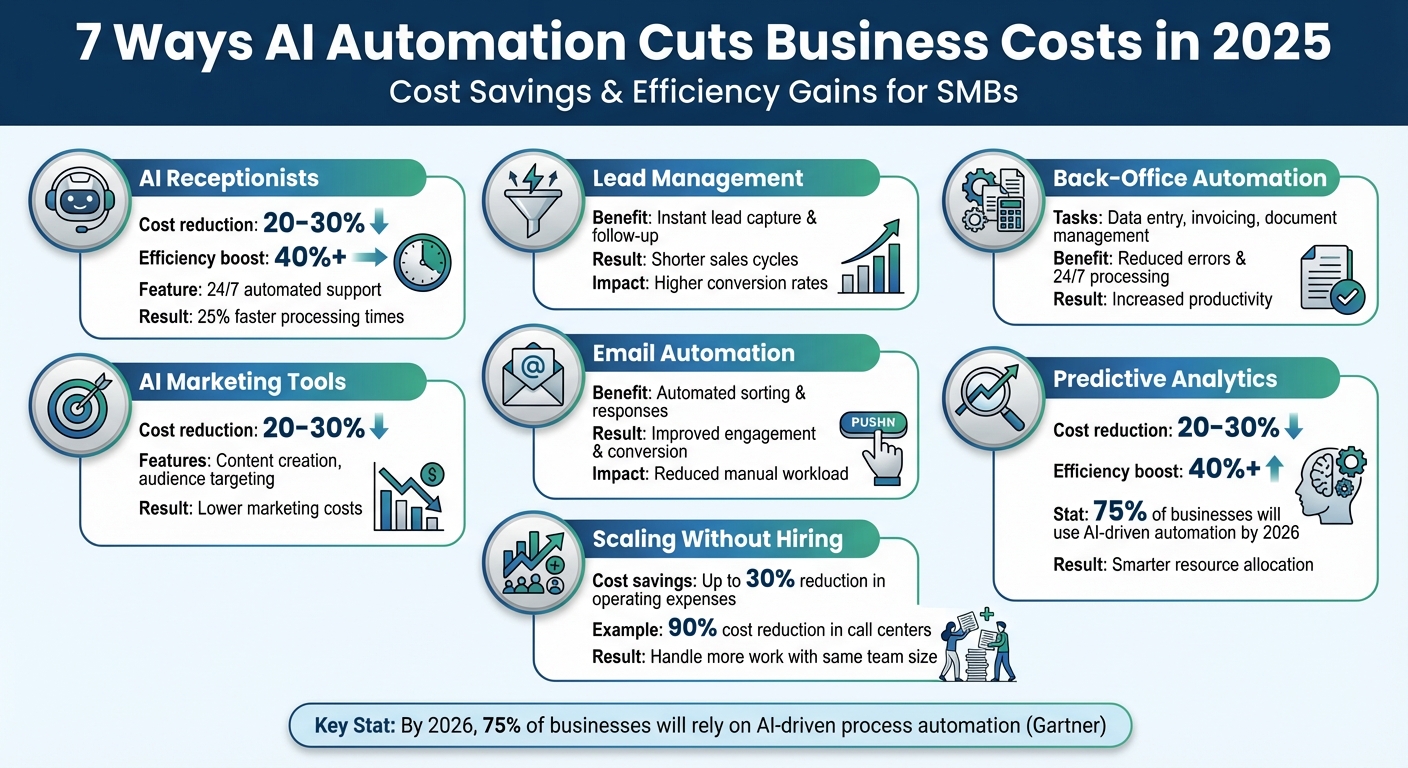
7 Ways AI Automation Cuts Business Costs in 2025
How Real Service Businesses Are Using AI to Save Time, Cut Costs & Scale Faster
1. AI Receptionists and Customer Communication
Managing customer communication manually can be a huge drain on resources for small and medium-sized businesses (SMBs). Enter AI receptionists, which can take over these tasks seamlessly, working around the clock without breaks.
Cost Savings Potential
AI tools can reduce operational costs by 20–30% while improving efficiency by over 40%. These systems can handle tasks like answering FAQs, scheduling appointments, directing inquiries to the right team members, and gathering lead information.
"Small businesses can’t afford to waste time on manual processes when every hour counts during peak season, and AI automation allows them to scale their operations without proportionally scaling their overhead cost." – Alison Stevens, Senior Director of HR Solutions, Paychex
Efficiency Gains
One of the standout benefits of AI receptionists is how they eliminate customer wait times with instant responses. Businesses that integrate these solutions report 25% faster processing times and a 50% boost in operational efficiency. For example, some government agencies have managed to resolve 42% of customer queries without needing human intervention. One agency even increased the number of calls answered by 30% thanks to automated systems. This lets human staff focus on more complex issues that require their expertise.
Scalability for SMBs
AI also helps SMBs handle spikes in demand without the need for additional labor costs. Take a local service provider, for instance – they use an AI chatbot to handle pricing questions, schedule appointments, and send follow-up messages. This allows them to manage busy periods effectively without hiring temporary staff. These examples highlight how AI is reshaping the way businesses operate, making them more agile and efficient.
2. Automated Lead Capture and Follow-Up
Relying on manual methods to capture leads can mean missed opportunities. With AI, every inquiry is captured instantly, and follow-ups are initiated without hesitation. This not only ensures a quicker response time but also creates a seamless process that boosts the chances of converting leads into customers.
Cost Savings Potential
Automating lead management significantly reduces costs by eliminating the need for manual data entry and follow-up. This streamlining lowers the cost per lead and shortens the sales cycle. As a result, businesses see a better return on investment – thanks to higher-quality leads, more time for staff to focus on revenue-generating tasks, and a faster path from inquiry to sale.
Efficiency Gains
AI systems can manage the entire lead lifecycle, from collecting contact details and booking appointments to scheduling demos and handling inquiries – all around the clock. This eliminates human error and drastically reduces response times. With these routine tasks automated, your team can dedicate their efforts to high-value activities like closing deals and addressing complex customer needs.
Customization for Industry Needs
AI systems can also be tailored to meet the specific demands of different industries, unlocking even more potential. For example, real estate companies can use chatbots to answer property-related questions and qualify leads. Law firms can simplify client intake processes, while medical practices can pre-screen patients and schedule appointments – all while staying compliant with regulations. By training AI systems on industry-specific data and requirements, businesses can achieve results that align perfectly with their unique goals and challenges.
3. Back Office Process Automation
Just like customer-facing tasks, automating back-office processes with AI can lead to impressive savings in both cost and time.
Back-office operations such as data entry, invoice processing, document management, and scheduling often consume a significant amount of time and energy. These repetitive tasks can bog down your team and drain resources. By automating these processes with AI, businesses can redirect their focus to activities that drive growth and innovation.
Cost Savings Potential
Manual back-office work doesn’t just take time – it’s costly. Beyond wages, errors and delays in human processing can add to the expense. AI systems eliminate many of these issues by automating tasks like document processing, expense tracking, inventory management, and compliance reporting. The outcome? Reduced operational costs and improved accuracy. Studies show that AI-driven automation not only cuts costs but also increases productivity, freeing up funds for strategic projects.
Efficiency Gains
AI works around the clock, tackling tasks like document processing, invoice matching, and scheduling adjustments without interruption. This 24/7 capability ensures smoother workflows, even outside standard business hours. By automating tedious, repetitive tasks, AI improves efficiency and minimizes errors. This allows your team to focus on more meaningful work that requires human insight and creativity.
Scalability for SMBs
As businesses grow, so do their back-office demands. Traditionally, this meant hiring more administrative staff to keep up. AI automation, however, provides a scalable solution. It enables small and medium-sized businesses to handle increasing workloads without the need for additional hires.
Customization for Industry Needs
Different industries come with their own unique back-office challenges and regulatory requirements. AI solutions can be tailored to fit specific workflows, integrate seamlessly with existing systems, and ensure adherence to industry regulations. Whether it’s managing patient records in healthcare, processing legal documents, or tracking real estate transactions, customized AI automation enhances efficiency while maintaining compliance with industry standards.
4. AI-Powered Content and Marketing Systems
AI has ushered in a new era for marketing, transforming how businesses create content and engage with their audiences. By automating key processes like content creation, campaign management, and audience targeting, AI empowers small and medium-sized businesses (SMBs) to streamline operations, save money, and compete effectively – even without large marketing teams.
Cost Savings Potential
AI tools can generate marketing materials like blog posts, social media updates, ad copy, and email campaigns quickly and at a fraction of the cost of traditional methods. By automating these tasks, businesses often see operational cost reductions of 20–30%. This efficiency allows SMBs to allocate resources to other critical areas while maintaining a strong marketing presence.
Efficiency Gains
AI systems excel at analyzing customer data to deliver tailored content, optimize posting schedules, and segment audiences based on behavior. For example, AI can identify customer segments, personalize email campaigns, and determine the best times to send messages. It can even generate creative ideas for social media posts, design ad visuals, and manage content across multiple platforms – all at lightning speed. These capabilities not only improve conversion rates but also make personalized marketing more scalable and effective.
Scalability and Customization
As businesses grow, AI-powered marketing tools can scale alongside them, handling increased demands without requiring additional staff. These systems adapt to industry-specific needs and audience preferences, offering a level of customization that was once reserved for larger companies. For instance, AI can craft personalized email subject lines, tailor messaging to individual customer behaviors, and recommend services based on past interactions. This level of precision makes advanced marketing strategies accessible to SMBs, enabling them to compete in ways that were previously out of reach.
sbb-itb-2339147
5. Email and Inbox Automation
Sorting through emails can easily eat up a large chunk of the workday for small business teams. Employees often spend hours managing their inboxes, which not only drains productivity but also inflates labor costs. AI-powered automation steps in to handle these repetitive tasks, freeing up time and resources for more impactful work.
Cost Savings Potential
AI-driven email systems take over time-consuming tasks like sorting, categorizing, and responding to routine emails. By automating these processes, businesses can reduce marketing expenses while improving engagement and conversion rates. Teams can analyze massive data sets instantly, eliminating the need for manual effort and enabling them to focus on strategic initiatives. This means businesses can achieve better outcomes with their current staff, avoiding the need to hire additional team members.
Efficiency Gains
AI makes email management more efficient by automatically organizing messages into task-specific folders and offering reusable templates for common responses. For marketing efforts, AI tools suggest attention-grabbing subject lines and pinpoint the best times to send emails, maximizing open rates. Even small teams with limited resources can meet growing content demands without needing to expand their workforce.
Scalability for SMBs
As your business scales, AI can handle the increased volume of emails effortlessly. These systems personalize content for different customer groups, automate follow-up sequences, and even manage full marketing campaigns with minimal human input. Generative AI further supports businesses by drafting responses and creating marketing materials, significantly cutting down on the manual workload. This capability ensures that businesses can keep up with growing communication needs without adding to their headcount. Like other AI tools, email automation highlights how targeted technology can streamline operations and reduce costs for small and medium-sized businesses.
6. Predictive Insights and Resource Allocation
Making decisions based on gut feelings can be costly. AI-powered predictive analytics steps in to replace guesswork by identifying trends through data analysis. Whether it’s inventory management, staffing, or budgeting, relying on data-driven insights leads to smarter decisions, reducing waste and improving how resources are managed.
Cost Savings Potential
Predictive analytics can lower operational costs by 20–30% while boosting efficiency by over 40%. These savings stem from avoiding common pitfalls like overstocking inventory, being understaffed during busy times, or failing to address cash flow issues before they escalate. AI systems process massive datasets quickly, offering actionable insights that help businesses forecast sales, understand customer preferences, and uncover new market opportunities. According to Gartner, by 2026, 75% of businesses will rely on AI-driven process automation to cut costs and increase flexibility.
Efficiency Gains
By identifying problems early, predictive analytics significantly improves ROI. For instance, smart inventory systems can predict stock shortages and automatically reorder supplies, removing the need for manual stock tracking. Businesses have reported productivity increases of up to 87%, along with notable cost reductions. Real-time monitoring allows companies to act swiftly, minimizing downtime, preventing lost revenue, and protecting their reputation.
Scalability for SMBs
Predictive insights also pave the way for small and medium-sized businesses (SMBs) to grow without unnecessary complications. As operations become more streamlined, AI-powered tools adapt to handle larger transaction volumes without driving up costs. Cloud-based, pay-per-use solutions make advanced analytics accessible, even for smaller businesses. No-code platforms further simplify the process, enabling SMBs to integrate predictive insights while keeping costs manageable. This scalable approach ensures businesses can expand their AI strategies at a pace that suits their growth, all while keeping an eye on key metrics to drive ongoing improvements.
7. Scaling Without Hiring More Staff
AI automation makes it possible for businesses to grow their operations without the need to bring on additional employees. By taking over repetitive tasks, AI allows your team to focus on activities that directly drive revenue. Let’s explore how it achieves this through cost savings, operational efficiency, and tailored solutions for different industries.
Cutting Costs While Scaling
Labor costs are often the biggest expense for small businesses. With AI automation, you can handle increasing workloads without the added cost of hiring more staff. Take, for example, a global asset manager that streamlined its customer support using AI. This move cut operating expenses by a third, translating into $100 million in savings. For smaller businesses, the impact can be just as striking – AI systems manage routine tasks at a fraction of the cost and operate around the clock.
Consider call centers: by implementing chatbots and AI-driven assistants, some have slashed costs by up to 90%. Similarly, businesses focused on content creation or software development have seen production become 50 times more efficient, reducing costs by 20% to 30%. Overall, automating repetitive tasks can cut operating expenses by as much as 30%, enabling businesses to grow without adding to their headcount.
Boosting Efficiency Across the Board
Beyond saving money, AI significantly enhances operational efficiency. A logistics company, for instance, used AI to streamline its RFP and support processes, improving procurement efficiency by 30% to 50%. In another case, an oil and gas firm reduced maintenance errors by 70% and cut preventive maintenance costs by over 40% with AI tools. These efficiency gains enable teams to handle more work without needing extra hands.
Amarra, a New Jersey-based distributor of special-occasion gowns, is a great example of this in action. Since 2020, they’ve been using ChatGPT for content creation, cutting production time by 60%. Their AI-powered inventory system also reduced overstocking by 40%, and AI chatbots now handle 70% of customer inquiries. This freed up their human staff to tackle more complex issues, allowing the company to scale its operations without expanding its team.
Tailored AI Solutions for Every Industry
AI’s scalability benefits aren’t one-size-fits-all – they vary by industry. For instance, manufacturers can use AI for quality control, achieving 98–99.5% accuracy in defect detection, and for predictive maintenance with 90–95% accuracy. In e-commerce, 69% of businesses report improved efficiency after adopting AI, with retail AI spending expected to hit $20.05 billion by 2026. Similarly, compliance-heavy industries like finance, healthcare, and legal can rely on AI to maintain records, flag anomalies, and generate audit trails – all without increasing staff.
For businesses with large field teams, such as maintenance or sales crews, AI can optimize workflows and boost individual productivity by 20% to 30%. Companies managing complex supply chains can use AI to spot pricing issues and streamline documentation, achieving efficiency gains of up to 50%. Custom AI systems, like those from Open Head, integrate seamlessly with existing tools, letting your team work smarter without adapting to rigid software.
Conclusion
AI automation is becoming a game-changer for small and medium-sized businesses, helping them cut costs, streamline operations, and achieve growth more efficiently. By automating repetitive tasks like handling customer inquiries, capturing leads, managing back-office processes, and even creating content, AI allows your team to focus on what truly matters – building strong relationships, closing sales, and driving new ideas. It offers unmatched accuracy, faster response times, and 24/7 service that manual processes simply can’t compete with. These benefits create a solid foundation for long-term growth.
Looking ahead to 2025, AI offers the ability to scale operations without a corresponding increase in costs. This means you can handle more customer interactions, process additional leads, and manage higher transaction volumes without needing to expand your team – a critical edge for businesses operating on tight budgets. This scalability frees up your staff to focus on strategic projects that require human expertise and creativity.
To make the most of these benefits, it’s important to choose a solution that fits seamlessly into your current workflow. Open Head’s custom AI systems are specifically designed for small and medium-sized businesses, delivering enterprise-level functionality without the complexity or expense of large-scale implementations. Whether you need an AI-powered receptionist, automated follow-ups for leads, or tools for content creation, these tailored solutions are built to meet your specific needs and deliver the results outlined in this article.
Adopting AI today can lead to measurable improvements in efficiency and responsiveness. Schedule a free consultation to explore how automation can transform your business operations and receive a personalized roadmap with clear ROI projections. The real question isn’t whether you can afford to automate – it’s whether you can afford not to.
FAQs
How does AI automation help small and medium-sized businesses save money and work more efficiently?
AI automation offers a game-changing advantage for small and medium-sized businesses, slashing operational costs by up to 30% while boosting efficiency. By taking over repetitive tasks like data entry and scheduling, it frees up teams to concentrate on more strategic and impactful work. Tools powered by AI, like chatbots, also elevate customer service by delivering fast, accurate responses around the clock, which can strengthen customer satisfaction and loyalty.
On top of that, AI systems deliver real-time insights that help businesses make smarter decisions, allocate resources more effectively, and simplify workflows. This technology allows companies to expand their operations without needing to grow their workforce, making it easier to achieve sustainable and cost-efficient growth.
What are the first steps to start using AI automation in my business?
To dive into AI automation, start by pinpointing clear objectives and identifying areas in your business where repetitive tasks or inefficiencies slow things down. Common candidates include workflows in customer service, marketing, or administrative tasks that could see improvements with automation.
Once you’ve mapped out these opportunities, research AI tools that fit your specific needs, budget, and current systems. Begin with small steps – try free trials or pilot programs to test if the solutions genuinely add value. Afterward, ensure your team is trained to use these tools effectively, and keep a close eye on performance to fine-tune and improve your automation approach over time.
How does AI automation help businesses comply with industry regulations?
AI automation simplifies regulatory compliance for businesses by making processes more efficient and reducing potential risks. It can handle complex tasks like conducting thorough risk assessments, automating the creation of necessary documentation, and offering real-time monitoring tailored to industry-specific needs. For instance, in healthcare, AI can securely analyze patient data to meet HIPAA standards, while in the finance sector, it can identify signs of fraud.
Additionally, AI tools often come equipped with features such as audit trails, bias testing, and impact assessments, which help businesses stay aligned with changing legal requirements. By addressing these regulations early, small and medium-sized businesses can save valuable time, lower their legal risks, and concentrate more on growing their operations.