

Missed leads are costing you money. With 90% of SMS messages read within three minutes and a 98% open rate, SMS marketing is one of the most effective ways to engage customers. But here’s the problem: 34% of consumers get frustrated by irrelevant messages. AI can fix that by delivering personalized, data-driven texts that feel tailored to each customer – boosting revenue by up to 40%.
Here’s how it works: AI analyzes customer data (like purchase history and location), segments your audience, and automates SMS campaigns with behavior-based triggers. The result? Messages that land at the right time with content that resonates. Businesses like Helix Sleep and Window Factory have already seen up to 25% increases in conversions using AI-powered SMS.
What’s in it for you? This guide breaks down how to:
- Use AI to segment customers and craft personalized messages.
- Automate SMS delivery based on customer actions.
- Optimize campaigns with predictive AI for better timing and results.
If you’re tired of generic texts that don’t convert, AI-driven SMS campaigns can save you time, cut costs, and deliver measurable results. Let’s dive in.
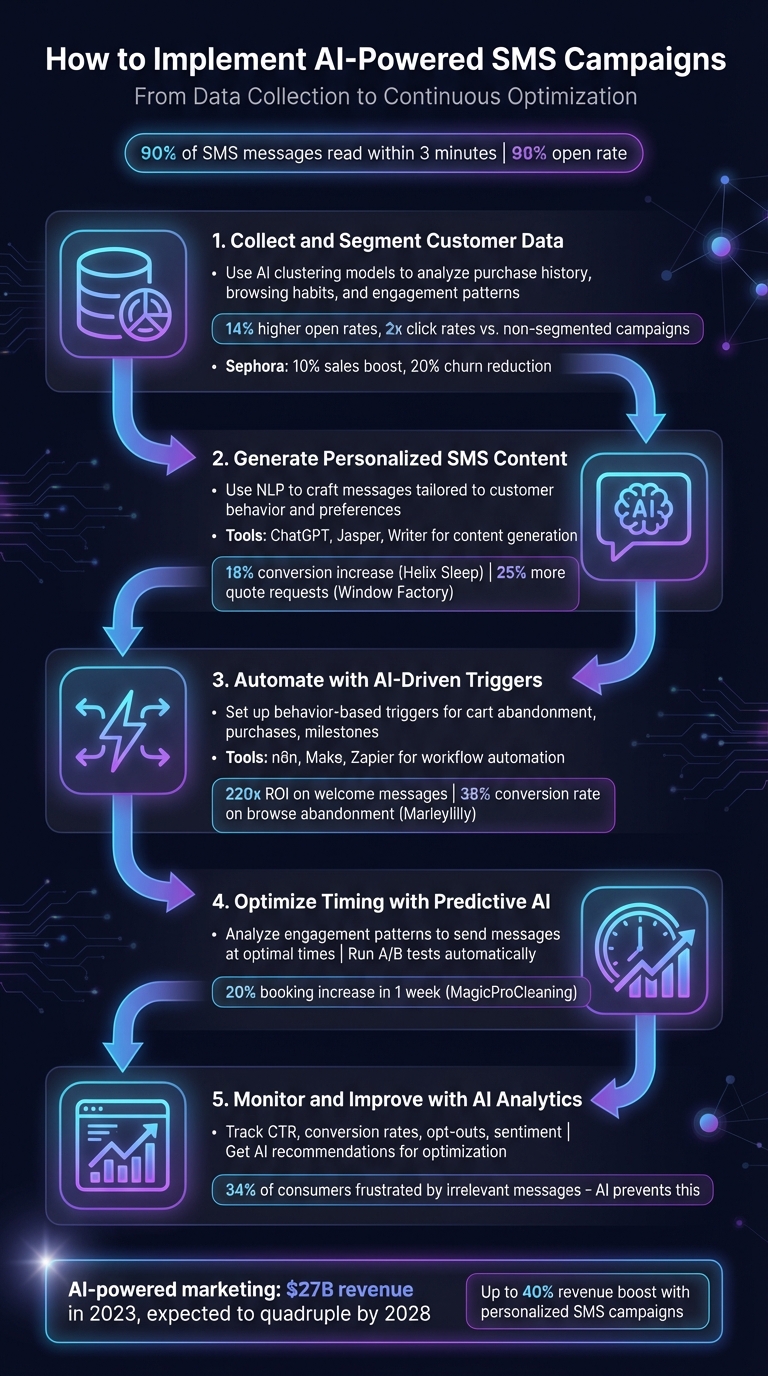
5-Step Process for Implementing AI-Powered SMS Campaigns
How to Build an Advanced AI SMS Assistant
Benefits of AI for Personalized SMS Marketing
AI has transformed SMS marketing by making it faster, smarter, and more effective – all while requiring less effort from your team. It not only speeds up message delivery but also ensures that every text feels relevant to the recipient.
Here’s how: AI taps into real-time customer data – like purchase history, browsing habits, and even location – to craft messages that resonate on a personal level. For instance, Helix Sleep saw an 18% jump in conversions by using AI to recommend mattresses based on customers’ responses to an online sleep quiz[6]. Similarly, Window Factory boosted quote requests by 25% by referencing each customer’s location and specific needs[6]. MagicProCleaning also reported a 20% increase in bookings in just one week by sending AI-driven reminders when customers were due for a cleaning[6].
But AI’s impact goes beyond personalization. Tasks that once consumed hours – like audience segmentation – are now completed in seconds. AI can group customers into categories like "High Value Customers", "Dormant Users", or "Holiday Shoppers" based on actual behavior, not guesswork. It can also produce multiple message variations for A/B testing, helping you quickly pinpoint the tone and content that resonates most. When combined with tools like n8n, Make, or Zapier, AI can automate actions like sending reminders for abandoned carts, post-purchase follow-ups, or re-engagement campaigns, streamlining your entire workflow.
AI doesn’t just send messages – it ensures they land at the perfect time with content that drives action. This approach has real financial impact: AI-powered marketing was projected to generate over $27 billion in revenue in 2023, with expectations to quadruple by 2028[5]. These numbers underline how AI can turn high open rates into tangible revenue.
That said, the human touch remains essential. AI can handle the heavy lifting – analyzing data, generating ideas, and automating tasks – but it’s up to you to refine the output, ensuring it aligns with your brand’s voice and values.
Step 1: Collect and Segment Customer Data with AI
The first step in building effective AI-driven SMS campaigns is understanding your audience through precise data segmentation. AI simplifies this process by analyzing purchase history, browsing habits, and engagement patterns, automatically grouping customers based on their behavior.
Using clustering models, AI digs into details like visit frequency, preferences, and engagement levels to create accurate customer segments. This data-driven approach results in groups such as "High Value Customers" or "Dormant Users", based on real actions rather than assumptions.
Why does this matter? Segmented SMS campaigns perform significantly better – delivering 14% higher open rates and more than double the click rates compared to non-segmented ones [10]. Businesses leveraging AI-powered segmentation have reported impressive results, including a 25% increase in sales and a 30% drop in marketing expenses [11]. For instance, Sephora used AI to segment customers by purchase and browsing history, achieving a 10% sales boost, a 15% rise in customer satisfaction, and a 20% reduction in churn [17].
How AI Handles Customer Segmentation
AI excels at spotting hidden patterns in data by analyzing hundreds of signals. It employs classification models to answer questions like "Is this customer likely to churn?" and uses predictive scoring to rank customers based on their likelihood to make a purchase, upgrade, or stop engaging [9].
AI also works in real time, updating segments as new data comes in. Take Michaels Stores, for example – they used a generative AI platform to refine their customer segmentation, increasing email campaign personalization from 20% to 95%. This shift led to a 41% boost in SMS click-through rates and a 25% lift in email performance [16]. Similarly, a European telecom company transitioned from just four broad customer segments to 150 highly personalized ones, tailoring messages to specific demographics, regions, and even dialects. The result? A 40% increase in response rates and a 25% reduction in deployment costs [16].
Once your segments are ready, the next step is to sync this data with your CRM for seamless integration.
Connecting Your CRM for Smarter Segmentation
To make the most of AI-powered segmentation, connect your CRM – whether it’s Salesforce, HubSpot, or Shopify – directly to your SMS platform [1]. If a native integration isn’t available, middleware tools like n8n, Make, or Zapier can bridge the gap [6][12]. Open Head specializes in creating these custom connections through its workflow automation services, ensuring data flows smoothly without the need for manual updates.
Warby Parker offers a great example of this in action. By implementing Segment.io to unify customer data, they launched highly personalized marketing campaigns that increased sales by 25% [11]. When lead capture forms map directly to CRM records – storing details like names, phone numbers, and preferences – AI can generate tailored messages that speak directly to individual customer needs [12][13]. This centralized approach gives AI a complete view of your audience, eliminating repetitive tasks by pulling existing data [15].
"Customer segmentation is not just about data; it’s about creating meaningful relationships with customers." – Forrester [17]
Before connecting your CRM, take the time to audit your data. Eliminate duplicates and standardize formats, as clean data is crucial for accurate segmentation [17][18]. Set up fields like "Initial Contact Date" and "Next Follow-up Date" to help AI manage outreach schedules and maintain your sender reputation [13]. High-quality, integrated data enables AI to craft messages that truly resonate with your audience. With segmentation in place, you’re ready to move on to generating personalized SMS content in the next step.
Step 2: Generate Personalized SMS Content Using AI
Once you’ve organized your customer segments, AI can step in to create SMS messages that feel personal and engaging. Instead of sending out generic texts, AI uses Natural Language Processing (NLP) to craft messages that align with your brand’s tone while addressing individual customer preferences based on past interactions [8]. The result? Messages that sound like they’re written just for the recipient but are entirely automated.
AI tools like ChatGPT, Jasper, and Writer can whip up catchy taglines, detailed product descriptions, or even adjust messaging for specific audience segments in a matter of seconds [7]. Beyond writing, AI can handle tasks like sending appointment confirmations or real-time shipping updates, all without human intervention [15]. Tools like Open Head’s workflow automation services integrate these AI capabilities into your existing systems, ensuring that messages are generated and sent seamlessly. This level of personalization helps your texts resonate with your audience on a deeper level.
Writing Messages That Match Customer Needs
AI goes beyond just plugging in a name – it tailors messages to align with each customer’s behavior and preferences. By analyzing data like purchase history, browsing habits, and engagement patterns, AI can suggest products, create time-sensitive offers, or adjust the tone to better connect with each segment. For example:
- Helix Sleep saw an 18% boost in conversions by sending AI-generated mattress recommendations based on responses to an online sleep quiz [6].
- Window Factory increased quote requests by 25% by using AI to craft personalized texts that referenced the recipient’s city and specific installation request [6].
To ensure your AI-generated messages hit the mark, use prompt engineering. For instance, you can assign roles and constraints like this: Role: SMS marketer; Task: Write three texts for a summer sale; Context: 50% off; Constraint: Keep it under 160 characters [7]. This structured approach ensures your messages are clear, concise, and in line with campaign goals. Additionally, AI tools can adjust the tone – whether friendly, formal, or concise – to better connect with your audience [6]. However, always review AI-generated content for emotional accuracy and avoid repetitive or overly generic phrasing [14]. The aim is to enhance your brand’s voice, not dilute it.
"AI is great for quickly brainstorming lots of different ideas around messaging and angles. Then you need to use your industry knowledge and expertise to pick and choose and refine." – Nora Sudduth, Marketing Consultant [6]
Adding Real-Time Customer Data to Messages
Dynamic content insertion takes personalization to the next level by pulling real-time data from your CRM or ecommerce platforms. This allows messages to automatically include details like product names, exclusive discount codes, or abandoned cart items [1]. AI tools connect to platforms like Salesforce, HubSpot, or Shopify to keep your messages timely and relevant without the need for manual updates.
For example, if a customer abandons their cart, AI can send a text mentioning the specific product, include a discount code, and tailor the message based on how long ago the cart was left behind. MagicProCleaning saw a 20% increase in bookings in just one week by using AI-crafted reminders that balanced urgency with value [6]. This level of personalization is only possible when AI has access to live customer signals such as clicks, purchases, and browsing sessions [19].
To make this work, connect your CRM data to AI tools using platforms like n8n, Make, or Zapier. These connections allow AI to instantly generate tailored follow-ups based on a customer’s past interactions, preferences, or objections [12][14]. By integrating real-time data with AI, your messages feel more like a natural, ongoing conversation rather than a one-size-fits-all template [3]. This approach ensures your texts stay relevant and engaging, keeping your audience interested and connected.
With your personalized SMS content ready, the next step is to automate the delivery process for maximum efficiency.
Step 3: Automate SMS Campaigns with AI-Driven Triggers
Once you’ve crafted personalized messages, the next step is to ensure they reach your customers at just the right time. This is where automation powered by AI triggers comes into play. These workflows send SMS texts automatically, responding to specific customer actions – like leaving an item in their cart, completing their first purchase, or reaching a milestone [1]. The result? Your messages hit their inbox precisely when they’re most likely to engage.
Automation doesn’t just save time; it ensures your campaigns are timely and effective. With 90% of SMS messages being read within three minutes, AI-triggered texts allow you to make the most of those crucial moments [1]. By using tools like n8n, Make, and Zapier, you can connect platforms like Salesforce, HubSpot, or Shopify to your SMS provider. This setup ensures your messages are sent instantly whenever a trigger condition is met. Open Head specializes in creating these seamless connections, allowing your SMS campaigns to run effortlessly while you focus on scaling your business.
Setting Up Behavior-Based Triggers
Behavior-based triggers are designed to respond directly to your customers’ actions – or even their inaction. These triggers can include scenarios like abandoned carts, browsing without purchasing, post-purchase thank-you messages, or re-engagement texts for dormant customers. AI analyzes real-time data – such as clicks, purchase history, and browsing habits – to identify these critical moments and act on them instantly [21].
Take Marleylilly, for example. By implementing AI-driven SMS triggers across the customer journey, they saw impressive results. Their automated welcome messages delivered a 220x ROI, while their browse abandonment texts achieved a 38% conversion rate [22]. According to Marketing Director Elizabeth Pingry, leveraging AI for real-time targeting helped break down operational silos and create a cohesive marketing strategy [22].
To create your own behavior-based triggers, start by identifying the key customer actions you want to respond to. Use middleware tools like n8n, Make, or Zapier to connect your systems, ensuring a text is sent as soon as a customer takes a specific action [4]. For instance, if someone abandons their cart, an automated text could follow up with a reminder and a discount code. Triggers can also be used for appointment reminders, subscription renewals, or even security alerts, such as notifying a customer of suspicious payment activity. Don’t forget to schedule messages during compliant hours (typically 8 AM to 9 PM) to adhere to TCPA regulations.
Once your triggers are in place, integrate them into a broader automation workflow.
Building Workflows with n8n, Make, and Zapier
Automation platforms like n8n, Make, and Zapier are the backbone of AI-driven SMS campaigns. These tools link your existing systems – CRMs, ecommerce platforms, and lead forms – with your SMS provider, ensuring messages are sent automatically based on customer activity. For example, you can set up a workflow where adding a new lead in HubSpot triggers a welcome text, or an abandoned cart in Shopify prompts a follow-up message with a discount.
Start by defining the trigger event (e.g., "new lead added" or "cart abandoned") and the corresponding action (e.g., sending an SMS). Then, use your preferred automation platform to connect the relevant apps. For even more precision, integrate a Customer Data Platform (CDP) like Twilio Segment. This allows you to capture detailed website events – such as "Product Viewed" or "Order Completed" – and use that data to send hyper-personalized messages [20]. With this level of integration, your campaigns become both timely and tailored to each customer’s behavior.
AI can also handle more complex workflows, like scheduling appointments, sending shipping updates, or managing order cancellations [15]. However, it’s important to set safety measures to ensure the AI only acts on intended triggers and maintains security [15]. Open Head offers expertise in building these workflows, ensuring your systems are connected and operational from day one. With the right setup, your SMS campaigns can run on autopilot, generating revenue 24/7.
These automated workflows set the stage for the next step: using predictive AI to refine and enhance your campaigns further.
sbb-itb-2339147
Step 4: Optimize Timing and Delivery with Predictive AI
Once automated triggers are in place, the next step is to fine-tune your message timing. Why? Because timing matters. Predictive AI digs into historical engagement patterns – like when customers open messages, click links, or respond – to pinpoint the best times to reach them [1]. Instead of sending texts at random hours, it creates personalized timing profiles. For instance, some people check their phones first thing in the morning, while others are more active in the evening. This precision is critical, especially since 90% of SMS messages are read within three minutes of being sent [1]. By syncing your CRM and SMS platform through tools like n8n, Make, or Zapier, you can use customer data to send messages at just the right moment. Open Head’s workflow automation services make this integration seamless, ensuring your messages land when they’re most effective.
Predictive AI also helps avoid overwhelming your audience. By analyzing how quickly customers respond and how engaged they are, it adjusts both the timing and frequency of messages to keep them interested without driving them to opt out.
Testing Message Variations with A/B Testing
Perfect timing amplifies the impact of A/B testing. AI takes this a step further by running real-time A/B tests, comparing different message versions and automatically shifting focus to the one that performs better [1][2]. As Plivo puts it:
AI also determines the ideal send times for each audience segment so your SMS messages reach recipients when they’re most likely to engage [1].
Automation platforms like Make and Zapier make it easy to set up branching workflows. For example, you can send Version A to one group and Version B to another, letting the system figure out which version gets more clicks, replies, or conversions.
Real-world examples show how effective this can be. Helix Sleep saw an 18% boost in conversions after using AI to suggest mattresses tailored to customer preferences, while Window Factory achieved a 25% increase in quote requests by customizing messages based on location and customer details [6]. By testing different calls-to-action and addressing specific pain points, AI identifies what resonates most and applies those insights to future campaigns automatically.
Adjusting Campaigns Based on Response Data
AI doesn’t just stop at sending messages – it learns and adapts. By tracking responses like clicks, replies, and even customer sentiment, it refines future campaigns. For instance, sentiment analysis can flag negative replies that need human attention, while positive ones can trigger automated follow-ups.
Take MagicProCleaning as an example. They saw a 20% jump in bookings in just one week by using AI-driven tone suggestions and sending timely reminders like, "It’s been X months since your last cleaning" [6]. As Marius Obert from Twilio explains:
An LLM is like a well-read librarian… whereas an AI agent is more like a project manager – it takes the librarian’s advice, interprets it, and then executes tasks [15].
To take your campaigns even further, ensure phone numbers are formatted consistently (e.g., in E.164 format) across platforms. Use AI to track how different customer segments respond over time. This creates a continuous feedback loop, helping the system build smarter predictive models for future campaigns. With Open Head’s expertise, you can turn raw data into actionable insights that drive measurable results.
Step 5: Monitor and Improve Campaigns with AI Analytics
After setting up automated and predictive systems, the next step is to continually refine your SMS campaigns using AI analytics. Once your campaigns are live, track their performance in real time. AI tools can identify patterns in customer behavior, highlight underperforming segments, and suggest changes to improve results. By analyzing response data as it comes in, AI transforms raw numbers into actionable insights, allowing you to fine-tune your approach without starting from scratch.
Important Metrics to Track
Not all metrics are created equal. Some, like open rates and click-through rates (CTR), reveal how immediately engaging your messages are. Others, such as conversion rates and ROI, show the actual financial impact of your campaigns. Opt-out rates are equally critical – they can indicate that your content is either irrelevant or poorly timed. For example, 34% of consumers report being frustrated by irrelevant SMS messages[1]. Additionally, reply rates and response times can help you understand which approaches – such as emphasizing "time savings" or offering "early access" – strike the right chord with your audience.
AI takes this a step further by analyzing deeper behavioral trends, such as link engagement and points where users drop off during conversational flows. Sentiment analysis can flag negative replies for human review while highlighting positive trends to replicate. Since 90% of text messages are read within three minutes[7], AI can identify ideal engagement windows and adjust send times dynamically. These insights ensure your messages are timely, relevant, and focused on driving conversions. Tools like Open Head’s workflow automation services integrate these analytics directly into your CRM, eliminating the hassle of managing multiple dashboards.
Getting Actionable Insights from AI
AI doesn’t just provide data – it offers recommendations. By examining historical trends, it can predict potential profits for upcoming campaigns and prioritize high-value audience segments. It can also re-engage dormant customers or one-time buyers by triggering personalized offers, such as discounts. For instance, if AI detects a group of frequent clickers who haven’t made a purchase, it might suggest stronger closing offers or a different messaging strategy.
Real-time A/B testing is another powerful feature. AI can analyze early campaign results and automatically shift remaining messages to the most effective variant during the peak engagement window. As marketing consultant Nora Sudduth puts it:
AI is great for quickly brainstorming lots of different ideas around messaging and angles. Then you need to use your industry knowledge and expertise to pick and choose and refine.[6]
The best results come from blending AI’s ability to recognize patterns with human judgment. While AI can identify weak areas and propose adjustments, it’s up to you to ensure those changes align with your brand’s voice. Open Head’s AI consulting services are designed to help you establish these feedback loops, enabling your campaigns to improve with every iteration – no advanced technical skills required.
Why Partner with Open Head for AI-Driven SMS Campaigns
Taking your SMS campaigns to the next level with AI can transform how your business connects with customers. But building an AI-powered SMS system from the ground up? That’s a whole other challenge. It’s a time-intensive, technically demanding process that requires expertise in CRM integration, intelligent workflows, and real-time optimization. That’s where Open Head steps in. Instead of spending months piecing together tools like n8n, Make, and Zapier, Open Head delivers a custom-built, fully integrated solution tailored to your business needs. It’s not just about saving time – it’s about getting an AI-powered system that’s designed to deliver results.
Tailored AI Solutions for SMS Campaigns
Forget cookie-cutter templates. Open Head builds every SMS automation system from scratch, using your business’s unique logic and requirements. This means no generic solutions – just custom-coded workflows that align perfectly with your goals. You’ll work directly with skilled engineers who ensure every integration is precise, seamless, and thoroughly tested. Whether you’re using Salesforce, HubSpot, or another CRM, Open Head ensures your system is fine-tuned using real performance data, not guesswork.
Take this example: A home services company might need SMS triggers based on service history to send timely appointment reminders. Meanwhile, an ecommerce store might require cart abandonment messages that adapt to browsing behavior and inventory levels. Open Head’s workflow automation services handle these complexities by connecting your SMS platform directly to your existing tools. The result? Manual data entry is eliminated, errors are reduced, and customer data flows effortlessly between systems, ensuring every message is relevant and timely.
Fast Implementation, Tangible Results
Unlike traditional enterprise platforms that drag on for months, Open Head can have your SMS automation system up and running in as little as 1–3 weeks. For straightforward setups like appointment confirmations or post-purchase messages, it’s often just 1–2 weeks. More advanced workflows – think predictive timing and dynamic segmentation – may take 4–6 weeks, but every solution is designed with one goal: driving revenue and business growth.
The results speak for themselves. Most Open Head clients see clear ROI in just 90 days, with many saving 10–20 hours per week on tasks like data entry, message scheduling, and follow-ups[23]. Pricing starts at $2,500 for simpler systems, while more advanced, multi-integration solutions range from $10,000–$50,000+[23]. To showcase the potential, Open Head even offers a free AI automation system to demonstrate immediate value. Ready to stop missing opportunities and start delivering SMS campaigns that convert? Book a free consultation and see how Open Head can transform your business.
Conclusion
AI-powered SMS campaigns are changing the way businesses connect with customers. By leveraging customer data, segmenting audiences, crafting personalized content, automating behavior-based triggers, and using predictive AI to optimize timing, SMS can become a powerful, always-on revenue channel. With 90% of consumers reading an SMS within three minutes of receiving it[7][1], the opportunity is huge – but only if your messages are relevant and tailored to your audience.
The real hurdle? Building a system that works seamlessly. Integrating your CRM, creating intelligent workflows with tools like n8n, Make, or Zapier, and adjusting campaigns based on real-time data takes time and technical know-how – resources many business owners don’t have. That’s where Open Head steps in. They deliver a custom-built AI solution designed specifically for your business, skipping the lengthy setup and delivering tangible results.
This approach not only simplifies operations but also strengthens customer relationships. Whether your goal is to recover abandoned carts, re-engage lapsed customers, or automate appointment reminders, the right AI system can make it happen. Success starts with a clear strategy: prioritize high-impact campaigns and work with experts who understand both the technology and your unique business needs.
Ready to take your SMS campaigns to the next level? Book a free consultation with Open Head today and see how their tailored solutions can drive real results.
FAQs
How can AI enhance the personalization of SMS campaigns?
AI transforms SMS campaigns by diving deep into customer data – think demographics, purchase history, behavior, and engagement trends. With this insight, businesses can send messages that feel tailor-made for each recipient.
What’s even better? AI handles the heavy lifting. It automates personalization and schedules messages to hit inboxes at just the right moment. The result? Customers feel more connected, and businesses see higher conversions and stronger customer relationships. It’s a win-win.
What are the benefits of using AI for personalized SMS campaigns?
AI-powered SMS tools make it possible to send personalized, timely messages to your customers on a large scale. By using AI, you can automatically group your audience based on their actions or preferences, ensuring every message hits the mark and feels relevant.
This not only cuts down on time spent on repetitive tasks but also increases response rates, speeds up sales processes, and enhances customer satisfaction. With AI taking care of the backend work, your team can concentrate on creating deeper connections and achieving impactful outcomes.
How can businesses connect AI-powered SMS campaigns with their CRM systems?
Businesses can connect AI-driven SMS campaigns directly with their CRM systems using automation tools like n8n, Make, or Zapier. These platforms sync real-time customer data from your CRM, allowing AI to create and send personalized messages automatically via SMS.
This setup streamlines communication, ensuring messages are timely and tailored to each recipient. The result? Increased customer engagement, higher revenue, and less manual work. Open Head offers custom solutions designed to align seamlessly with your business processes and objectives.