

Dynamic email content transforms how small businesses connect with customers. Instead of sending the same email to everyone, it customizes messages based on each recipient’s behavior, location, and preferences – automatically. This approach isn’t just convenient; it drives results. Emails with dynamic content can see 6× higher transaction rates, boost click-through rates by 41%, and recover lost revenue from abandoned carts. If you’re still relying on generic email blasts, you’re leaving money on the table.
Here’s how small businesses can use dynamic email content to save time and increase revenue:
- Abandoned Cart Recovery: Automatically remind customers about items left in their cart, complete with personalized recommendations.
- Weather-Based Recommendations: Show products that match local weather conditions when the email is opened.
- Personalized Appointment Reminders: Send tailored reminders with appointment details, pre-visit instructions, and rescheduling options.
- Behavioral Segmentation: Use browsing and purchase history to deliver emails that match individual interests.
- Seasonal Promotions: Highlight relevant offers using real-time trends like weather or inventory updates.
Dynamic email platforms integrate with tools like Shopify, Salesforce, and Zapier, making it easy to automate these strategies. Small businesses using these tools report higher open rates, better engagement, and increased conversions – all while saving hours of manual work each week.
If you’re ready to turn your email list into a revenue driver, dynamic content is the way forward.
4 Powerful Ways to Personalize Marketing Automation Emails
1. Abandoned Cart Recovery
Losing a sale to an abandoned cart is a common challenge for online stores. In fact, 70.19% of online shoppers leave items in their carts without completing the purchase [8].
Dynamic email content offers a powerful solution by automatically pulling in abandoned products – complete with images, prices, and personalized recommendations based on browsing history. For example, if a customer in a rainy location abandons running gear, the email can spotlight waterproof options tailored to their needs [7]. This approach ensures the details in the email, from pricing to inventory availability, are always accurate and relevant.
AI takes this one step further by analyzing customer behavior to determine the best time to send recovery emails. If someone tends to browse late at night but makes purchases during lunch breaks, the system adjusts accordingly [6, 13]. This timing precision, combined with real-time updates, ensures customers receive messages when they’re most likely to act. Automated emails, in fact, boast 84% higher open rates and 341% higher click rates compared to manual efforts [8].
To make this work seamlessly, your ecommerce platform, CRM, and email system must share data effortlessly. This ensures that once a customer completes their purchase, the system stops sending cart recovery emails [8]. Nothing sours the shopping experience like being reminded to buy something you already purchased.
The results speak for themselves. Businesses using automated cart recovery emails have seen conversion rates soar by an incredible 2,270% [8]. With the right tools, you can turn hesitant shoppers into loyal customers – at scale.
2. Weather-Based Product Recommendations
Crafting email content that aligns with local weather conditions can make your messages feel more relevant and timely. Weather-based product recommendations adjust dynamically based on each subscriber’s local weather at the moment they open the email, ensuring the content resonates with their immediate environment.
Personalization Level
This strategy brings "hyper-personalization" to life, creating a truly tailored experience. Take Allen Edmonds as an example: they ran a dynamic email campaign where the displayed products shifted based on the local temperature. If a recipient opened the email in an area with temperatures above 40°F, they saw one set of product recommendations. If it was colder than 40°F, the email showcased weather-appropriate alternatives instead [2]. The impact of this level of personalization is clear – personalized emails have been shown to generate transaction rates that are six times higher than generic ones [1].
Integration Capabilities
To make weather-based emails work seamlessly, you’ll need to connect your email platform with real-time weather APIs and your CRM. Many modern email services support dynamic content blocks, but when you integrate real-time weather data via tools like n8n, Make, or Zapier, you unlock a whole new level of personalization. For instance, imagine configuring your system to automatically highlight winter coats when local temperatures drop below 40°F or to switch to summer apparel as the weather warms up. While this might sound complex, automation tools handle the heavy lifting, linking weather data to your email campaigns effortlessly.
Impact on Engagement Metrics
The results of weather-driven campaigns speak for themselves. ON Sportswear used server-side APIs and client-side scripts to tailor their emails based on local weather and purchase history. Subscribers in rainy areas were shown waterproof gear, leading to a 537% increase in click-through rates for non-shoe products and contributing to 16% of their total online revenue [7]. More broadly, AI-driven personalization can boost click-through rates by up to 41%, with personalized content improving CTR by about 14% and conversions by 10% [5].
Ease of Implementation
Manually aligning weather data with subscriber lists is impractical, but modern AI tools simplify the process. With a master email template featuring dynamic content blocks, you can set temperature thresholds and product rules. The system then pulls real-time weather data when the email is opened, automatically displaying the most relevant products. If you’re already using an ecommerce chatbot for personalized product recommendations on your website, adding weather-based triggers to your email campaigns ensures a seamless and consistent experience across all touchpoints. Start by gathering geographic data through sign-up forms or website analytics, optimize your email visuals for mobile devices, and use simple "if/else" logic to adjust recommendations based on real-time weather conditions [6].
This weather-based approach is just one way to harness dynamic email strategies that boost engagement and sales. By tailoring your content to real-time conditions, you can create a more personalized and impactful connection with your audience.
3. Personalized Appointment Reminders
Personalized appointment reminders are a game-changer for businesses. They not only make your emails more relevant but also cut down on manual tasks, saving time and effort.
Personalization That Matters
Dynamic reminders now tap directly into your booking system, pulling essential details like appointment type, provider, location, and time. This allows you to craft tailored emails with pre-visit instructions and even product suggestions. For instance, a dental office might send preparation tips for a root canal, while a salon could recommend products based on a client’s last treatment. These thoughtful touches make customers feel acknowledged, building trust and loyalty over time[5].
Seamless Integration
For these reminders to work effectively, your email platform needs to connect effortlessly with your CRM, scheduling tools, and product databases. Tools like n8n, Make, and Zapier act as bridges, linking systems like Calendly or Google Calendar with your email service provider[7]. This integration ensures real-time data – such as appointment details and rescheduling options – flows directly into your emails. Features like "Add to Calendar" links make it easy for recipients to save appointments to Google Calendar, Outlook, or Apple Calendar[1]. If you’re already using an AI receptionist to manage bookings, syncing this data with your email system ensures every customer interaction stays consistent and professional.
Boosting Engagement Metrics
The numbers don’t lie. Personalized subject lines can increase open rates by 26%[5]. Adding dynamic content – like a warm greeting, appointment specifics, and a clear call-to-action – can further improve click-through rates by 14% and boost conversions by 10%[5]. Timely triggers, such as reminders sent 24 hours before an appointment or follow-ups after a missed booking, create a sense of urgency and keep your business top-of-mind. This strategy reduces no-shows, improves attendance, and drives revenue growth.
Easy to Get Started
The best part? You don’t need a tech team to set this up. Modern platforms offer drag-and-drop interfaces and AI-powered assistants that make creating dynamic emails and automated workflows a breeze[1][9]. Start by centralizing your CRM data and setting up triggers like booking confirmations and 48-hour reminders. Experiment with A/B testing for subject lines and calls-to-action to fine-tune your approach[4][5][9].
"Email has shifted from mass messaging to meaningful one-to-one conversations with every subscriber"[9].
If you’re aiming to simplify your entire customer journey, workflow automation services can connect your booking system, CRM, and email platform into one smooth, hands-free process.
4. Behavioral Interest Segmentation
Personalization Level
Behavioral interest segmentation zeroes in on what customers actually do, not just who they are. Instead of relying on demographics, it tracks behaviors like browsing habits and click patterns to deliver highly tailored content. Picture this: a subscriber frequently checks out waterproof running gear but never makes a purchase. The next email they receive could spotlight those exact products, paired with a special offer to seal the deal. This kind of precision isn’t just theoretical – ON Sportswear used website activity and even local weather data to trigger personalized email sequences. The result? A 537% jump in click-through rates for non-shoe products[7]. Behavioral data like this lays the groundwork for seamless cross-platform integration, ensuring your marketing tools work together effortlessly.
Integration Capabilities
For this approach to shine, your tech stack needs to work as a cohesive unit. Your ecommerce platform (like Shopify), CRM (like Salesforce or HubSpot), and email marketing tool must share data in real-time. Tools like n8n, Make, and Zapier automate this process, letting behavioral signals flow freely without manual intervention. Server-side APIs track everything from page views to cart additions, feeding this information directly into your segmentation engine[4][7]. If you’re already using workflow automation tools, adding behavioral triggers to your email campaigns is a natural next step.
Impact on Engagement Metrics
The payoff for using behavioral data is clear: engagement metrics soar. AI-driven campaigns based on real-time behavior achieve 50% higher open rates than generic emails[7]. Companies adopting behavioral segmentation report a 41% increase in click-through rates and a 20% boost in conversions[7]. Take Hotel Chocolat, for example – they used AI to analyze individual subscriber behaviors and fine-tune their email send times. The result? A 40% drop in unsubscribe rates and a 25% revenue increase[7]. These aren’t minor tweaks – they’re game-changing results that transform email campaigns into revenue drivers.
Ease of Implementation
The best part? You don’t need a team of data scientists to make this happen. Modern platforms with no-code AI features can automatically segment your subscribers based on their behavior[4][9][11]. Start simple – try one trigger, like recommending products to browsers, and track the results over 30 days[7]. But remember, clean data is critical. Before diving into AI-powered segmentation, scrub your lists to remove inactive subscribers and fix duplicate records[4][7]. For even more precision, consider using an AI sales chatbot to capture visitor behavior on your site and feed it directly into your email system.
"Behavioral emails were our past. Predictive personalization is our future. We’ve evolved from reacting to customer actions to anticipating their needs." – Nazir Uddin Himel, Marketing Lead, FluentCRM[9]
sbb-itb-2339147
5. Seasonal Promotions with Real-Time Trends
Personalization Level
Seasonal promotions thrive when they connect with your audience’s real-time situations. Instead of sending out a generic "Spring Sale" email to everyone, you can tailor your message based on live data like weather or inventory. For instance, if it’s raining in a customer’s area, your email could highlight waterproof gear. Adding dynamic countdown timers can also create a sense of urgency, prompting quicker clicks and engagement [1].
Integration Capabilities
To pull this off, your tech tools need to work together seamlessly and in real time. Your ecommerce platform (like Shopify or WooCommerce), CRM (such as Salesforce or HubSpot), and email marketing tool must share data instantly. Tools like n8n, Make, and Zapier can connect these systems, integrating live weather APIs, inventory updates, and user behavior signals. This ensures your emails stay relevant and timely, triggered by up-to-the-minute information [4][12].
Impact on Engagement Metrics
The results speak volumes. Businesses using AI-driven seasonal personalization have reported a 41% increase in click-through rates and a 20% rise in conversions [7]. Even small changes, like personalizing subject lines, can boost open rates by 26% [5]. Take ON Sportswear’s 2025 campaign as an example: they sent weather-triggered emails featuring waterproof products during rainy days in subscribers’ locations. This strategy led to a staggering 537% increase in click-through rates for non-shoe products, with 16% of their online revenue coming from these tailored recommendations [7]. Real-time inventory updates also prevent promoting sold-out items, while predictive timing ensures your emails hit inboxes at the perfect moment for each recipient [4].
Ease of Implementation
You don’t need a team of data scientists to get started with real-time seasonal promotions. Begin by cleaning up your subscriber list – remove hard bounces and ensure tracking pixels are functioning properly. AI relies on clean, accurate data to perform effectively [7]. Start small by testing a single trigger, like weather-based product suggestions or a countdown timer for a weekend sale, over a 30-day period [7]. Many modern email platforms offer no-code AI tools that simplify the process, doing the heavy lifting for you. To avoid spam filters, stick to the 60/40 rule – 60% text and 40% images [3]. Remember, AI-generated content should be treated as a starting point; human editing is crucial to keep the tone aligned with your brand’s voice [4].
If you’re already using an AI sales chatbot to track visitor behavior, that data can seamlessly feed into your seasonal email triggers. This creates a smooth connection between website activity and email personalization. These seasonal strategies complement other dynamic methods discussed earlier, reinforcing a cohesive approach to AI-powered email marketing.
How Open Head Builds Dynamic Email Systems
Open Head doesn’t settle for cookie-cutter solutions. Every dynamic email system begins with a process diagram – a visual map that outlines what needs to happen, when, and why. As Olivia Milton, Fractional CMO and AI-powered growth strategist, explains:
"Before you start doing any automation… I advise to visualize first what you want to automate. So start with a process diagram" [17].
This initial mapping sets the stage for building workflows tailored to your business needs.
Using tools like n8n, Make, and Zapier, Open Head creates custom workflows that seamlessly integrate with platforms such as Shopify, WooCommerce, Salesforce, and HubSpot. For instance, a WooCommerce store can use webhooks to send real-time cart recovery emails when a customer abandons their cart. Considering that around 70% of online shopping carts are abandoned, this step is crucial – automated recovery emails can boost conversion rates by over 20% [13]. While the technology does the heavy lifting, human oversight ensures everything aligns with your brand and messaging.
Manual approval steps are built into these workflows to maintain brand consistency. Additionally, behavioral data – like website activity or chatbot interactions – feeds directly into email triggers, creating a seamless connection between customer actions and personalized communication [15].
Open Head’s strategy is simple: start small and focus on one high-impact area to deliver quick results. For example, optimizing a single bottleneck has led to measurable outcomes, such as a 760% increase in email revenue [18]. If you’re unsure where to begin, Open Head offers AI consulting services, including automation audits, to identify where AI can save you time and money.
Real-time data triggers like tracking pixels, webhooks, and behavioral signals power these personalized emails. The results speak for themselves – targeted campaigns have achieved a 34.7% boost in open rates and significant revenue growth [18]. Behind the scenes, the technical complexity is handled for you, leaving your customers with emails that feel personal, arrive at just the right moment, and drive meaningful results.
Results Small Businesses Can Expect
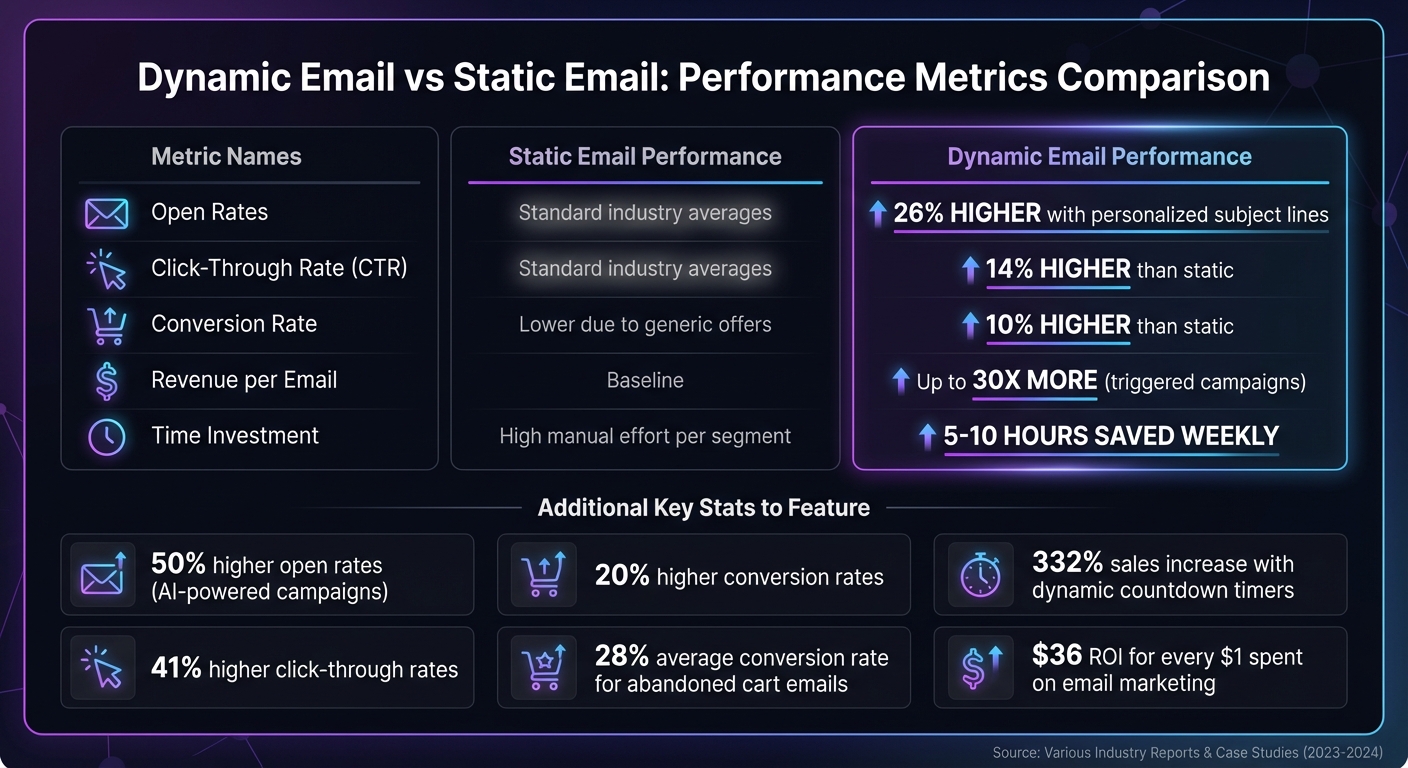
Dynamic vs Static Email Performance: Key Metrics Comparison
Dynamic email campaigns are proving to be a game-changer for small businesses, delivering clear, measurable results. Personalized subject lines alone can increase open rates by 26% [5][19], while dynamic content boosts click-through rates by 14% compared to generic campaigns [5]. Even better, conversion rates rise by an additional 10% when emails are tailored to individual subscriber data [5]. Triggered emails, such as abandoned cart reminders, generate up to 30 times more revenue per recipient [5][19].
But the impact goes beyond just numbers. Features like dynamic countdown timers, which create a sense of urgency, have driven sales up by a staggering 332% in certain campaigns [14]. Meanwhile, abandoned cart emails achieve an average conversion rate of 28% [14]. Considering that email marketing typically delivers a return of $36 for every $1 spent [1], adding dynamic personalization turns email into a revenue powerhouse. Cynthia Price, SVP of Marketing at Litmus, highlights this momentum:
"Email is both at an all-time high in volume and in ROI… overall email volume up 13% since 2020, expected to grow another 13% by 2026" [1].
Dynamic emails also meet a growing demand for personalized experiences. A whopping 71% of consumers now expect companies to deliver tailored interactions [5][10], while 76% feel frustrated when they don’t [6]. For small businesses, using workflow automation services to power these campaigns can save 5–10 hours per week by eliminating the need for manual segmentation [14][16].
| Metric | Static Email | Dynamic Email |
|---|---|---|
| Open Rates | Standard industry averages | 26% higher with personalized subject lines [5][19] |
| Click-Through Rate | Standard industry averages | 14% higher than static [5] |
| Conversion Rate | Lower due to generic offers | 10% higher than static [5] |
| Revenue per Email | Baseline | Up to 30x more (triggered campaigns) [5][19] |
| Time Investment | High manual effort per segment | 5–10 hours saved weekly [14][16] |
Efficiency is another major win. A single master template with dynamic blocks can replace the need for dozens of manually segmented campaigns. This allows small teams to operate with the speed and precision of much larger marketing departments. With 90% of marketers agreeing that personalization increases profitability [12] and 52% of consumers reporting greater satisfaction with personalized digital experiences [12], dynamic email has become a must-have tool. These results highlight how Open Head can help small businesses implement winning dynamic email strategies.
Getting Started with Open Head
Kick things off with a free 30-minute consultation where Brandon Meyer and his team dive into your business needs, analyze your customer data, and map out a custom automation plan with clear ROI projections. This strategy session lays the groundwork for using dynamic email technology to drive better engagement and higher conversion rates.
From there, Open Head builds your personalized dynamic email system using powerful tools like n8n, Make, and Zapier. The setup process, which typically takes 1 to 3 weeks, is completely handled by their team – setup, testing, and training included. No coding required. This seamless process ensures your investment starts delivering measurable results quickly.
Pricing starts at $297/month for ongoing support and management, while custom projects range from $1,500 to $10,000, depending on scope. Every solution is tailored to match your workflows, customer segments, and specific business goals.
Open Head doesn’t just leave you after deployment. They provide comprehensive support to keep your campaigns running smoothly, including performance reviews, content updates, and tweaks as your business evolves. With 99% of marketers reporting positive results from AI-powered email campaigns [7], it’s no longer a question of whether to automate – it’s about how soon you can get started.
Want to see what Open Head can do for your email marketing? Book your free consultation at openhead.ai and get started today. Many businesses notice improved conversion rates and ROI within just 3 to 6 months of consistent AI-driven optimization [7].
Conclusion
Dynamic email content has moved from being a nice-to-have to an absolute must. With consumers expecting personalized interactions and generic email blasts falling flat, strategies like abandoned cart recovery, weather-based recommendations, personalized appointment reminders, behavioral segmentation, and real-time seasonal promotions prove that AI-driven automation delivers real results – without requiring a massive marketing team.
The numbers speak for themselves: AI-powered emails see 50% higher open rates, 41% higher click-through rates, and 20% higher conversion rates. Plus, 92% of marketers confirm its ROI, while businesses save 5–10 hours per week thanks to automation [7][16]. That extra time can be redirected to crafting strategy and strengthening customer relationships.
The transition from manual, reactive campaigns to automated systems that anticipate customer needs is already underway. Tools like n8n, Make, and Zapier make implementing these strategies straightforward, even without technical skills. You don’t need to master the tech – you need someone who can integrate it seamlessly with your business goals. This shift is your opportunity to act now.
If you’re ready to move beyond one-size-fits-all emails and deliver personalized experiences at scale, Open Head can create a custom dynamic email system tailored to your needs. Setup takes just 1 to 3 weeks, with pricing starting at $297/month. Schedule your free consultation at openhead.ai and transform your email list into a revenue-generating machine that works 24/7.
FAQs
How can dynamic email content boost engagement and drive conversions?
Dynamic email content boosts engagement by sending personalized, action-based messages that resonate with each recipient. This strategy makes emails feel more relevant and timely, leading to higher open and click-through rates.
When you match offers or information to a subscriber’s interests or behavior – like reminding them about items left in their cart or showcasing seasonal deals – you’re not just improving engagement. You’re turning more leads into customers and driving real revenue growth in the process.
What tools do small businesses need to create dynamic email campaigns?
To run effective email campaigns, small businesses should consider using an AI-driven email marketing platform that enables personalized, action-based messaging. Combine this with email automation tools to send targeted emails triggered by customer behaviors – think abandoned shopping carts or reminders for upcoming appointments. Many platforms integrate easily with tools like Zapier, Make, or n8n, making the entire process smoother.
For businesses aiming to get the most out of their efforts, a tailored solution – such as those provided by Open Head – can ensure your email campaigns are perfectly aligned with your business processes and goals.
How can I use weather-based recommendations to personalize email marketing?
Imagine sending emails that adapt to your subscriber’s local weather in real time. With weather-based recommendations, you can do just that – creating highly personalized content that feels relevant and timely. By integrating a weather API into your email platform, you can adjust your product suggestions, service reminders, or promotions based on the current forecast. For instance, highlight raincoats during a stormy week or showcase outdoor furniture when sunshine is in the forecast.
Open Head specializes in setting up these automations using tools like n8n, Make, or Zapier. Here’s how it works: capture your subscriber’s ZIP code, pull the local weather forecast, and dynamically insert tailored content – like product carousels or exclusive discount codes – into your email template. The result? Emails that resonate with your audience and drive higher click-through rates and sales.
Let Open Head take care of the technical heavy lifting, from setup to testing and ongoing maintenance. You focus on growing your business while we ensure your emails stay relevant and effective. Reach out to us today to see how weather-based email personalization can elevate your marketing strategy and boost your revenue.