


Struggling to decide between ready-made AI tools and custom AI solutions? Here’s the bottom line:
- Ready-made AI: Quick to set up, lower upfront cost, great for standard tasks like chatbots or CRM automation. But it’s less flexible and may not fit your business perfectly.
- Custom AI: Tailored to your specific needs, higher upfront investment, but delivers 2–3x better ROI over time by leveraging your unique data and workflows.
Key Stats:
- 78% of businesses used AI in at least one function by late 2024.
- Ready-made tools can be deployed 60-70% faster but come with recurring fees.
- Custom AI often breaks even within 24 months and eliminates long-term licensing costs.
Quick Tip: Use ready-made AI for routine tasks and custom AI for core processes that give you a competitive edge.
| Factor | Ready-Made AI | Custom AI Solutions |
|---|---|---|
| Upfront Cost | Low (Subscription-based) | High ($50K–$500K+) |
| Flexibility | Limited | High, tailored to workflows |
| Deployment Time | Days to weeks | 3–6 months or more |
| Long-term Cost | Higher (Recurring fees) | Lower after one-time cost |
| ROI Timing | Immediate but limited | Higher, realized after ~24 months |
| Data Control | Vendor-managed | Full ownership |
If you’re unsure which approach fits your business, consider a hybrid strategy: combine ready-made tools for quick wins and custom AI for critical, specialized tasks.
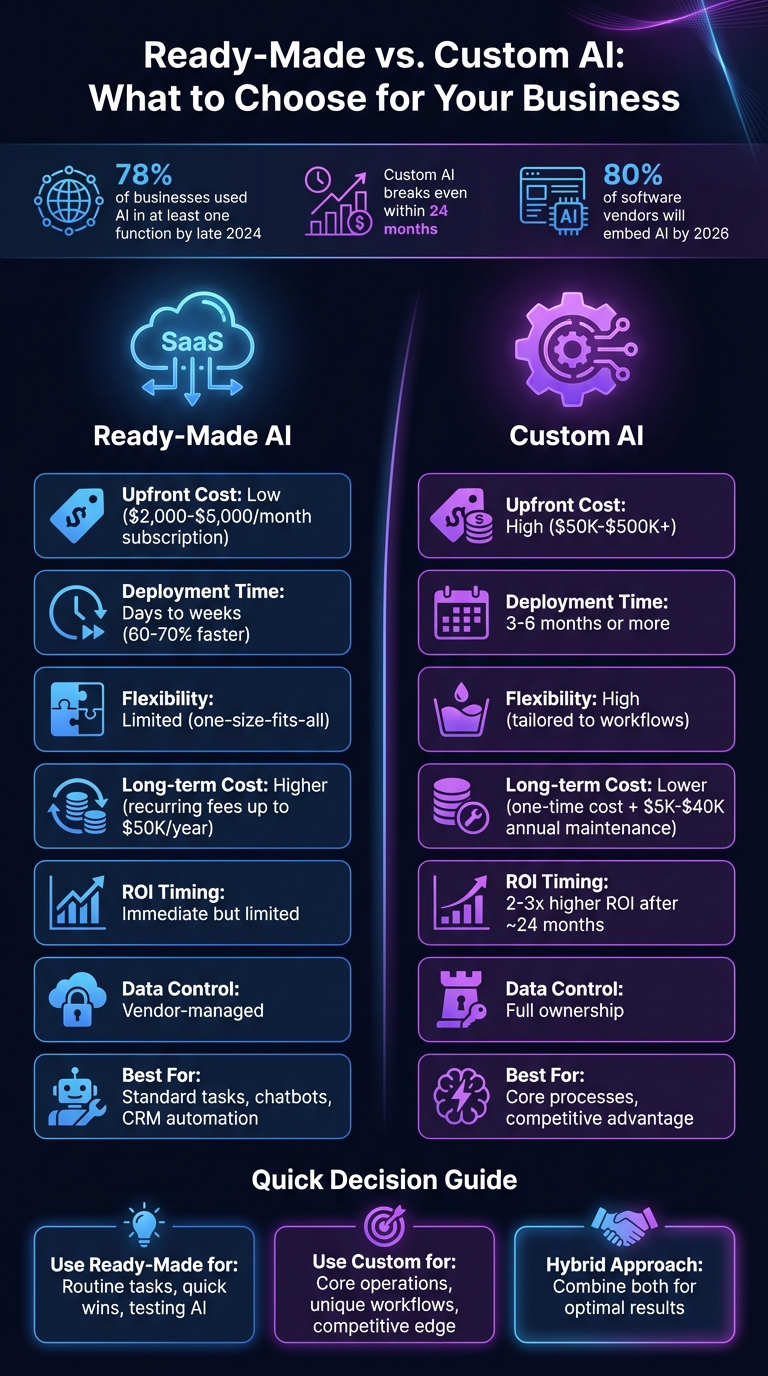
Ready-Made vs Custom AI: Cost, ROI, and Deployment Comparison
Build or Buy AI? When Custom Tech Beats Off-the-Shelf Software
What Are Ready-Made AI Tools?
Ready-made AI tools, often called off-the-shelf AI, are pre-built software solutions offered by third-party vendors. Delivered as Software-as-a-Service (SaaS) or accessible through Application Programming Interfaces (APIs), these tools are designed to be integrated into your systems and start working right away.
These tools use pre-trained models based on generalized datasets, enabling them to handle tasks like answering questions, analyzing customer feedback, or extracting data from invoices. For instance, Salesforce Einstein provides predictive lead scoring for sales teams, while AWS Textract uses Optical Character Recognition (OCR) to process documents. If you’re already using workflow automation services to connect tools like your CRM, email, and calendar, these AI solutions can easily slot into your existing processes.
One of the biggest draws of off-the-shelf AI is its quick deployment and relatively low upfront cost. According to Gartner, by 2026, 80% of software vendors will embed AI capabilities directly into their products [3]. Instead of building your own AI from scratch, you can subscribe to proven solutions. Costs for these tools typically fall between $2,000 and $5,000 per month, though they can climb into six figures as your usage grows [4].
That said, there are limitations. These tools are designed for general applications, so they may not fully align with the specific needs of your business. Their one-size-fits-all nature can overlook industry-specific details or fail to integrate seamlessly with your unique workflows. Additionally, since your data is stored on the vendor’s servers, you’re tied to their update schedules and feature development roadmap.
"The primary advantage of off-the-shelf AI is speed and convenience. Organizations can deploy AI capabilities quickly without having in-house data science teams." – 8allocate [3]
Ready-made AI tools are ideal for standardized tasks like customer service chatbots, basic document handling, or CRM automation. They’re quick to implement, require little technical expertise, and let you experiment with AI without a hefty initial investment. However, if your business demands a more customized approach – such as an AI receptionist that mirrors your team’s specific appointment scheduling process – these tools might fall short. Up next, we’ll explore how custom AI solutions can address these gaps.
What Are Custom AI Solutions?
Custom AI systems are built specifically for your business, using your unique data and workflows[1]. Unlike generic tools designed for broad use, these solutions address your specific challenges – whether that’s detecting fraud, predicting maintenance needs, or refining lead qualification. They’re designed to grow and adapt as your business evolves.
Developing custom AI involves several key components: designing the model architecture, setting up data pipelines, iterative training, smooth integration with existing systems, and ongoing maintenance through MLOps[2]. Take JP Morgan’s "COiN" system as an example – it processes and reviews legal contracts in seconds, saving the company an astounding 360,000 hours of manual work each year[4]. Similarly, Mayo Clinic created an AI model tailored for cardiac diagnostics, achieving accuracy levels that outperform standard medical tools[4].
One major benefit of custom AI is full control over your data, model, and processes. This is especially critical in industries like finance and healthcare where regulatory compliance is non-negotiable[1]. You’re not locked into a vendor’s updates or limitations; instead, the solution evolves alongside your business. You can set your own risk thresholds, compliance rules, and other parameters that off-the-shelf tools simply can’t match[1].
Custom AI also integrates seamlessly with your existing systems like CRMs, ERPs, and legacy platforms, eliminating the need for additional integration work. For instance, a drafting automation tool designed for PLG reduced document drafting time by an impressive 91%[1].
"RTS Labs has been an invaluable partner in transforming our data and analytics capabilities. Their innovative solutions have streamlined our processes, improved risk assessments, and enhanced efficiency across our operations."
- Jennifer Linton, CEO, Fenris Digital[1]
The main trade-offs for custom AI are time and cost. While off-the-shelf tools can be up and running in a matter of days or weeks, building a custom solution typically takes 3 to 6 months or longer[2]. Development costs range from $50,000 to over $500,000 depending on the complexity and integration needs[9]. However, with the precision that comes from leveraging your proprietary data, custom AI often delivers 2–3x better ROI compared to generic solutions[1].
These advantages provide a strong foundation for comparing custom AI with off-the-shelf alternatives.
Ready-Made vs. Custom AI: Pros and Cons
When it comes to AI solutions, businesses are often faced with a choice: ready-made tools or custom-built systems. Each option serves different needs and comes with its own set of trade-offs.
Ready-made AI tools are designed for broad, standard business applications. These tools are quick to deploy – usually up and running within days or weeks – and operate on a subscription model, keeping upfront costs low. They’re ideal for businesses with straightforward processes, as they don’t require internal technical resources; the vendor handles all maintenance. However, their downside lies in their limited ability to adapt to unique workflows or specialized requirements [1][4].
Custom AI, on the other hand, is tailored specifically to your business. It requires a larger initial investment, typically ranging from $50,000 to $500,000, with annual maintenance costs between $5,000 and $40,000. While the upfront costs are higher, custom AI is built to align perfectly with your business processes, proprietary data, and any industry-specific needs. It evolves with your business, delivering 2–3x higher ROI over time by eliminating recurring fees and providing full ownership of the intellectual property. Most businesses see a break-even point within 24 months of implementation [1][4][9].
The long-term financial picture also favors custom AI for high-volume operations. Ready-made tools often come with annual subscription fees that can reach up to $50,000 [6]. Over a three-year period, these recurring costs can surpass the one-time development expense of a custom solution, making the latter a smarter financial choice in such scenarios [3][5][6].
When deciding between the two, consider whether the AI will support a core business function or a non-essential task. Custom AI is ideal for critical operations that give you a competitive edge, while ready-made tools work well for routine tasks like basic chatbots or meeting transcription [6][8].
Comparison Table
This table highlights the key differences between ready-made and custom AI solutions, helping you weigh your options based on your business needs:
| Factor | Ready-Made AI | Custom AI Solutions |
|---|---|---|
| Upfront Cost | Low (Subscription/Licensing) | High ($50K–$500K+) |
| Long-term Cost | Higher due to recurring fees | Lower after one-time development |
| Deployment Time | Days to weeks | 3–6 months or longer |
| Flexibility | Limited; fixed features | High; tailored to specific workflows |
| ROI Timing | Immediate but limited | Realized after ~24 months, with higher potential |
| Scalability | Vendor-dependent | Scales with business complexity |
| Data Control | Vendor-managed | Full ownership and security |
| Maintenance | Vendor-handled | Requires dedicated MLOps budget |
| IP Ownership | None (vendor-owned) | Full ownership (company asset) |
Choosing between these two approaches ultimately depends on your business priorities, budget, and long-term goals. Each has its place, but understanding their differences ensures you make the right investment for your needs.
When Ready-Made AI Makes Sense for Small Businesses
Off-the-shelf AI tools shine when it comes to tackling routine, standardized tasks. If you’re managing FAQs or running basic email campaigns, these solutions can start delivering results in just days or weeks [1]. They’re a great fit for businesses with straightforward, predictable needs.
These tools are especially useful for non-core activities – the kind of tasks that keep things running smoothly but don’t necessarily set you apart from competitors. Think meeting transcriptions, appointment scheduling, or simple document sorting. For instance, 66% of Shopify merchants use AI chatbots to handle customer interactions [4]. If your team struggles with after-hours calls, an AI receptionist can step in and manage those without requiring a custom-built system.
Cost is another big factor. Ready-made AI tools often come with predictable subscription fees, making them easier on the budget compared to hefty upfront investments. Entry-level options typically cost between $2,000 and $5,000 per month [4].
"Ready-to-use AI offers speed, convenience, and lower upfront costs, making it ideal for standardized processes."
– Dejan Markovic, Co-founder of Hype Studio [7]
For small businesses that prefer manageable monthly expenses over large capital outlays, this pricing model is a natural fit.
Another perk? These tools are vendor-managed, meaning you don’t need an in-house tech team. This can reduce deployment time by 60–70% [1][7]. Many vendors also offer free trials or freemium tiers, so you can test out the benefits before committing [10].
If your operations are simple and align with widely available AI solutions – like Salesforce Einstein for CRM automation or Zapier for workflow management – ready-made AI can get you up and running fast, without the headaches of custom development.
sbb-itb-2339147
When Custom AI Makes Sense for Small Businesses
Custom AI is the go-to solution when your business operates in ways that off-the-shelf tools just can’t handle. If your workflows rely on proprietary data – whether that’s niche industry datasets, distinct customer behavior patterns, or specialized operational metrics – generic models often miss the mark [3,6]. This level of precision becomes even more critical when your industry operates under strict regulatory standards.
Regulatory compliance is a big reason to consider custom AI. In industries like healthcare, finance, and legal, data sovereignty, algorithm transparency, and adherence to standards like HIPAA or GDPR are non-negotiable. With custom solutions, you maintain full control over how data is stored and processed while meeting the audit trail requirements regulators demand [4,6].
Custom AI also makes sense when it’s central to your competitive edge. If AI is what sets your business apart, off-the-shelf tools won’t cut it. A custom-built system creates a unique advantage that competitors can’t simply buy [5,6]. For businesses dealing with complex, multi-variable challenges – like logistics routing based on cargo weight, weather conditions, and fuel costs – generic solutions often fall short [6].
"Custom AI isn’t just another piece of software; it’s a strategic asset that adapts with your business and creates an edge no competitor can simply buy off the shelf." – Appinventiv [4]
Long-term scalability is another reason to invest in custom AI. While the upfront costs can range from $50,000 to $500,000 [6], you avoid recurring licensing fees and per-user charges that increase as your business grows. Over time, custom AI proves more cost-effective, delivering a 2–3x stronger ROI within three years [1].
At Open Head, we specialize in building custom AI systems for small and medium-sized businesses. Whether it’s AI sales chatbots or workflow automation services, we tailor solutions to fit your unique processes. If off-the-shelf tools aren’t cutting it and your business needs a custom approach, our AI consulting services can guide you in deciding if custom development is the right move.
Why Small Businesses Choose Open Head for Custom AI
Small businesses often find themselves frustrated with generic AI tools that demand they alter their workflows to fit the technology. That’s where Open Head steps in, offering custom AI solutions designed to align perfectly with the unique needs and operations of each business. Instead of forcing businesses to adapt, Open Head builds systems tailored to their specific processes and challenges [11].
What sets Open Head apart is the level of control and customization it provides. With their solutions, you retain complete ownership of your algorithms and data – an essential factor for businesses aiming to differentiate themselves. This is especially critical in industries like healthcare, legal, and finance, where strict data governance and encryption standards are mandatory. Open Head’s approach ensures compliance without compromising flexibility [1][2].
The company’s founder, Brandon Meyer, brings a wealth of experience to every project. A former software engineer at Lockheed Martin and Raytheon, Meyer has a track record of success, including scaling a real estate services business to $1.2 million in its first year through complete operational automation. This same engineering-first mindset drives Open Head’s projects. Whether it’s an AI receptionist to handle after-hours calls or workflow automation services using tools like n8n, Make, and Zapier, Open Head focuses on delivering measurable results.
From start to finish, Open Head manages every aspect of the process – strategy, design, deployment, and ongoing maintenance – so you don’t need an in-house tech team [1]. Most solutions are up and running in just 1–3 weeks, supported by a dedicated Denver-based team. Their integrated approach ensures that strategy seamlessly translates into execution. Plus, Open Head’s AI consulting services include a free 30-minute strategy call, complete with a tailored automation roadmap and ROI projections.
When it comes to AI, clarity and customization are game-changers. Unlike off-the-shelf tools that offer cookie-cutter solutions, Open Head’s custom AI delivers unique advantages designed to grow with your business. There are no arbitrary limits as your data scales, making it a solution built for the long haul [1].
Combining Ready-Made Tools with Custom Solutions
Why choose between ready-made tools and custom AI when you can have the best of both? A hybrid approach combines the quick setup of off-the-shelf solutions with the tailored precision of custom-built systems. For small businesses, this means using pre-built tools for common tasks like answering FAQs while integrating custom AI to handle workflows unique to your operations [1]. This strategy taps into the strengths of both approaches, creating a system that works smarter, not harder.
The magic lies in orchestration. Platforms like n8n, Make, and Zapier bring these tools together into a seamless system [13]. Picture this: A customer fills out a form on your website – powered by a ready-made tool. That triggers a workflow in n8n, which sends the data to a custom AI model for analysis, updates your CRM, and pings your team on Slack. The result? A "Trigger → Process → Action" system that eliminates manual steps and keeps everything running smoothly [13].
Open Head specializes in building these hybrid systems, integrating platforms like n8n, Make, and Zapier into your existing tools. Whether you’re using Salesforce, HubSpot, Shopify, or QuickBooks, the goal is to automate repetitive tasks, freeing your team to focus on what truly matters. This approach combines the speed of pre-built tools with the precision of custom logic, creating a system that works exactly how you need it to.
Real-world examples show just how effective this can be. All Source Building Services implemented an AI-powered form workflow that tags submissions, routes them to CRM fields, and notifies team members via Slack – completely removing the need for manual lead assignments [13]. Similarly, Vendasta, a SaaS company, used Zapier to connect Typeform, Clearbit, HubSpot, and Slack for lead enrichment. This zero-touch workflow didn’t just save time – it reclaimed over $1 million in revenue and freed up 282 workdays annually [14].
The beauty of a hybrid approach is its flexibility. You can start with ready-made tools and gradually add custom components as your business grows. This phased strategy keeps upfront costs low while allowing for long-term scalability [4]. Plus, modular workflows make it easy to upgrade individual components – like swapping in a more advanced AI model – without overhauling your entire system [12]. It’s a smart, adaptable way to stay ahead in a competitive market.
Conclusion: Choosing the Right AI Approach for Your Business
When it comes to deciding between ready-made and custom AI, it’s not about picking the "better" option – it’s about what works best for your business. Ready-made tools are quick to implement and budget-friendly, making them perfect for straightforward tasks like basic customer support or analytics. On the other hand, custom AI aligns with your specific workflows and taps into your unique data, often delivering 2–3x higher ROI compared to off-the-shelf models[1].
For many small businesses, a hybrid strategy strikes the perfect balance. Use ready-made tools for routine functions where speed matters, and invest in custom AI for areas that give you a competitive edge. While custom solutions might require more upfront investment, they eliminate ongoing licensing fees and often pay for themselves within two years[1].
The real question isn’t just about choosing between ready-made and custom AI – it’s about identifying which parts of your business will benefit most from a tailored approach. That’s where expert guidance can make all the difference. Open Head specializes in helping small businesses make these decisions, whether you’re looking for an AI receptionist to handle after-hours calls, workflow automation to connect your tools, or a custom AI solution built around your specific needs. This personalized approach has helped countless businesses simplify their operations and achieve measurable results.
Curious about the right AI strategy for your business? Schedule a free consultation with Open Head. You’ll get a custom automation roadmap, detailed ROI estimates, and a clear action plan – no strings attached, just actionable advice from AI experts who understand small business challenges.
FAQs
What are the key advantages of custom AI over ready-made AI for small businesses?
Custom AI solutions let small businesses fine-tune automation to match their unique workflows, data, and customer interactions. Unlike generic, off-the-shelf tools, these tailored systems integrate seamlessly with platforms your team already uses – think Salesforce, HubSpot, Slack, Google Workspace, Shopify, or QuickBooks. The result? A system that fits like a glove, working exactly where you need it.
By focusing on your specific needs, custom AI can streamline repetitive tasks with precision, generate insights from your own data, and craft personalized customer experiences that boost conversions. It’s not just about working smarter – it’s about aligning automation with your business goals, allowing you to grow without constantly expanding your team.
At Open Head, we build these systems using no-code automation tools like n8n, Make, and Zapier, so you don’t need to be tech-savvy to get started. Our mission? To eliminate bottlenecks, speed up response times, and deliver results you can measure. Schedule a free consultation today and see how custom AI can take your business to the next level.
What’s the best way to combine ready-made and custom AI solutions for small businesses?
A hybrid AI approach blends the quick deployment of ready-made tools with the tailored precision of custom-built solutions. You can begin by using off-the-shelf AI tools, like chatbots or document summarizers, to handle basic needs and gauge user engagement. Once the initial system is up and running, you can introduce a custom-built AI solution designed to fit your business’s specific workflows, compliance standards, and proprietary data.
Open Head specializes in crafting these hybrid systems by combining pre-built AI with custom components through tools like n8n, Make, and Zapier. For instance, an off-the-shelf AI might manage routine tasks like qualifying leads, while a custom AI module tackles more specialized needs, such as analyzing legal documents or evaluating real estate. This modular setup not only ensures flexibility and cost-effectiveness but also keeps your data fully under your control.
By starting with a pilot program and fine-tuning based on actual results, this approach delivers quick outcomes and a stronger return on investment. Open Head takes care of the entire process – from automating workflows to developing custom AI – so you can focus on scaling your business without getting bogged down by the technical complexities.
How do I decide between ready-made AI tools and custom AI solutions for my business?
Deciding between off-the-shelf AI tools and custom AI solutions comes down to your business’s needs, budget, and long-term objectives. Here’s how they stack up:
Ready-Made AI Tools
These tools are quick to deploy and easy on the budget upfront. They’re ideal for handling standardized tasks and getting results fast. However, they often fall short when it comes to flexibility. If your business has unique workflows or needs deep integration with existing systems, ready-made solutions might feel limiting.
Custom AI Solutions
Custom-built AI takes more time and money to set up, but the benefits are hard to ignore. These solutions are tailored to fit your specific processes, compliance requirements, and growth strategies. They’re designed to scale with your business and align closely with your goals, offering better long-term returns. Plus, you can connect custom AI to platforms like Salesforce, HubSpot, or QuickBooks using tools like n8n, Make, or Zapier, streamlining automation and boosting efficiency.
So, what’s the right choice? If you’re looking for a quick, budget-friendly fix, ready-made AI tools might do the trick. But if you’re planning for long-term growth and want a solution that evolves with your business, custom AI offers the precision and flexibility to keep you ahead of the curve.