


Small retailers lose money due to stockouts, overstocking, and manual inventory tracking. AI inventory systems solve these problems by automating stock management, predicting demand, and reducing errors.
Here’s the reality: manual processes and outdated tools can’t keep up with the complexities of running a retail business. AI systems integrate with platforms like Shopify and POS systems to provide real-time tracking, automatic reordering, and demand forecasting. These tools help retailers avoid costly mistakes, save time, and improve customer satisfaction by keeping shelves stocked with the right products.
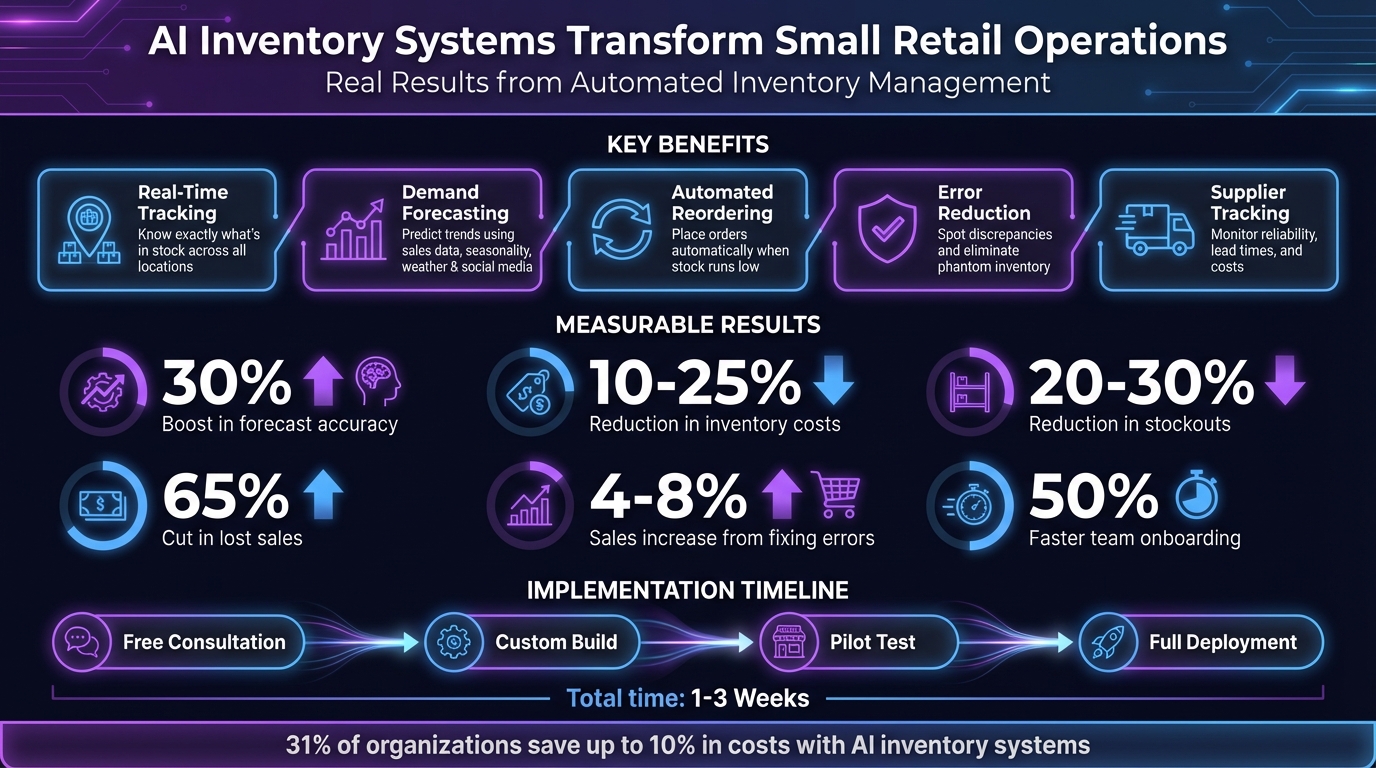
Key Benefits of AI Inventory Systems:
- Real-time tracking: Know exactly what’s in stock across all locations.
- Demand forecasting: Predict trends using sales data, seasonality, and external factors like social media or weather.
- Automated reordering: Place orders automatically when stock runs low.
- Error reduction: Spot discrepancies and fix issues like phantom inventory.
- Supplier performance tracking: Monitor reliability, lead times, and costs.
Small retailers using AI inventory systems report up to a 30% boost in forecast accuracy and a 10%-25% reduction in inventory costs. These systems are affordable, quick to implement (1–3 weeks), and tailored to your needs. Whether you’re managing one store or multiple warehouses, AI tools take the guesswork out of inventory management.
Stop losing sales to stockouts and wasting money on overstock. Book a free consultation with Open Head to see how AI can transform your inventory process.
AI Inventory Systems Benefits and ROI for Small Retailers
Inventory Problems Small Retailers Face
Running Out of Stock or Ordering Too Much
Small retailers often walk a financial tightrope when it comes to inventory. Too much stock? Your cash is tied up in unsold items, leaving less for essentials like marketing, payroll, or expanding your product lineup. Plus, overstock means added costs for storage and insurance, and eventually, you’ll need to slash prices to clear out excess inventory.
On the flip side, running out of popular items can hurt even more. Imagine a customer visiting your store or browsing your website, ready to buy, only to see "out of stock." They’re not likely to wait – they’ll buy from a competitor instead. Beyond the immediate loss of a sale, this erodes customer trust over time. These inventory missteps often lead to deeper struggles with manual tracking and poor forecasting.
Mistakes from Manual Tracking
When you’re just starting out, spreadsheets or paper logs might seem manageable. But as your business grows, they can quickly become a recipe for chaos. Every manual update is a chance for errors to creep in. Your inventory data gets scattered across your point-of-sale (POS) system, e-commerce platform, and warehouse records, none of which work together seamlessly.
"Before we switched over to Finale, we were keeping track of all of our inventory and purchase orders by hand. It was a nightmare!"
- Stephanie Parks, CEO, DermWarehouse [8]
This disconnect creates "phantom inventory", where your records don’t match reality. The result? Poor purchasing decisions, inflated inventory values on your balance sheet, and hours wasted each week answering simple questions like, "Do we have enough stock for next month?" For example, in 2025, CarboNet, an advanced chemistry company, saved countless hours weekly by ditching manual tracking in favor of automation [1].
Trouble Predicting Customer Demand
Forecasting demand is tricky, especially if you’re relying on gut instincts or last year’s sales averages. Customer behavior can shift in an instant – a viral TikTok trend, a sudden weather change, or a local event can all drive unexpected spikes or drops in demand. Static spreadsheets can’t keep up with these rapid shifts.
Without data-driven tools, you’re left guessing. You might overestimate demand and end up with excess stock, or worse, underestimate it and run out during a busy promotion. Both scenarios hurt your bottom line.
"The first sign of an inventory problem often isn’t an empty shelf. It’s a customer support inbox overflowing with questions like, ‘Where’s my order?’"
- Stevia Putri, Marketing Generalist, eesel AI [9]
Supply Chain Delays and Disruptions
Even with better forecasting, external factors like supply chain disruptions can throw a wrench in your plans. Small retailers often lack the leverage to secure priority treatment from suppliers, making them especially vulnerable. A two-week delay in receiving inventory could mean missing out on peak-season sales or scrambling to find alternative suppliers at higher costs.
Labor shortages, bad weather, and transportation bottlenecks only make things worse. Static reorder systems don’t account for these variables, leaving you constantly adjusting orders manually and hoping for the best. If you’re juggling multiple suppliers across different product categories, it’s nearly impossible to track everything without automation. By integrating workflow automation services, you can streamline processes like supplier communications and customer updates, saving time and avoiding headaches.
AI Inventory Management: Predict Demand, Prevent Stockouts
How AI Systems Fix Inventory Problems
AI systems tackle inventory challenges head-on, eliminating guesswork and reducing manual errors through smart, data-driven solutions.
Predicting Demand in Real Time
AI takes the uncertainty out of demand forecasting by analyzing a mix of historical sales data, current inventory levels, supplier lead times, and external factors like weather, social media trends, competitor pricing, and local events. For example, if a product goes viral on TikTok or a heat wave hits, the system adjusts inventory needs automatically, helping you avoid stockouts. Unlike static spreadsheets, AI provides detailed forecasts – predicting, say, the exact need for 120 units of a specific item rather than lumping all variants together. The system continuously learns from each transaction and adjustment, and it even runs "what-if" scenarios to prepare you for potential disruptions. These insights are the backbone of the automated processes that follow. Want to integrate this predictive power into other areas of your business? Check out our workflow automation services at Open Head.
Automatic Reordering
Once demand forecasting is in place, AI takes over reordering tasks. It updates reorder points and generates purchase orders automatically when inventory dips below optimal levels. The system adapts to factors like sales speed, seasonality, and real-time demand, allowing for either manager approval or full automation after trust is built. For instance, CarboNet, a company specializing in advanced chemistry, implemented a custom AI solution to streamline inventory tracking across multiple warehouses, saving hours each week previously spent on manual checks [1]. Modern AI systems also integrate with platforms like Shopify, WooCommerce, and Amazon through APIs, ensuring inventory updates across all sales channels to prevent overselling.
"For the first time in 20 years of running an inventory based business I TRUST what my inventory management system tells me I have in stock." – Brett Haney, President, Microfiber Wholesale [8]
Another example is Shelf Engine, a grocery chain that leveraged AI-driven demand forecasting to cut waste and boost margins, achieving $40 million in additional profit within a year [1].
Spotting Errors and Sending Alerts
Manual inventory tracking is prone to mistakes – mis-scanned items, unlogged shipments, or misplaced products can wreak havoc on accuracy. AI solves this by cross-referencing data from scanners, RFID tags, POS systems, and warehouse records. If an item marked as shipped is still on the shelf, the system flags the discrepancy instantly. By focusing on exceptions, AI provides a prioritized list of problem SKUs, such as stalled shipments or sudden stock drops, so your team can zero in on real issues. Fixing these errors can increase sales by 4% to 8% [2]. Advanced tools like IoT sensors and computer vision enhance this process further, using shelf weight sensors and visual stock counts to detect problems early, trigger alerts, and eliminate "phantom inventory" that can distort financial reports and lead to bad purchasing decisions.
Planning for Different Scenarios
Supply chain disruptions are inevitable, but AI helps you stay ahead of them. It simulates scenarios like supplier delays, demand surges, or transportation issues, allowing you to make proactive adjustments such as increasing safety stock or transferring inventory to high-demand locations. AI also supports hyper-local forecasting, redistributing stock based on localized demand patterns. For example, if one store sees increased foot traffic due to a local event, the system might recommend shifting inventory from a slower location. This adaptability is especially helpful for small retailers aiming to maximize efficiency. Ready to take your operations to the next level? Our AI consulting services at Open Head can help pinpoint the most impactful opportunities for your business.
What AI Inventory Systems Include
Modern AI inventory systems are transforming how small retailers manage their stock by eliminating manual tracking and streamlining operations. These systems combine three key components to provide seamless control and visibility across the entire inventory process.
Connections to Shopify, WooCommerce, and Other Platforms

AI inventory systems integrate directly with platforms like Shopify, WooCommerce, Amazon, QuickBooks, and your POS system. This two-way integration ensures inventory counts are always accurate across all sales channels. For example, when a customer makes a purchase on your website, the system immediately updates stock levels, reducing the risk of overselling. If you’re managing multiple storefronts or warehouses, these integrations create a unified data ecosystem, so you’re always working with the most up-to-date information. Need help setting this up? Open Head offers workflow automation services to build custom integrations tailored to your specific setup.
Centralized Inventory Dashboards
All this data flows into a centralized dashboard, giving you a complete, real-time view of your inventory. Instead of juggling spreadsheets, you can see stock levels across physical stores, warehouses, third-party logistics providers, and Amazon FBA – all updated automatically with every sale or restock. These dashboards don’t just show numbers; they highlight critical issues like low-stock alerts, delayed shipments, or unexpected demand spikes. Some systems even include conversational AI, allowing you to ask questions like, "When will SKU X run out?" and get instant, actionable answers. With this exception-based approach, you can focus your attention where it’s needed most.
Tracking Supplier Performance
Beyond managing stock, AI inventory systems also keep an eye on your suppliers. By analyzing historical data, these systems predict lead times and adjust reorder points if suppliers are consistently late. Supplier performance metrics – like pricing, reliability, and delivery speed – are tracked to provide data-driven insights for negotiations or supplier changes. If a shipment is marked as received but hasn’t been scanned into inventory, automated alerts flag the issue before it leads to stockouts or accounting errors. For retailers aiming to fine-tune their supply chain, Open Head’s AI consulting services can pinpoint areas for automation and cost savings.
sbb-itb-2339147
Why Small Retailers Choose Open Head for Inventory Automation
Small retailers often face the challenge of managing inventory with outdated, manual systems that make stock control a headache. Open Head simplifies this process by creating tailored AI systems that fit seamlessly into your workflow. Whether you run a single storefront or oversee multiple warehouses, Open Head integrates directly with tools you’re already using – like Shopify, WooCommerce, QuickBooks, and POS systems – so you can streamline operations without overhauling your entire setup [3]. This personalized approach is why many retailers see it as a game-changer.
Custom AI Systems Designed for Your Business
Open Head leverages platforms like n8n, Make, and Zapier to build AI-driven inventory systems that adapt to your specific needs, including your sales patterns and seasonal trends [3]. Unlike rigid, off-the-shelf solutions, their approach allows you to start small – perhaps automating key SKUs or focusing on a single warehouse – and expand as your business grows [3][9]. This "pilot scope" method ensures you’re not investing in a massive system you don’t need. Instead, you get a dynamic solution that evolves with your business, using feedback loops to fine-tune operations rather than relying on static rules that quickly become outdated [2]. For retailers bogged down by manual tracking, Open Head’s automation creates a real-time, synchronized system that keeps all your sales channels aligned.
Fast Implementation and Tangible Results
Open Head’s systems are up and running in just 1–3 weeks, a far cry from the months-long timelines typical of enterprise solutions [2]. By using low-code platforms, they cut down on both costs and development time [5][6]. The payoff? Immediate improvements in areas like demand forecasting, automated restocking, and anomaly detection [1]. Retailers who embrace AI-powered inventory management report an average 10% to 25% reduction in inventory costs and up to a 30% boost in forecast accuracy [10]. Open Head starts with a free consultation to identify the most impactful areas for automation, ensuring you only invest in features that deliver real value. These quick wins pave the way for long-term growth, as demonstrated by numerous client success stories.
Real-World Success with Open Head
Open Head’s founder, Brandon Meyer, knows the power of automation firsthand – he scaled a real estate services business to $1.2 million in its first year by automating operations from top to bottom. That same expertise now helps retailers transition from manual spreadsheets to real-time, automated systems in under three weeks. For example, one client eliminated ongoing stockouts of their best-selling products by implementing automated reordering based on demand forecasts and supplier lead times. Open Head’s systems don’t just handle routine tasks – they flag unusual situations or high-value orders for human approval, giving you control where it matters most while AI takes care of the repetitive work [2][3].
How Open Head Implements AI Inventory Systems
Open Head takes a step-by-step approach to set up your custom AI inventory system, typically completing the process within 1–3 weeks. They start by identifying your specific challenges, then develop a tailored solution using tools like n8n, Make, and Zapier. Finally, they ensure your team is ready to manage the system confidently from day one with hands-on training.
Free Consultation and Inventory Assessment
The journey begins with a free 30-minute consultation where Open Head evaluates your current workflows and speaks with key stakeholders to pinpoint stock-related issues [6]. They also consolidate data from systems like your POS, ERP, QuickBooks, or spreadsheets into a centralized ecosystem, ensuring the data is ready for predictive analytics [6][13]. At the end of this assessment, you’ll receive a custom automation roadmap, complete with ROI projections and a clear step-by-step implementation plan. This comprehensive evaluation sets the stage for building your solution.
Building and Installing Your Custom System
Once the roadmap is finalized, Open Head constructs your custom system by integrating APIs and middleware, ensuring seamless compatibility with your existing tech stack [6][7]. This includes setting up no-code or low-code AI agents tailored to your business needs, like automating reordering thresholds or calculating supplier lead times [11][1]. Before full deployment, a pilot test is conducted – often focusing on a single store or product category – to confirm the system performs effectively in real-world conditions [6]. For example, CarboNet transitioned from manual tracking to a custom automated app, saving hours of work each week [1]. Open Head also ensures all your sales channels stay synchronized in real time, eliminating the hassle of manual updates.
Training Your Team and Providing Support
After installation, Open Head provides detailed training to ensure every team member can make the most of the system. Training is tailored to specific roles, whether for warehouse staff, managers, or other users [6]. With conversational NLP interfaces, your team can easily ask questions like, "Which items are running low?" – cutting onboarding time by up to 50% [12][6][14]. Role-based dashboards are also configured, so each department – whether operations, finance, or warehouse – sees only the data and alerts relevant to them [1]. The system uses a human-in-the-loop approach, where AI suggests actions (like reordering), but your team retains control to approve or adjust those suggestions [2][7]. Ongoing support ensures the system evolves with your business, addressing issues and refining processes as needed.
| Implementation Phase | Key Activities | Expected Outcome |
|---|---|---|
| Assessment | Workflow mapping, stakeholder interviews, data audit | Clear identification of automation opportunities and pain points |
| Building | API integration, data cleaning, custom agent setup | A unified data ecosystem with functional AI tools |
| Deployment | Pilot testing, KPI tracking, system adjustments | Proven performance in real-world conditions |
| Support | Role-based training, NLP interface setup, ongoing maintenance | High team adoption and long-term operational efficiency |
Get Started with AI Inventory Management
AI-powered inventory systems are transforming how businesses manage stock, offering tangible savings and improved efficiency. Small retailers using these systems have reported reducing stockouts by 20%-30% and cutting lost sales by as much as 65% [4][8]. Additionally, 31% of organizations have seen cost savings of up to 10% [4].
These systems simplify daily operations by replacing manual adjustments with precise, forward-thinking planning. They provide a unified view of your inventory across all channels, eliminating the inaccuracies of manual spreadsheets. The result? Fewer errors, better stock management, and improved customer satisfaction thanks to consistent product availability [3][8].
Open Head specializes in creating custom AI inventory solutions tailored to your business. These systems seamlessly integrate with platforms like Shopify, WooCommerce, QuickBooks, and your point-of-sale (POS) system. Features include automated reorder triggers, real-time stock syncing, and supplier performance tracking. By leveraging automation tools like n8n, Make, and Zapier, Open Head delivers solutions that are up and running within 1–3 weeks, ensuring you start seeing results immediately.
To make the transition even smoother, Open Head offers a free 30-minute consultation. During this session, they’ll analyze your workflows, pinpoint automation opportunities, and provide a personalized roadmap with ROI projections and a clear implementation plan. Along with the quick 1–3 week setup, your team will receive hands-on training and ongoing support to ensure the system evolves alongside your business.
Want to eliminate stockouts, lower carrying costs, and streamline your operations? Book your free consultation with Open Head today.
FAQs
How do AI inventory systems help small retailers predict demand?
AI inventory systems leverage machine learning to dig into a retailer’s past sales data, seasonal patterns, promotional schedules, and supplier timelines. They don’t stop there – they also take into account external factors like market shifts or nearby events that might impact demand. As fresh data rolls in, these systems adjust their predictions in real time, keeping retailers prepared for changes in demand.
With precise demand forecasts, small retailers can maintain the right stock levels, avoid overstocking or running out of popular items, and streamline their operations for better efficiency.
What are the key advantages of using AI for inventory management in small retail businesses?
AI-driven inventory management brings a host of advantages to small retailers, starting with improved accuracy. By cutting down on human errors in stock tracking, it ensures your inventory numbers are reliable. It also automates time-consuming tasks like demand forecasting and reordering, freeing up your time to focus on growing your business.
Another major perk? Better cash flow. By keeping excess inventory in check and avoiding stockouts, you save money and keep operations running smoothly. Plus, this system directly impacts customer satisfaction by ensuring shelves are stocked with the products your customers want, creating a seamless shopping experience.
For small businesses aiming to streamline their processes and grow efficiently, AI-powered inventory management offers a smart, cost-effective solution.
How long does it take for a small retailer to set up an AI-powered inventory system?
Most small retailers can get an AI-powered inventory system up and running in roughly 90 days. This timeline includes setting up the system, integrating it with your current tools, and adjusting it to fit your store’s unique requirements.
Working with experts like Open Head can make the process smoother. They specialize in creating custom solutions designed specifically for your business. Their approach prioritizes delivering measurable outcomes, ensuring your new system is ready to improve your operations without unnecessary delays.