


Behavioral data analysis helps small businesses understand customer actions like clicks, scrolls, or cart abandonment to improve conversions and recover lost revenue. With e-commerce conversion rates averaging 2–3% and cart abandonment as high as 70%, even small improvements can significantly boost sales. AI tools simplify this process by automating insights and actions, eliminating the need for costly data teams.
For example, using AI-driven triggers to recover just 10% of abandoned carts can increase revenue by up to 15%. Tools like Open Head’s AI chatbots analyze user behavior in real time, send personalized messages, and recover lost sales. One Shopify store recovered 27% of abandoned carts in a month by offering targeted discounts through AI.
Key takeaways:
- Behavioral data tracks user actions like clicks, time on page, and cart activity.
- AI automation allows small businesses to act on real-time insights without hiring data experts.
- Proven ROI: AI personalization boosts revenue by 5–15%, while cart recovery can reclaim up to 30% of lost sales.
If you’re looking to reduce abandoned carts, improve conversions, and personalize customer experiences, behavioral data analysis is a straightforward way to drive results.
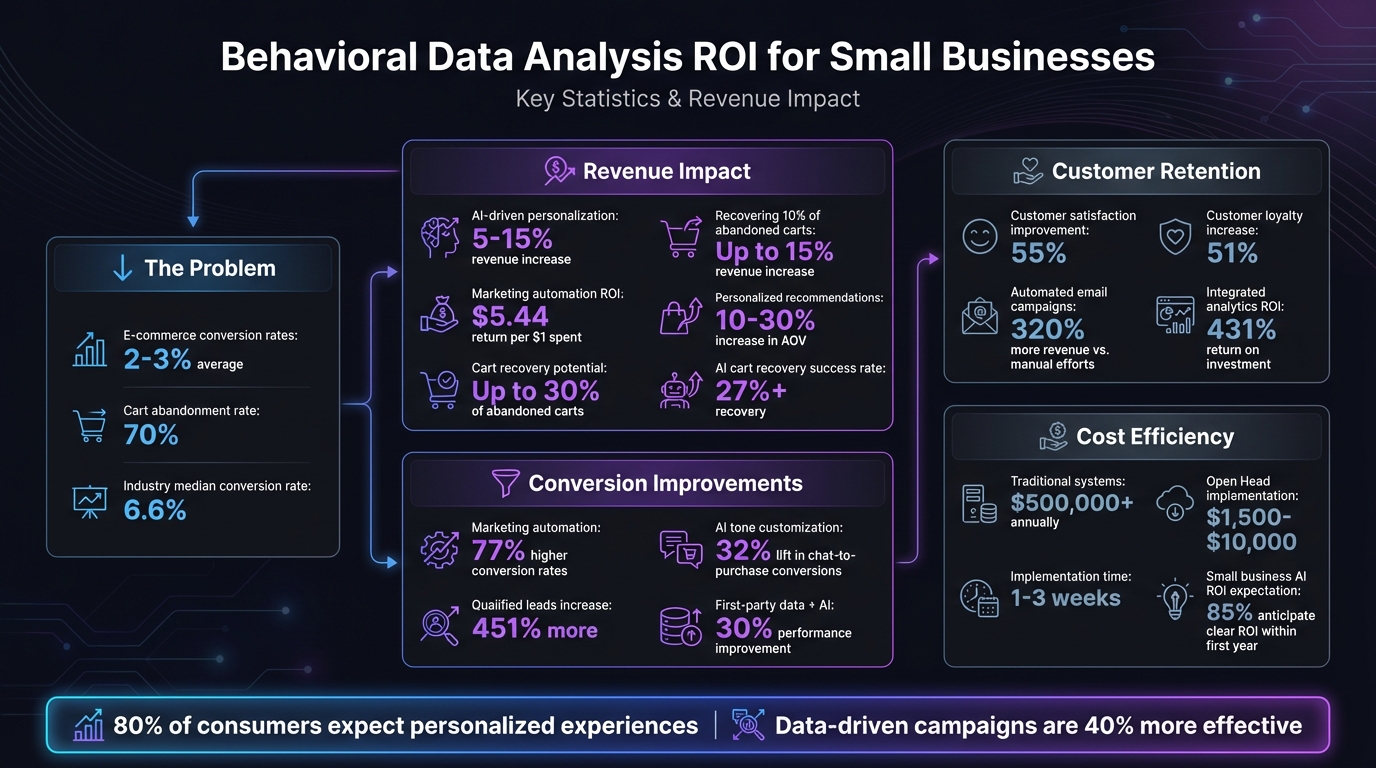
Behavioral Data Analysis ROI Statistics for Small Businesses
AI-powered conversion optimization (and the power of PERSONALIZED experiences) w/ Angelo Ferro
What Behavioral Data Is and How It Improves Conversions
Behavioral data tracks every action users take on your website or app, offering direct insights that external sources simply can’t provide. Instead of focusing on demographics, it captures behaviors like product views, page interactions, cart additions, and even checkout abandonment. Since this data comes straight from your own platforms – your website, mobile app, or social channels – it’s classified as first-party data. As CDP.com Staff puts it:
"Behavioral data is essential in marketing because it reflects your relationship with that customer." [9]
Compared to purchased lists, first-party data offers a clearer, more accurate picture of what’s resonating with your audience and what isn’t.
Types of Behavioral Data
Small businesses can collect several types of behavioral data to better understand their customers. Here are some examples:
- Website interactions: Metrics like clicks, scroll depth, and page visits reveal which parts of your site grab attention and which are ignored.
- Ecommerce events: Tracking cart actions, purchase history, and product views helps identify buying patterns.
- Search behavior: Keywords entered into your site’s search bar or external search engines show user intent and interests.
- Communication data: Email open rates, click-through rates, and chatbot conversations highlight what customers are curious about.
- Engagement metrics: Actions like form submissions, downloads, and account sign-ups demonstrate user interest.
- Offline data: For brick-and-mortar businesses, tracking foot traffic and in-store purchases provides valuable insights.
It’s also critical to monitor negative behavioral data, such as cart abandonment, email unsubscribes, or negative social media feedback. For example, around 68% of shopping carts are abandoned before checkout [10]. By analyzing where users drop off – whether on a product page, at the cart, or during checkout – you can pinpoint where to step in and improve the experience. Together, these data points reveal patterns that can guide more effective strategies to boost conversions.
How Behavioral Data Drives Conversion Improvements
Using behavioral data allows you to turn customer insights into actionable strategies for improving conversions. For instance, analyzing heatmaps and scroll depth might reveal that visitors are engaging with your content but missing the call-to-action (CTA). Life Pro Fitness faced this issue when users read product descriptions but didn’t scroll far enough to see the "Buy Now" button. By repositioning the CTA higher on the page, they increased sales by 15.63% and added $0.67 in revenue per visitor [13].
Real-time behavioral triggers can take this further by personalizing the customer journey. For example, if a visitor shows exit intent – like hovering over the back button – an AI sales chatbot can pop up to offer a discount or highlight low stock. Wikijob, a site with 500,000 monthly visitors, used behavioral insights to add social proof elements, leading to a 34% jump in purchases [13]. Similarly, Safety Gear Data noticed that visitors who used the search bar converted more often but found that many weren’t using it. By making the search bar more prominent on mobile devices, they saw an 8.33% increase in purchases [13].
Behavioral data also powers personalization, which can boost the average order value (AOV). For example, if a customer is browsing hiking boots, an ecommerce chatbot might suggest related items like socks or waterproofing spray based on past purchases. These tailored recommendations can lift AOV by 10–30% [1]. Aligning your messaging with where the customer is in their journey – whether they’re exploring options, comparing solutions, or ready to buy – ensures every interaction feels purposeful. This level of precision not only enhances ROI but also supports sustainable business growth [2].
Research Findings: ROI and Revenue Impact from Behavioral Data
Recent studies confirm a clear link between using behavioral data and improving both conversions and revenue for small businesses.
Conversion Rate Increases
Personalizing customer experiences with behavioral data has proven to increase revenue significantly. McKinsey reports that AI-driven personalization can boost revenue by 5–15%, and marketing automation tools analyzing user behavior generate an average return of $5.44 for every $1 spent. Businesses using these tools also enjoy a 77% jump in conversion rates and see 451% more qualified leads[1][6].
In 2023, researchers Sagit Bar-Gill, Erik Brynjolfsson, and Nir Hak conducted a field study on eBay sellers who were given access to the Seller Hub dashboard, which offers behavioral and performance insights. The results showed a 3.6% revenue increase on average for these businesses. Interestingly, a significant portion of this growth came from managers who actively monitored the data, demonstrating the value of engagement with these tools[12].
Cart abandonment remains a persistent issue, but behavioral triggers like exit-intent nudges can recover up to 30% of abandoned carts – outperforming static email campaigns[1]. Across various industries, real-time behavioral interventions consistently deliver better results than delayed or batch-processed actions, highlighting their role in driving both revenue and customer retention.
Revenue and Customer Retention Results
While increasing conversions is important, retaining customers adds even more value. Personalized product recommendations based on browsing behavior can increase average order value (AOV) by 10–30%[1]. For example, a boutique skincare brand used an ecommerce chatbot to analyze customer purchase history and live cart data. By offering tailored recommendations during real-time chat sessions, the brand boosted its AOV by 18% over a six-week period[1].
AI-powered personalization also builds stronger customer loyalty. Forrester found that personalized interactions using AI led to a 55% improvement in customer satisfaction and a 51% increase in loyalty[7]. Automated email campaigns triggered by behavioral insights generate 320% more revenue than manual efforts[6]. In one case, a business using integrated journey analytics and personalization tools reported a 431% return on investment, with payback achieved in under six months[11].
How AI Amplifies Behavioral Data ROI
AI tools enhance the impact of behavioral data by enabling real-time interventions and streamlining operations for small businesses. These tools process data faster and more accurately than manual methods, leading to better outcomes. For instance, AI-driven exit-intent nudges can recover 27% or more of abandoned carts[1]. Similarly, AI-powered tone adjustments during live chats can increase chat-to-purchase conversions by 32%[1]. Marketers leveraging first-party customer data with AI report a 30% improvement in performance compared to those who don’t[14].
Small businesses don’t need large data science teams to benefit from AI. Tools like an AI sales chatbot can detect hesitation during checkout and instantly offer incentives like free shipping or discounts. This kind of constant optimization allows smaller teams to compete with larger retailers. It’s no wonder that 85% of small and mid-sized businesses using AI anticipate seeing a clear return on investment within their first year[6].
| Behavioral Intervention | Impact | Source |
|---|---|---|
| Marketing Automation | $5.44 per $1 spent, 77% higher conversion rate | [6] |
| AI Cart Recovery | Up to 30% recovery rate | [1] |
| Personalized Recommendations | 10–30% increase in AOV | [1] |
| Exit-Intent Nudges | 27%+ increase in recovery | [1] |
| Tone Customization | 32% lift in chat-to-purchase conversions | [1] |
| First-Party Data + AI | 30% lift in performance | [14] |
sbb-itb-2339147
Costs, Metrics, and ROI Calculation for Behavioral Data
Key Metrics to Track
If you’re running a small business, understanding the right metrics is essential to make the most of your behavioral data efforts. Start with macro conversions – these are your big wins like completed purchases, sign-ups, or form submissions. But don’t stop there. Keep an eye on micro conversions too, which act as early indicators of customer intent, such as clicks on specific buttons or time spent on product pages[8].
Another must-track area is where users drop off in your sales funnel. By measuring conversion rates at each stage – Landing Page, Pricing, Add to Cart, and Checkout – you can identify where potential customers are getting stuck[8]. Tools like heatmaps and session recordings add a visual layer to your analysis. For example, heatmaps reveal where users click (or don’t), while session recordings can show signs of frustration, like "rage clicks" or abandoned form fields[8][2].
For subscription-based businesses, it’s not just about the initial sale. Metrics like churn rate, Customer Lifetime Value (LTV), and revenue from up-sells or cross-sells are just as important. These numbers help you gauge the long-term effects of your behavioral data strategies[15]. As a benchmark, the median conversion rate across industries is 6.6%[8], so use that as a starting point to evaluate your performance.
| Metric Category | Specific Metrics | Purpose |
|---|---|---|
| Conversion | Macro CR, Micro CR, Checkout Abandonment | Measure success and customer intent |
| Revenue | Average Order Value (AOV), Revenue Per Visitor (RPV) | Understand financial impact |
| Efficiency | Cost Per Lead (CPL), Customer Acquisition Cost (CAC) | Assess marketing spend effectiveness |
| Behavioral | Scroll Depth, Rage Clicks, Time on Pricing Page | Pinpoint UX pain points |
| Retention | Churn Rate, Customer Lifetime Value (LTV) | Evaluate long-term customer value |
How to Calculate ROI
Calculating ROI doesn’t have to be complicated. Use this formula: ROI = (Net Benefits / Cost of Investment) × 100%[16]. Net Benefits include all the value added – like increased revenue or reduced costs – minus what you spent on the behavioral data solution[16].
When breaking down benefits, think beyond just revenue. Include savings from reduced labor hours, better lead targeting, and fewer missed opportunities thanks to 24/7 lead capture. Reducing abandoned carts or inquiries also lowers failure costs[16]. For instance, doubling your conversion rate from 1% to 2% means you’re effectively cutting your Customer Acquisition Cost (CAC) in half for the same ad spend[2].
Start by documenting your baseline. This includes labor costs (wages and benefits), missed revenue from abandoned carts or unanswered calls, and any current software expenses[16]. Take NTVAL, for example – a valve manufacturer led by CEO Bruce Zheng. In December 2025, they used data analysis to fine-tune their production cycle. By tracking daily inefficiencies, they saved $150,000 annually in inventory holding costs and cut labor expenses by $20,000 by reducing downtime by 60 hours per month[5].
Consistency is key when measuring ROI. Make sure the timeframe for calculating benefits matches the period over which costs were incurred. This prevents skewed results. Beyond direct revenue, factor in avoided costs from outdated systems and productivity gains, like time saved by marketers using automation tools[11]. This method gives you a clear view of the financial advantages of behavioral data systems.
Open Head‘s Cost-Effective Implementation
Traditional behavioral data systems often require hefty investments – think large data science teams and expensive enterprise software licenses. Open Head takes a different approach. By leveraging platforms like n8n, Make, and Zapier, they create custom solutions that integrate seamlessly with your existing tools, cutting costs significantly[1][18].
While big companies might spend upwards of $500,000 annually on analytics tools and staff[17], Open Head offers complete implementations starting at just $1,500 to $10,000. Small businesses can deploy a fully operational behavioral data system – including features like an AI sales chatbot for lead capture or an ecommerce chatbot for cart recovery – in as little as 1-3 weeks, all without hiring additional analysts.
Their solutions connect with over 3,000 apps, including Shopify, WooCommerce, Salesforce, HubSpot, and Google Analytics. This means you can start tracking behavioral metrics and automating responses right away – no need to overhaul your current systems. It’s a practical, budget-friendly way to make behavioral data work for your business.
How to Implement Behavioral Data Analysis in Your Business
Implementation Steps
Start by defining clear, measurable goals and unifying your data sources. Instead of vague objectives like "get more leads", aim for something precise, such as "Increase product demo bookings from 2% to 3%" or "Lower cart abandonment rates for mobile users from 75% to 65%" [8].
Next, bring your scattered data into one centralized location. Many small businesses have critical customer information spread across CRMs, website analytics, accounting software, and support tools. For example, in January 2026, Brewster Consulting Group helped an energy company consolidate data from OGSYS and Monday.com into a single SQL-based data mart. This process uncovered a $225,000 discrepancy in mispaid invoices [4]. Tools like n8n, Make, and Zapier make it possible to integrate systems without custom coding.
Focus on identifying key drop-off points in your customer funnel using tools like heatmaps and session recordings. If, for instance, 40% of visitors leave between your pricing page and checkout, that’s where you should direct your efforts. These tools can reveal issues like users clicking excessively on non-functional elements or abandoning forms midway [8]. Formulate hypotheses using a straightforward approach: "Because we observed [data], if we [make change], then [metric] will [improve]" [8].
Take a page from the jewelry retailer Hearts on Fire. In 2024, their behavioral analytics showed that a product slated for discontinuation was actually in high demand – it was just understocked by retailers [3]. This example underscores the importance of data-driven decisions over assumptions.
By following these steps, you set the stage for AI tools that can act on behavioral data in real time.
Open Head’s AI Automation Solutions
Open Head takes these insights and turns them into immediate, actionable results through custom AI automation. Unlike traditional analytics tools that provide static reports, Open Head’s solutions respond dynamically to customer behavior.
Their AI sales chatbot detects signs of purchase intent – like time spent on pricing pages, items added to carts, or hovering over the back button – and delivers tailored responses on the spot.
For ecommerce businesses, Open Head’s ecommerce chatbot goes beyond answering basic FAQs. It monitors browsing behavior, suggests products based on activity, and helps recover up to 35% of abandoned carts by addressing hesitation in real time [19]. In 2025, Shopify brand Moonrise Apparel adopted this solution, cutting response times from 12 hours to less than 30 seconds and recovering 29% of abandoned carts – equivalent to $18,000 in monthly lost revenue [19].
What makes Open Head stand out is its advanced system architecture. By combining Retrieval-Augmented Generation (RAG) with Knowledge Graphs, it reduces inaccurate AI responses by up to 70% [19]. This ensures precise, context-aware interactions throughout the customer journey.
Plus, these solutions integrate effortlessly with your existing tools using workflow automation platforms like n8n, Make, and Zapier. Whether you use Shopify, WooCommerce, Salesforce, HubSpot, or QuickBooks, Open Head’s behavioral tracking and automated responses can be implemented without disrupting your current setup. Most businesses see their systems go live within 1–3 weeks.
Common Implementation Challenges and Solutions
Even with a solid strategy, businesses often face hurdles that need tailored solutions. The three most common challenges are limited technical resources, data quality issues, and disconnected systems.
For small businesses without in-house developers, setting up tracking systems or running A/B tests can be daunting [1]. Open Head addresses this with a no-code visual builder that requires zero coding skills. Setup takes about five minutes, allowing you to focus on your business while the platform handles the technical side [19].
Data quality is another frequent issue. AI models can sometimes produce confident but incorrect answers, which can harm customer trust. Open Head mitigates this risk with its dual RAG and Knowledge Graph architecture. Rather than guessing, the system retrieves and verifies information from your own business data, enabling it to resolve 80–93% of customer inquiries accurately without human intervention [19].
A third challenge is the loss of customer context. Many systems fail to remember user history across sessions, creating a disjointed experience. Open Head solves this with a hybrid memory architecture that combines PostgreSQL for structured data and graph databases for mapping relationships. This ensures the system remembers past conversations, purchase history, and preferences, delivering a seamless, personalized experience [19].
For businesses worried about losing the human touch, Open Head’s systems include sentiment analysis to detect frustration in customer interactions. If a user shows signs of distress or presents a complex issue, the AI transfers the conversation to a human agent, complete with chat history. This hybrid approach – combining efficient AI support with human empathy – is preferred by 89% of consumers [19].
If your data is trapped in silos across accounting, CRM, or operational systems, Open Head’s AI consulting services can help consolidate it all into a single source of truth. This not only simplifies reporting but can also uncover hidden revenue leaks and inefficiencies in operations.
Conclusion
Understanding and using behavioral data is no longer optional for small businesses – it’s a game-changer. Studies reveal that strategies rooted in data can make campaigns up to 40% more effective, improve productivity by 63%, and boost revenue by 5–15% through AI-driven personalization [1][5][20]. Real-world success stories drive this point home. Take LEGO, for instance: by closely examining customer behavior, the company climbed out of near-bankruptcy to generate $7 billion in annual revenue. Similarly, Hindustan Unilever tapped into rural consumer insights to drive 35% of its revenue [20].
This shift from intuition to data-backed decisions isn’t just about improving short-term results. With 80% of consumers now expecting personalized experiences [3], businesses that neglect behavioral data risk being left behind. Fortunately, tools like n8n, Make, and Zapier have made it easier and more affordable than ever to implement these strategies, giving even smaller businesses the chance to compete effectively.
Open Head takes this a step further by turning behavioral insights into measurable growth. Whether it’s an AI receptionist to handle after-hours inquiries, an ecommerce chatbot to reduce cart abandonment, or workflow automation services to unify your systems, Open Head’s solutions integrate effortlessly with your existing tools.
Founded by Brandon Meyer, Open Head specializes in creating AI solutions that directly impact revenue. For example, they’ve helped businesses recover up to 30% of abandoned carts and improve customer response times [1]. These results make it clear: behavioral data analysis is a cornerstone for sustainable growth.
Why rely on guesswork when data can lead the way? Book a free consultation today and discover how AI and behavioral insights can elevate your business.
FAQs
How can small businesses leverage behavioral data without a dedicated data team?
Small businesses can tap into behavioral data with the help of AI-driven automation tools that make collecting and analyzing data straightforward. These tools track user actions – like clicks and browsing habits – and present clear, actionable insights through user-friendly dashboards.
With low-code platforms and AI-powered solutions, small businesses can boost conversion rates without hiring a dedicated data science team. Open Head offers customized AI systems designed to simplify this process, allowing businesses to concentrate on growth while delivering measurable results.
What types of behavioral data can help boost e-commerce conversions?
When it comes to boosting e-commerce conversions, certain behavioral data points stand out as game-changers. Key insights like exit-intent signals, purchase history, and product views help create personalized recommendations that resonate with customers. On top of that, cart abandonment triggers and real-time interaction data – such as chat preferences and click patterns – play a crucial role in keeping customers engaged and driving them toward completing their purchases.
For small businesses, tapping into these data points can transform the customer journey, potentially boosting conversion rates by 10–30% or more. Open Head offers AI-powered systems designed to streamline this process, delivering tailored solutions that focus on measurable ROI.
How can AI automation boost the ROI of behavioral data analysis for small businesses?
AI automation transforms behavioral data into practical tools for small businesses, enabling real-time, personalized interactions. Think automated chatbots that answer customer questions, exit-intent prompts that re-engage users before they leave, or workflow triggers that streamline follow-ups. These tools not only simplify operations but also boost conversion rates. In fact, businesses can see up to a 15% increase in revenue while cutting down on support costs.
By handling repetitive tasks and creating tailored customer experiences, AI-powered solutions make the most of behavioral data. The result? Better efficiency, happier customers, and measurable ROI – all without the need for technical expertise from the business owner.