


Here’s the problem: You spend hours writing a blog post, but it barely gets seen. Meanwhile, your social media channels are empty, and creating posts for each platform feels like a full-time job.
The solution? AI tools can take a single blog post and turn it into 20–30 ready-to-publish social media posts in seconds. These tools extract key points, quotes, and stats to create content tailored for platforms like LinkedIn, Instagram, and Twitter – all while keeping your brand’s voice consistent.
Why does this matter?
- 80% of social media marketers already use AI to save time and boost efficiency.
- Modern marketing strategies recommend spending 75% of your time distributing content – AI helps you focus on that.
- Small businesses can maintain a professional social presence without hiring extra staff.
What’s involved?
- Prepare your blog: Pull out key insights, quotes, and stats for AI to work with.
- Choose the right tools: Platforms like n8n, Make, or Zapier automate the process.
- Generate platform-specific posts: AI creates LinkedIn summaries, Instagram carousels, and Twitter threads.
- Fine-tune with automation: Adjust tone, format, and hashtags for each platform.
- Automate publishing and tracking: Post automatically and analyze performance to refine future efforts.
The bottom line? AI eliminates the manual work of repurposing content, letting you focus on strategy while reaching more people with less effort. Tools like Open Head’s custom workflows make this process even easier by handling everything from content extraction to automation.
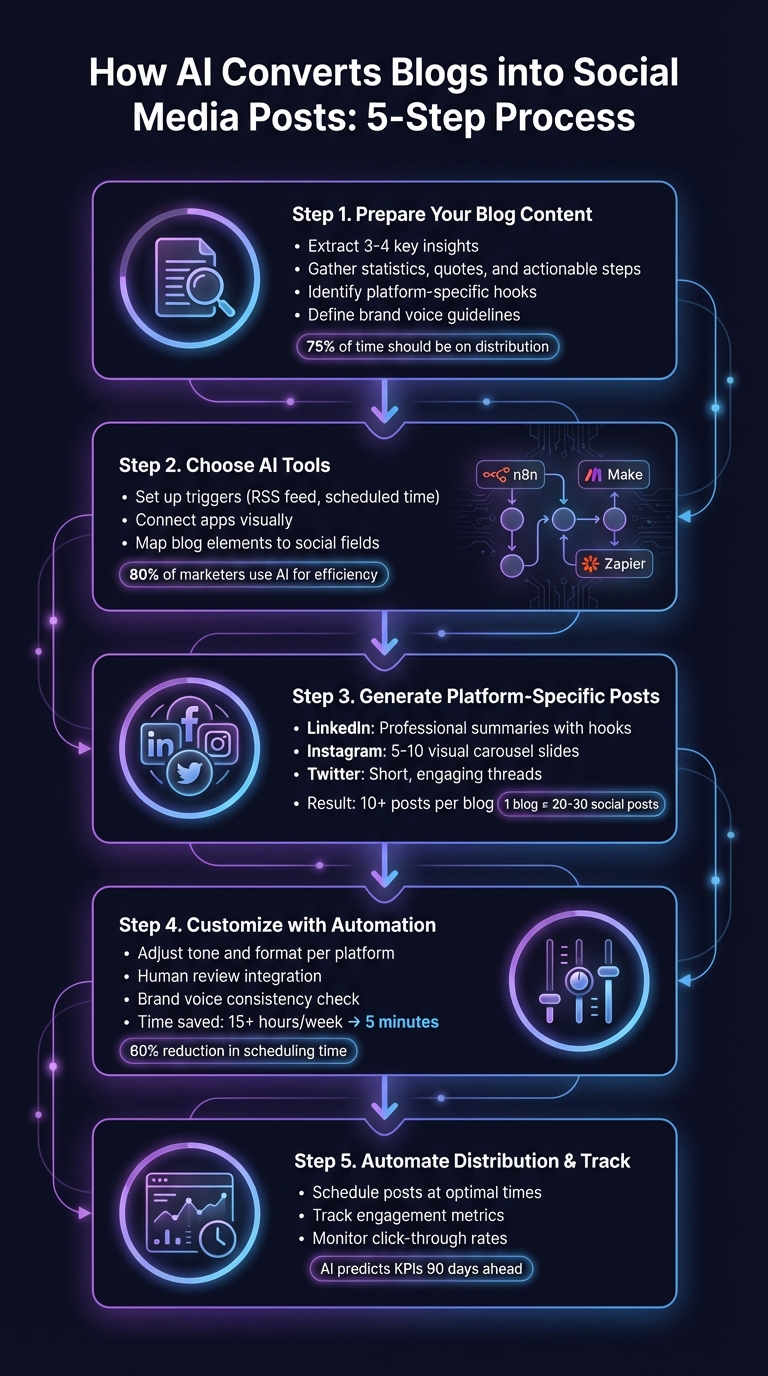
5-Step Process to Convert Blog Posts into Social Media Content Using AI
Use AI To Turn One Blog Post Into Countless Social Posts!
Step 1: Prepare Your Blog Content for AI
Your blog post is a treasure trove of potential content. A well-written 2,000-word article can be repurposed into multiple pieces of engaging material – if you know how to mine it effectively.
Start by pulling out 3–4 key insights from your blog. These are the standout takeaways or "aha moments" that position you as an expert, particularly on platforms like LinkedIn. Then, gather supporting elements like statistics, quotes, and actionable steps. These are perfect for creating quote graphics for Instagram, individual tweets for Twitter threads, or slides for carousel posts. Bullet points and numbered lists work especially well for Twitter threads, while stories or case studies can be reshaped into compelling long-form posts on Facebook or LinkedIn.
Don’t overlook your blog’s headline and key phrases from the introduction and conclusion. These are prime material for crafting platform-specific hooks – those attention-grabbing lines that stop users mid-scroll in their crowded feeds.
Each platform has its own style and preferences. LinkedIn thrives on professional insights and discussion-worthy summaries. Twitter favors snappy, concise threads. Instagram and TikTok lean toward visual appeal, with carousels that highlight one major point per slide or quick how-to videos. Tailor your extracted insights to fit these formats before automating the process.
Feeling overwhelmed by the idea of manually organizing content for multiple platforms? Open Head’s workflow automation services can take care of the heavy lifting, extracting and formatting your blog content for you.
Lastly, ensure the AI understands your brand’s voice. Provide it with your brand guidelines, audience details, and any essential phrases or tone preferences. This step is what transforms generic AI-generated content into posts that resonate with your audience and sound authentically like you. Careful preparation here ensures your AI outputs deliver consistent, high-quality content that drives engagement on social media.
Once your content is ready, the next step is configuring your AI tools to make the most of it.
Step 2: Choose and Configure AI Tools for Conversion
Turning a single blog post into a stream of social media content is easier than you might think – if you have the right tools. The trick is picking platforms that fit your technical comfort level and meet your business needs.
Open Head uses tools like n8n, Make, and Zapier to create custom workflow automations for clients. These platforms feature visual interfaces where you connect "nodes" that represent apps – think WordPress, LinkedIn, Instagram, or AI content generators – into seamless workflows. For instance, when you publish a new blog post, the system can automatically pull out key points, craft platform-specific captions, and post them across your social channels, all without lifting a finger [9][12].
Each tool has its own pricing and strengths. Make charges based on operations, n8n on complete workflow runs, and Zapier uses a tiered task system – so there’s something for every budget and technical preference [11][13]. If you want a user-friendly platform with over 2,800 pre-built app integrations, Make is a great choice [11]. On the other hand, n8n is perfect for teams with developer resources, offering self-hosting options and lower long-term costs [10][11]. Both platforms allow for branching workflows, meaning a single blog post can be formatted and sent to multiple social platforms simultaneously [10][12]. Once you’ve picked your tool, it’s time to configure your workflow.
To set up your automation, start by defining your trigger. This could be anything from a new RSS feed item to an updated Airtable row or a scheduled time. Then, map elements from your blog – like the headline, summary, or featured image – to corresponding social media fields using an intuitive graphical interface [12][13]. Add an AI node, such as OpenAI’s GPT, to transform your blog excerpt into something catchy, like a LinkedIn hook or a Twitter thread. Finally, connect nodes to push the content to each platform’s API [9][10]. Open Head can handle everything for you, from setting up triggers to fine-tuning AI prompts, so you don’t need to touch a single line of code.
If you’re new to automation, start small – like converting one blog post to a single social platform. Once you’ve mastered the basics, you can expand to more complex, multi-channel workflows [9]. Tools like n8n and Make also include monitoring features to catch errors early. For added peace of mind, consider including a human review step to ensure the content stays aligned with your brand voice.
Step 3: Generate Platform-Specific Social Media Posts
Now that your workflow is ready, let AI transform your blog into tailored social media posts. The trick is recognizing that each platform demands a unique approach – what grabs attention on LinkedIn might fall flat on Instagram or Twitter. AI shines in reformatting your blog content to suit the tone and style each platform requires.
To make this work, use prompt engineering effectively. For example, instruct the AI to match your brand’s voice and role, such as "B2B SaaS social media manager", and specify the audience, tone, and stage of the buyer’s journey [14]. This ensures your posts don’t sound generic but instead reflect your brand’s personality. In 2024, Ashwin Thapliyal, Head of Marketing at Exemplifi, demonstrated this by using AI-driven audience segmentation to create targeted LinkedIn campaigns for a B2B logistics client. The results? A 20% boost in lead generation and a 50% cut in content planning time [3].
Here’s a simple rule to follow: one blog should give you at least ten social posts [4]. For LinkedIn, AI can pull out three or four key takeaways, add a professional hook, and structure the text with line breaks for better readability [4][7]. On Instagram, your blog can become five to ten visual slides – starting with a compelling hook on the first slide and ending with a strong call-to-action (CTA) [4]. Twitter threads work best when AI breaks the content into short, engaging tweets, with the first tweet acting as a hook and the last one driving your main CTA [7][5].
Don’t forget hashtags and CTAs – they’re essential. AI can suggest hashtags and CTAs tailored to your buyer’s journey. For example, use educational CTAs for awareness-stage content and direct actions like "Register Now" or "Book a Demo" for conversion-focused posts [3][14]. If you want to automate the entire process – from turning blogs into posts to publishing them across platforms – Open Head’s workflow automation services can build a custom AI system to handle it all, no manual prompts needed. This kind of integration showcases how AI can simplify and supercharge your social media strategy.
Before hitting publish, always apply the HUMAN framework: check if your AI-generated content is Helpful, Unique, Memorizable, Actionable, and Natural [14]. Skipping this step can hurt your engagement – one financial services client saw a 12% drop in engagement when using unedited, robotic AI captions [3]. A quick human touch ensures the content feels authentic and resonates with your audience. Up next, discover how to fine-tune these posts with automated customizations.
sbb-itb-2339147
Step 4: Customize and Refine Outputs with Automation
After AI generates your social media posts, automation tools step in to fine-tune and format them. Platforms like n8n, Make, and Zapier handle tasks such as adjusting tone and ensuring posts meet platform-specific requirements, all while staying true to your brand voice. This can save a significant amount of time – social media professionals typically spend over 15 hours per week on tasks like writing captions, scheduling posts, and analyzing performance [16]. With automation, that workload can shrink to under five minutes for an entire campaign [17]. Essentially, automation connects the dots between AI content creation and final approval for publishing.
Here’s how it works: you can create workflows that automatically generate review tasks. For example, by linking your AI content generator to project management tools like Trello or Asana using n8n or Zapier, you can have the system draft posts and assign review tasks to human editors. Once a post is approved and marked as ready, the system publishes it [15]. This "human-in-the-loop" approach ensures your content stays polished and authentic, maintaining audience trust and engagement.
Automation also excels at tailoring content for different platforms. With modular agents in n8n, you can automatically adjust tone, format, and style for LinkedIn, Instagram, or Twitter. For instance, one agent could pull real-time search data to craft an engaging LinkedIn hook, while another converts Instagram posts into carousel formats designed to grab attention [15]. This platform-specific customization ensures your posts resonate effectively with each audience.
Beyond saving time, automation boosts your return on investment by ensuring every post is polished and ready to perform. If you’re looking for a custom system that handles everything from AI content generation to platform-specific refinements, Open Head’s workflow automation services can create a solution tailored to your needs. This allows your team to focus on strategy and creativity instead of repetitive tasks.
Cost management is another area where automation proves its worth. Tools like n8n offer workflow-based pricing, keeping costs predictable even as your automation scales. On the other hand, platforms like Zapier and Make charge per task, which can get expensive for more complex workflows [15]. Choosing the right tool – and a reliable partner to implement it – can dramatically improve both efficiency and your bottom line. Up next, we’ll explore how to automate content distribution and track performance to complete your content strategy.
Step 5: Automate Distribution and Track Performance
Once your AI-generated posts are ready, the next step is to publish them and measure their impact. Workflow automation platforms like n8n, Make, and Zapier make this process seamless by connecting your content creation system directly to your distribution channels. For instance, you can set up a workflow in n8n that monitors your blog’s RSS feed, triggers an AI generation step, and automatically sends the finished post to scheduling tools or CRMs like HubSpot or Salesforce [9][8]. This eliminates the need for manual copy-pasting and ensures your content reaches the right platforms at the perfect time.
Timing matters. AI-driven analytics can identify the best posting times based on your audience’s actual behavior, rather than relying on generic industry averages. One expert noted that this approach cut scheduling time by 60% [3]. Posting at the right moment can significantly boost engagement. For example, LinkedIn posts without external links achieve 6x the reach and 4x the reactions compared to posts with links [1].
AI also simplifies performance tracking. It processes engagement data and forecasts trends, helping you refine future campaigns [3]. Tools like sentiment analysis and AI-powered social listening can even predict KPIs up to 90 days in advance with impressive accuracy [3]. Key metrics to watch include click-through rates to your blog, engagement stats like shares and comments, and overall reach across platforms [5][6][2]. Integrating this data with your CRM creates a feedback loop, revealing which repurposed content drives the most conversions. This data-focused approach ensures your distribution efforts are as effective as possible.
If you’re ready to build a custom system for smarter content distribution and strategy refinement, Open Head’s workflow automation services can help. Their tailored solutions are designed to learn from your data and continually improve – so you’re not just publishing content, you’re amplifying what works best. Up next, learn how custom AI workflows can take your content repurposing to the next level.
How to Scale Content Repurposing with Custom AI Workflows
Most automation tools fall short when it comes to turning a single blog post into 20-30 customized social media assets. Their basic "if-this-then-that" logic just can’t handle the nuanced adjustments needed for tone, format, and visuals across platforms like LinkedIn, X, Instagram, and TikTok. Custom AI workflows, however, use specialized agents to manage multi-step operations with precision [15]. Let’s take a closer look at how Open Head creates these advanced systems using modular agents.
Open Head’s workflow automation services are built around modular systems, where each agent focuses on a specific task. For example:
- A keyword clustering agent organizes topics based on intent.
- A content brief agent analyzes search results and gathers competitor insights.
- A publishing agent formats content and distributes it to your CMS and social platforms.
This system transforms a single 2,000-word blog post into a variety of assets – 10-15 individual posts, 3-5 carousels, and 5-10 graphics – all without the headache of manual copy-pasting [4][19].
The standout feature here is human-in-the-loop integration. While the AI takes care of repetitive tasks like research and drafting, your team reviews and refines the content before it’s published. This step ensures the final product aligns with your brand’s voice and feels authentic [15].
"AI works best when used as a tool to foster and support human creativity. It makes teams faster and more agile. But it can’t take the place of a skilled social media manager" [3].
Cost is another crucial factor. Platforms like n8n use a fair-code model, where pricing is based on active workflows rather than individual tasks. This makes high-volume operations more predictable and budget-friendly [15]. In contrast, task-based pricing can quickly become expensive as your needs grow. For small businesses trying to hit the 48-72 posts per week benchmark – recommended by Hootsuite for maximum reach – this pricing difference can make a big impact [3].
Open Head’s systems also incorporate a dynamic feedback loop, learning from performance data to refine content formats for better engagement and conversions. If you’re ready to explore how an intelligent content repurposing system can transform your workflow, book a free consultation to see what’s possible for your business.
Conclusion
Transforming a single blog post into 20–30 social media assets is a smart way to get more value out of your content. By leveraging AI automation, the tedious tasks of reformatting, customizing for different platforms, and scheduling are taken off your plate. This allows your team to focus on the bigger picture – strategy and creativity – rather than getting bogged down in repetitive work. Regularly repurposing content boosts visibility without overloading your team or blowing through your budget.
The real game-changer lies in custom AI workflows. Unlike basic automation tools, custom workflows are all about precision and scalability. With tools like n8n, Make, or Zapier, you can turn your blog’s RSS feed into a fully automated system that creates platform-specific posts, schedules them at the best times, and even uses performance data to get better over time [18][19].
That said, 72% of teams report wasted investments when AI tools miss the mark – either by failing to scale or sounding off-brand [20]. This is where Open Head stands out. Their workflow automation services are tailored to your brand, using modular agents trained on your unique voice, past content, and specific business goals. No cookie-cutter templates, no robotic-sounding posts.
Ready to step away from manual content slicing and take your strategy to the next level with smart automation? Book a free consultation with Open Head today. They’ll provide a custom roadmap, ROI projections, and a clear plan to turn one blog post into a month’s worth of high-performing social content – all without adding to your team or sacrificing quality.
FAQs
How does AI ensure my social media posts align with my brand’s voice?
AI takes the guesswork out of maintaining your brand’s voice on social media. By analyzing your blog posts, website copy, and style guides, Open Head creates a detailed "voice profile" that reflects your brand’s personality. Whether your tone is laid-back and approachable or polished and professional, the AI ensures every post aligns perfectly with your style.
The entire process is automated with tools like n8n, Make, or Zapier to keep things running smoothly. Posts are crafted to match your voice, paired with relevant hashtags, and scheduled for the right platforms – all without lifting a finger. This approach not only saves time but also keeps your content consistent and true to the identity your audience recognizes and values. Want to make content creation easier? Schedule your free consultation with Open Head today!
How can AI help turn blog posts into engaging social media content?
AI makes it easier than ever to turn blog content into engaging social media posts by automating tasks like extracting key points, summarizing, and formatting. With tools such as n8n, Make, and Zapier, you can set up workflows that transform blog ideas into share-ready posts. These tools also handle scheduling and publishing across platforms, saving time and ensuring your brand stays consistent.
If you’re looking for a more personalized approach, Open Head offers custom AI automation systems tailored to your needs. Their expertise with tools like n8n and Zapier allows them to create workflows that convert your blog content into posts designed to boost engagement and deliver results. Let the AI take care of the repetitive work so you can focus on growing your business.
How can I monitor the success of AI-generated social media posts?
Measuring how your AI-generated social media posts perform is essential for refining your strategy and proving ROI. A good starting point is to use unique UTM parameters (like utm_source=linkedin&utm_medium=social&utm_campaign=blog-to-post) for every post. These parameters let you track clicks in tools such as Google Analytics or your CRM. Combine this with platform-specific metrics – likes, shares, comments, click-through rates, and conversions – and compile everything into a single, centralized dashboard.
At Open Head, we make this process seamless by setting up automated workflows using tools like n8n, Make, or Zapier. These workflows pull performance data directly into platforms like Google Sheets, HubSpot, or Salesforce, eliminating the need for manual reporting. For a deeper dive, we offer custom dashboards that not only highlight key metrics but also flag posts that aren’t performing well. Plus, these dashboards connect engagement data to tangible outcomes like lead generation or sales. Want to see how this works? Schedule a free consultation, and let Open Head simplify your performance tracking so you can focus on growing your business.