


67% of businesses using AI tools can’t measure ROI in the first year. For small businesses, this is a problem – tight budgets mean every dollar spent needs to prove its worth quickly. AI tools, whether $30/month subscriptions or $50,000 custom systems, can save time, cut costs, and grow revenue. But without tracking the right metrics, you risk wasting money on tools that don’t work.
Here’s what you need to know:
- Baseline tracking is key. Start by measuring how long tasks take or how much errors cost before AI.
- Hidden costs add up. Beyond subscriptions, factor in setup, training, and maintenance.
- Measure time and money saved. Examples include cutting lead response times from 2 hours to 2 minutes or reducing errors by 80%.
- Revenue impact matters. AI can boost conversions by 15–20%, leading to thousands in extra sales.
Agentic AI for Small Business: $3.50 ROI Per $1 Invested with Grant McGaugh
sbb-itb-2339147
Common Problems When Measuring AI ROI
Many small businesses dive into AI adoption without first gathering baseline metrics. This oversight makes it tough to measure the true impact of their investment.
Missing Baseline Data
Before you can demonstrate that AI is delivering results, you need a clear picture of how things worked before its implementation. Unfortunately, many small businesses don’t track key metrics like “time spent on billing” or “average response time to new leads,” which makes it nearly impossible to compare AI-driven improvements to past performance.
Take Green Thumb Landscaping, for example. This 15-person gardening service spent two weeks documenting their scheduling process before rolling out an AI assistant in June 2025. They discovered their team was dedicating 4 hours per week to scheduling tasks and dealing with a 30% late payment rate. After introducing AI for scheduling and invoicing, scheduling time dropped to just 1 hour per week, and late payments fell to 10%. Over a year, this change saved them $4,020 while costing $1,800, resulting in a 123% ROI [4].
Without this kind of initial audit, it’s hard to pinpoint AI’s exact impact. This is especially true for small teams where employees juggle multiple responsibilities, like sales, support, and billing. Tracking where time savings actually go becomes tricky.
To establish a baseline, audit your key processes for 1–2 weeks using simple tools like spreadsheets or Google Forms. Focus on a few critical bottlenecks – such as customer response times or invoice processing – rather than trying to track every detail. For those exploring automation in lead response, tools like an AI sales chatbot can help collect accurate baseline data while also improving performance.
Now, let’s look at another common challenge: hidden costs that can cloud ROI calculations.
Overlooked Implementation Costs
The upfront subscription fee is just one piece of the puzzle. While off-the-shelf AI tools might cost between $30 and $200 per month, the real expenses often include setup, training, data preparation, and ongoing support. Small businesses frequently underestimate the time and effort required for configuring systems and resolving issues.
| Cost Type | Estimated Range |
|---|---|
| Off-the-shelf AI Subscriptions | $30 – $200 per month |
| Custom AI Software | $15,000 – $50,000 |
| Infrastructure (Cloud/Compute) | $3,000 – $10,000 per year |
| Training & Onboarding | $4,000 – $10,000 (one-time) |
| Maintenance & Support | $2,500 – $5,000 per month |
Source: [6]
Don’t forget to factor in the learning curve. Productivity may temporarily dip as your team adjusts to the new system. Hidden costs like training sessions, process mapping, and integration can quickly add up. For example, if you’re implementing workflow automation services, you’ll need time to map out current workflows before automating them.
To get a clearer picture of your investment, calculate the Total Cost of Ownership (TCO) over 6 to 12 months. Include software fees, cloud hosting, staff time, consultant hours, and any fine-tuning costs. This broader view ensures you’re not blindsided by unexpected expenses.
Next, we’ll explore benefits that, while harder to measure, can significantly impact your business.
Difficult-to-Measure Benefits
Not all AI advantages show up on a balance sheet. Boosts in customer satisfaction, reduced employee burnout, and faster decision-making are all valuable but tricky to quantify in financial terms.
"AI automation creates value in ways that traditional business investments don’t." – Lingows.ai [1]
One example of this “prevention-focused” value is an AI receptionist that ensures every call is answered. While it’s clear this prevents missed opportunities, assigning a dollar value to those saved opportunities can be a challenge.
Attribution also complicates things. When other changes – like hiring a new salesperson – happen alongside AI implementation, it becomes difficult to isolate AI’s specific impact. In fact, 36% of organizations report no revenue change after adopting AI [2].
To measure these harder-to-quantify benefits, use proxy metrics. For instance, track Net Promoter Scores (NPS) to gauge customer satisfaction, monitor employee retention rates to assess morale, or measure task completion times for productivity. If AI reduces turnover, you can calculate recruitment savings to assign a tangible value to this otherwise elusive benefit.
For those considering AI consulting services, working with experts can help set up systems to track both measurable and intangible ROI from the start.
Key AI ROI Metrics for Small Businesses
After addressing the challenges AI can solve, it’s time to dive into the numbers that prove its worth. Tracking specific metrics tied to your revenue and efficiency will clearly demonstrate AI’s impact on your business.
Cost Savings
One of the easiest ways to see AI’s value is through labor cost savings. Calculate this by multiplying the hours saved by your team’s hourly rate. For instance, if your team spends 10 hours a week on data entry at $25 per hour and AI cuts that down to 2 hours, you’re saving $200 per week – or $10,400 a year.
AI also helps reduce costly errors. Manual processes often lead to mistakes that take time and money to fix. Imagine your billing department averages five errors a month, each costing $150 to resolve. If AI reduces that to just one error per month, you’re avoiding $7,200 in annual rework costs. By tracking the frequency and cost of mistakes before and after AI implementation, you can quantify these savings.
Revenue Growth
AI doesn’t just cut costs; it can also grow your revenue. Tools like AI sales chatbots are known to boost conversion rates by 15–20%[6].
Take the example of a Denver management consulting firm. In June 2025, they implemented AI for proposal generation and saw a 20% increase in proposal acceptance rates, resulting in an $85,000 revenue boost in their first year[1]. To measure this for your business, track conversion rates and average deal sizes before and after using AI.
Lead Response Time
Quick responses to potential customers can set you apart from competitors. AI makes this possible by automating initial replies. Track your average lead response time – from when a lead submits a form or calls to when they receive a meaningful reply. For example, cutting response time from 2 hours to just 2 minutes can give you a significant edge. Businesses using an AI receptionist often see noticeable improvements in response times within days.
Employee Productivity
AI frees up your team’s time for more meaningful work. You can measure this by calculating the percentage of time spent on high-value tasks: (Time Spent on High-Value Tasks ÷ Total Work Time) × 100[8].
For example, if your marketing manager spends 15 hours a week on admin tasks and 25 hours on strategy, that’s 62.5% of their time on high-value work. With workflow automation services taking over the admin tasks, those 15 hours can shift to strategic work, dramatically increasing productivity. A 2023 study found that customer support teams using AI assistants resolved 14% more issues per hour[7]. For a three-person team handling 300 tickets weekly, that’s 42 additional resolved tickets – without hiring extra staff.
Customer Retention
Keeping customers is often cheaper than finding new ones, and AI helps by improving service speed and personalization. To measure this, track metrics like monthly churn rate and repeat purchase rate. AI systems that remember customer preferences and respond instantly can boost NPS by 10–15 points within six months. For example, reducing churn from 5% to 3% per month could retain 24 more customers annually. If each customer has a lifetime value of $2,000, that’s $48,000 in retained revenue.
| Metric Category | What to Track | How to Calculate |
|---|---|---|
| Cost Savings | Labor hours saved | (Hours saved per week) × (Hourly rate) × 52 weeks |
| Revenue Growth | Conversion rate change | (Post-AI conversion %) – (Baseline conversion %) |
| Lead Response | Average response time | Total response time ÷ Number of leads |
| Productivity | High-value time ratio | (Strategic hours ÷ Total hours) × 100 |
| Retention | Monthly churn rate | (Customers lost ÷ Total customers) × 100 |
These metrics, along with a reported 28% economic boost in sales and marketing[2], show just how impactful AI can be for small businesses. By focusing on these areas, you can clearly see where AI delivers measurable results.
How to Calculate AI ROI Step-by-Step
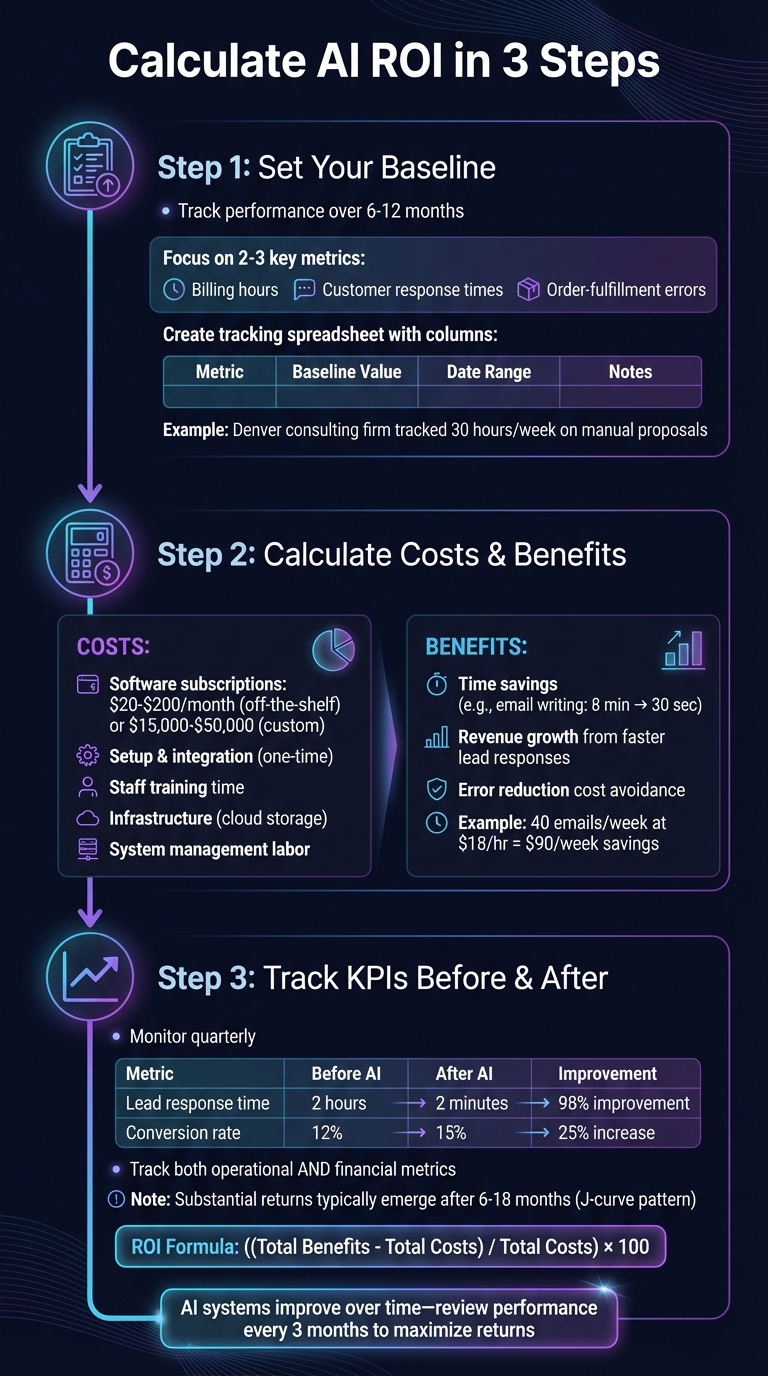
How to Calculate AI ROI for Small Businesses in 3 Steps
To calculate AI ROI, use the formula: ((Total Benefits – Total Costs) / Total Costs) × 100. The tricky part is gathering all the relevant data accurately.
Setting Your Baseline
Start by documenting your current performance to establish a clear reference point. Ideally, track performance over 6–12 months to account for seasonal trends. Focus on 2–3 metrics that significantly impact your business and are easy to measure, such as billing hours, customer response times, or order-fulfillment errors.
If you lack historical data, conduct a short "snapshot" audit over 1–2 weeks. Use simple tracking tools to log how long tasks take, how many errors occur, and what your current costs look like. For instance, if you’re evaluating AI consulting services to streamline proposal generation, track how many hours your team spends on proposals weekly and measure your current proposal acceptance rate.
Create a spreadsheet with columns for "Metric", "Baseline Value", "Date Range", and "Notes." This will serve as your ongoing reference. For example, one Denver consulting firm found they were spending 30 hours per week on manual proposals before adopting AI automation. Their baseline data helped confirm $117,000 in annual labor savings and a 20% boost in proposal acceptance, resulting in an ROI of 1,646% [1].
Calculating Costs and Benefits
Start by listing all costs. These include software subscription fees, one-time setup and integration expenses, staff training time, infrastructure needs like cloud storage, and the labor involved in managing the system. For small businesses, off-the-shelf AI tools typically cost between $20 and $200 per month, while custom solutions can range from $15,000 to $50,000 depending on complexity [4][6].
Next, quantify the benefits. Begin with time savings. For example, if writing a customer email takes 8 minutes and AI reduces it to 30 seconds, multiply the time saved per email by the number of emails sent and the hourly rate of your staff. Sending 40 emails per week at an $18 hourly rate would result in about $90 in weekly savings. Beyond time savings, faster lead responses can drive revenue growth, and reducing errors can help avoid costly mistakes.
With your costs and benefits clearly defined, tracking changes over time becomes much easier.
Tracking KPIs Before and After
Using your baseline data and cost-benefit analysis, monitor key performance indicators (KPIs) to measure AI’s impact. Create a simple comparison table to track these metrics over time, and review them quarterly. Your table should include the metric name, baseline value, current value, and the percentage change.
For example, if your baseline lead response time was 2 hours and AI reduces it to 2 minutes, that’s about a 98% improvement. Similarly, if your conversion rate grows from 12% to 15%, that’s a 25% increase. Track both operational metrics (like time savings and error reductions) and financial metrics (like revenue growth and cost savings) to showcase AI’s impact and identify areas for further improvement.
"AI ROI differs from traditional technology ROI… AI systems exhibit learning behaviors that improve performance over time, making initial ROI calculations potentially misleading."
- Wyatt Mayham, Founder, Northwest AI Consulting
Keep in mind that AI often follows a "J-curve" pattern, where initial costs are higher and benefits take time to materialize. Substantial returns typically emerge after 6–18 months. Be patient, continue tracking your progress, and refine your approach based on the data. This process helps confirm AI’s measurable impact and guides future adjustments effectively.
How Open Head Delivers Measurable AI ROI
Open Head specializes in crafting automation systems tailored to your business, designed to deliver clear and trackable results. These solutions are built to evolve, ensuring they continuously provide maximum value.
Custom AI Systems Designed for Your Needs
Open Head begins by identifying the specific operational challenges your business faces – whether it’s managing an overwhelming number of invoices, delays in customer response times, or errors from manual data entry. Each project is guided by SMART goals to ensure alignment with your business priorities from the outset [6].
Using tools like n8n, Make, and Zapier, Open Head integrates automation seamlessly into your existing software stack, including platforms like HubSpot, Salesforce, QuickBooks, Shopify, and Google Workspace. This approach ensures the automation fits naturally into your team’s workflow. For example, a landscaping company managed to cut its scheduling workload from four hours to just one per week, significantly reducing labor costs.
Whether you need an AI receptionist to handle after-hours calls, an AI sales chatbot to capture leads from your website, or workflow automation services to eliminate repetitive administrative tasks, Open Head customizes every system to meet your specific goals. Success is measured using metrics that matter most to your business, ensuring a smooth transition to impactful results.
Rapid Deployment with Tangible Results
Speed is key when it comes to implementation. Open Head ensures a 1–3 week deployment timeline, so you start seeing results quickly. Within 30 days, businesses typically experience improvements such as faster lead response times, reduced labor costs, or higher conversion rates. In fact, AI can cut process times by 40% to 70% within the first month [3].
To track progress, every project begins with baseline performance measurements, allowing you to clearly compare results before and after implementation. Metrics such as labor hours saved, improved lead response times, reduced error rates, and revenue growth are all part of this evaluation. For example, AI-driven email automation can increase weekly client engagements from 200 to over 500 without adding staff [6]. If your team is spending too much time qualifying leads or scheduling appointments, AI consulting services can help pinpoint the tasks that will deliver the quickest returns.
"AI is no longer a luxury for SMBs – it’s an essential tool for scaling business operations, increasing efficiency, and driving higher revenues."
- Vibertron [6]
Open Head employs a 30-day decision framework to evaluate automation projects. If a system is performing well, it’s scaled up. If it’s underperforming, adjustments are made. And if it’s not delivering results, it’s fixed or replaced – no waiting for lengthy quarterly reviews [3].
Continuous Tracking and Optimization
Accurate tracking is built into every Open Head solution, ensuring ongoing improvements. By integrating automation with your existing tools, Open Head provides real-time visibility into key performance indicators (KPIs) like labor savings, lead conversion rates, response times, and error reductions [1].
Quarterly reviews refine workflows and integrations [5], while AI models are updated with better data to enhance their efficiency [6]. Adoption rates are also monitored to ensure your team fully utilizes the new systems instead of falling back on manual processes [3].
To safeguard your operations, every automation includes an instant rollback option, allowing you to address potential issues without risking significant losses during the optimization phase [3]. This safety feature ensures control while the system adapts and improves. From scaling chatbots to optimizing workflows across departments, Open Head’s ongoing support ensures your AI investment continues to deliver measurable returns as your business grows. By focusing on continuous improvement, Open Head positions AI as a powerful tool for long-term business success.
Maintaining and Scaling Your AI Investment
AI systems need regular attention and a clear strategy to keep delivering value as your business grows. When managed effectively, your initial investment can snowball into greater returns over time. The key is to create a plan that supports both steady performance and scalable growth.
Start with a Pilot Program
Begin by testing AI in one specific area of your business for 1–3 months. Focus on a particular challenge, like scheduling appointments, processing invoices, or following up with leads, and measure 4–5 key metrics during this trial. For instance, a small gardening service used AI tools for scheduling and invoicing, cutting down manual work and achieving a 123% ROI [4].
Starting small allows you to test your assumptions without disrupting your day-to-day operations. If the pilot delivers an ROI of 50% or more, you’ll have the data to confidently expand the system into other parts of your business [4]. Whether it’s an AI sales chatbot capturing leads or workflow automation services eliminating repetitive tasks, a focused pilot gives you the evidence you need to scale effectively.
Review Performance Quarterly
AI systems improve over time, but only if you actively monitor and refine them. Plan a performance review every three months to compare your "Baseline vs. Current" metrics and spot new automation opportunities [4][5]. These regular check-ins ensure that your AI investment continues to deliver measurable results.
"AI pilots for small businesses aren’t ‘set and forget.’ Every 3 months, update your ‘Baseline vs. Current’ sheet. This keeps AI ROI on your radar – rather than buried in a ‘never review again’ folder." – Oryx Consulting [4]
During these reviews, focus on key indicators like accuracy improvements, user adoption rates, and error reductions [2]. If your team is still doing tasks that AI should handle, it’s likely a training issue rather than a technology problem. Dedicate time each quarter to explore new integrations that could further enhance your system’s performance [4]. The AI field evolves quickly, and staying updated ensures you’re not missing out on opportunities to save time or money.
Open Head’s Ongoing Support
Open Head doesn’t just implement your AI system and leave you to figure out the rest. Their approach includes continuous monitoring and optimization to ensure your investment keeps delivering as your business grows. After a successful pilot, Open Head helps you scale seamlessly by refining workflows and updating AI models with improved data.
Want to take your operations to the next level? Schedule a free consultation with Open Head’s AI consulting services. They’ll create a custom roadmap and ROI projections tailored to your needs. Open Head specializes in helping small businesses identify the best automation opportunities and implement them quickly – often within 1–3 weeks. Whether you’re just starting or ready to expand, their team provides the technical expertise and strategic advice to maximize your returns.
Conclusion
Tracking AI ROI doesn’t have to be complicated. It starts with setting clear baselines before implementation, focusing on metrics like time saved, cost reductions, and revenue growth, and consistently reviewing performance. Businesses that follow structured frameworks typically see returns in 9 to 12 months, while those without clear metrics often take over 18 months to achieve similar results [3]. This method lays the groundwork for measurable improvements in business operations.
Start small with a pilot program, calculate your total costs – including training and upkeep – and use this straightforward formula: (Total Benefits – Total Costs) / Total Costs × 100. Alongside financial metrics, monitor operational gains like faster response times and reduced errors. This strategy, which we’ve explored throughout, is at the core of how Open Head drives results for its clients. Over time, as systems adapt and improve, ROI continues to grow.
Open Head’s tailored solutions are designed with ROI tracking from the outset. Whether it’s their AI sales chatbots that work around the clock to capture leads or workflow automation services that eliminate repetitive tasks, you’ll have the data to prove success from day one.
Ready to see how AI can work for you? Schedule a free consultation with Open Head’s AI consulting services. They’ll help you map out a custom automation plan and provide ROI projections tailored to your business. Learn which processes will deliver the quickest returns and how to scale your AI investment as your business grows. No technical knowledge is required – just a willingness to work smarter, not harder.
FAQs
What steps should small businesses take to measure their starting point before using AI?
To figure out where they stand, small businesses should start by gathering data on key metrics like task costs, revenue by channel, average response times, error rates, and productive hours. Tools like accounting software, CRMs, or workflow management systems can make this process straightforward.
Once you’ve collected this information, set SMART goals – those that are Specific, Measurable, Achievable, Relevant, and Time-bound. These goals will establish a clear baseline before implementing AI, making it easier to monitor progress and calculate the ROI of your AI investment.
What hidden costs should small businesses consider when adopting AI?
When small businesses start using AI, they often think about advantages like quicker response times and reduced labor costs. However, there are additional expenses that can sneak up on you. For instance, the initial setup costs can vary widely – ranging from a few hundred dollars for basic tools to over $20,000 for custom-built integrations. On top of that, ongoing expenses such as hosting, model updates, and vendor support can run anywhere from $100 to $5,000 per month, depending on how complex and heavy your usage is.
Then there are the less obvious costs. Data preparation can be a big one, as you might need to clean up and organize your data to make the AI work effectively. Compliance costs are another factor, especially if you need to meet requirements for regulations like HIPAA or PCI. Don’t forget the time and resources needed to train your team on the new tools and to keep an eye on how the AI is performing over time. If you’re not careful, these hidden expenses can eat into your return on investment.
That’s where Open Head steps in to make things easier. With our done-for-you solutions, we take care of data engineering, compliance, and ongoing system maintenance. Plus, we integrate directly with popular tools like Salesforce, HubSpot, and QuickBooks, so you don’t have to worry about pricey custom coding. And to top it off, our free consultation ensures you’ll know the full cost upfront – no unexpected surprises down the road.
How can small businesses track the less obvious benefits of AI, like better customer satisfaction?
Small businesses can gauge the less obvious perks of AI by keeping an eye on key customer experience metrics. Start by evaluating customer satisfaction (CSAT) and Net Promoter Scores (NPS) both before and after introducing AI. Additionally, monitor shifts in response times, customer retention rates, and repeat purchase behavior to spot areas of improvement.
Tracking these metrics over time helps paint a clearer picture of how AI is improving customer interactions and driving business growth. Open Head crafts AI solutions designed to deliver measurable outcomes, making it easier to understand their impact on your bottom line.