

Chatbots are transforming how small businesses operate by automating repetitive tasks and improving customer interactions. They provide 24/7 support, handle multiple queries simultaneously, and save costs by reducing the need for additional staff. Here are 10 ways small businesses can use chatbots to boost efficiency and customer satisfaction:
- Lead Generation: Engage website visitors instantly, collect contact information, and qualify leads in real time.
- Customer Support: Answer FAQs, troubleshoot issues, and escalate complex cases while saving labor costs.
- Appointment Scheduling: Allow customers to book appointments anytime with calendar integration and automated reminders.
- Product Recommendations: Offer personalized shopping assistance based on customer preferences and past purchases.
- Cart Abandonment Recovery: Follow up with customers to address concerns and incentivize them to complete purchases.
- Feedback Collection: Gather customer insights through interactive surveys and real-time feedback tools.
- Sales Qualification: Identify high-value leads using targeted questions and route them to the sales team.
- Order Management: Provide instant updates on shipping, returns, and cancellations.
- Onboarding Assistance: Help new customers get started with guided setup and feature tutorials.
- 24/7 Availability: Ensure customers receive instant responses, even outside business hours.
Chatbots are a game-changer for small businesses, offering cost-effective solutions to improve customer experience and streamline operations. Whether it’s generating leads, managing orders, or providing round-the-clock support, these tools are designed to help businesses thrive in a competitive market.
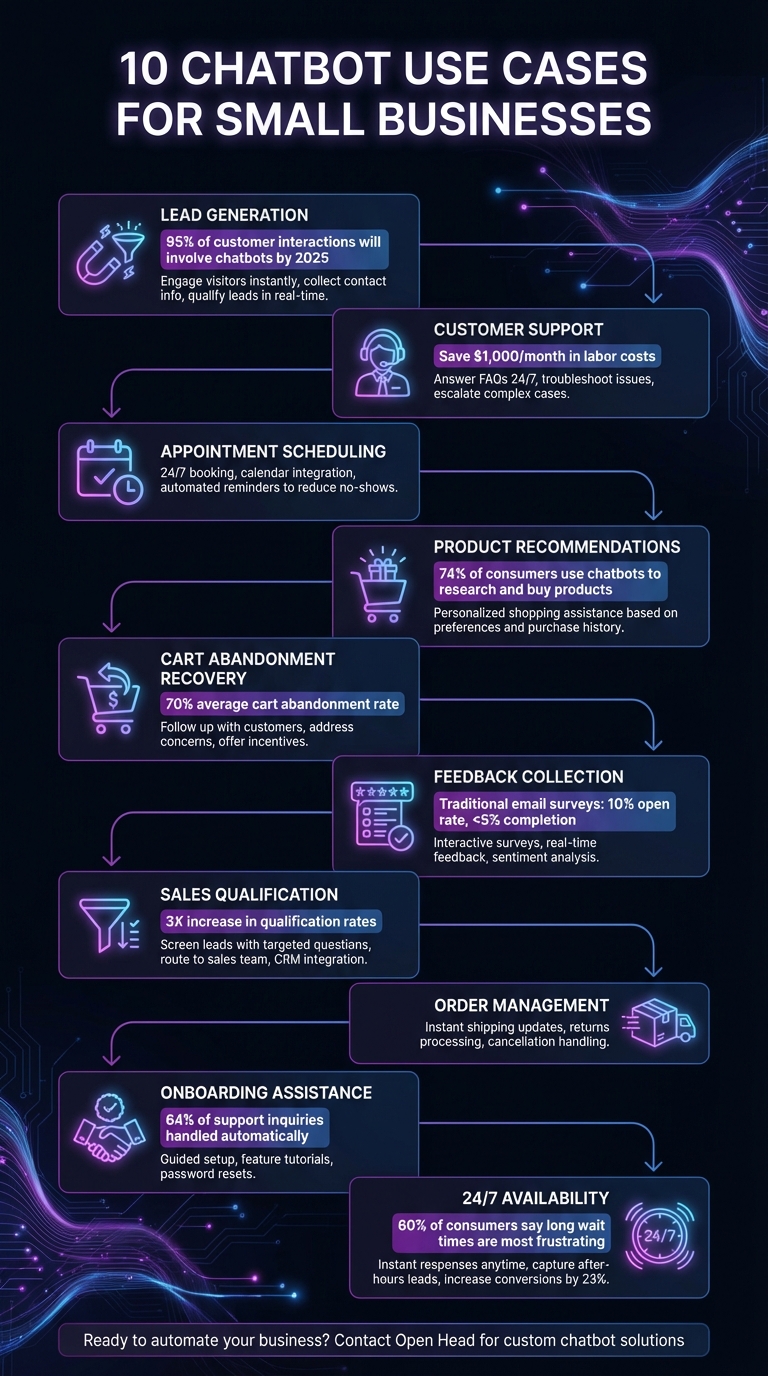
10 Chatbot Use Cases for Small Businesses
Boost Sales 24/7: How Small Businesses Can Use AI Chatbots
1. Lead Generation
Many small businesses miss out on potential customers simply because they can’t respond quickly enough. When website visitors have unanswered questions, they tend to leave – and often head straight to a competitor. This is where chatbots step in. They engage visitors immediately, collect contact details, and gauge interest before those prospects move on. This instant connection sets the stage for better lead qualification.
Chatbots go beyond just gathering basic information. Unlike static contact forms that wait passively to be filled out, chatbots actively start conversations. They ask focused questions about things like budget, project timelines, company size, and specific needs. This interactive approach builds a detailed profile of the lead in real time. If the chatbot identifies a promising prospect, it can notify your sales team instantly through Slack or email. Better yet, it can transfer the chat to a human agent while the visitor is still engaged.
The impact is clear: chatbots are becoming a go-to tool for consumers researching and purchasing products or services online. In fact, experts estimate that by 2025, 95% of all customer interactions will involve chatbot technology [2]. For small businesses competing with larger companies, chatbots create an even playing field by offering instant, 24/7 responses. This kind of efficient lead generation is just one way chatbots help small businesses stay competitive.
"The first step to capturing any lead is engagement, and chatbots can quickly engage with potential customers from the moment they access the website." – Robert Pleasant, Content Writer, Nextiva [5]
Getting started doesn’t have to be complicated. Begin by programming your chatbot to handle the five most common lead-related questions: pricing, availability, service areas, timelines, and features. As you review conversation logs during the first month, you’ll notice trends and can fine-tune the bot’s responses. The result? More qualified leads captured automatically – no extra staff required.
2. Customer Support
Small businesses often lose sales and leave customers frustrated when their questions go unanswered after hours. Chatbots can step in to bridge that gap by instantly addressing routine inquiries, eliminating the need for round-the-clock staff availability. Whether it’s questions about business hours, shipping policies, return processes, or product details, chatbots handle the repetitive tasks that typically eat up a support team’s time.
These days, customers expect quick answers – not an email response hours later. Chatbots excel here, managing multiple conversations at once, something that would take a team of support agents to achieve. For a small business, this means having a single virtual assistant that can handle the workload of several people.
"The primary purpose of chatbots is to improve CX with real-time automated support and self-service options." – Robert Pleasant, Content Writer, Nextiva [5]
Modern chatbots go beyond answering FAQs. They can assist with troubleshooting, resetting passwords, updating accounts, and even escalate cases when needed. Using sentiment analysis, they can detect when a customer is frustrated and ensure those issues are passed to a human agent promptly [5]. This approach ensures simple problems are resolved quickly, while more complex concerns get the personal attention they require.
Chatbots don’t just improve service – they also save money. For example, saving 10 hours of support work per week at $25/hour adds up to $1,000 in monthly labor cost savings [6]. Rather than replacing your support team, chatbots free them up to focus on high-value tasks that demand human judgment, empathy, and expertise.
3. Appointment Scheduling
Missed calls and endless back-and-forths over scheduling can lead to lost business. When customers can’t easily book an appointment, they’re likely to move on to a competitor. Chatbots solve this issue by offering 24/7 appointment scheduling, making it easy for customers to book at their convenience.
Here’s how it works: the chatbot syncs with your calendar in real time, checks for available slots, and presents them to the customer. Once a time is selected, it confirms the booking and integrates with tools like Google Calendar or Calendly. Booking links are shared directly within the chat, so customers don’t have to navigate away from the conversation [7][8]. This streamlined process not only simplifies scheduling but also keeps customers engaged.
Another major benefit? Fewer no-shows. Automated reminders – sent via SMS or email a day before the appointment – help ensure customers show up, keeping your schedule on track and your team productive [3]. With fewer scheduling headaches, your staff can focus on delivering top-notch service instead of answering repetitive questions or managing calendars.
Chatbots take the hassle out of scheduling, freeing up your team for tasks that truly matter.
4. Ecommerce Product Recommendations
When customers visit your online store, the sheer number of options can feel overwhelming. This is where a chatbot steps in as a virtual shopping assistant. By asking targeted questions about preferences, budget, and specific needs, it helps narrow down choices quickly. Instead of scrolling through endless product pages, customers receive tailored suggestions right in the chat, often presented with visual cards or galleries for easy browsing [1][3].
Integrating your chatbot with your CRM and order history allows it to recognize returning customers and make recommendations based on past purchases [5]. Plus, with machine learning, these suggestions improve in real time [2]. This creates a seamless and personalized shopping experience without requiring extra effort from your team.
Here’s what the numbers say: 74% of consumers use chatbots to research, find, and buy products online [2], and 80% report positive experiences [1]. A great example of this in action is LEGO‘s 2017 holiday campaign, which introduced "Ralph", a Facebook Messenger bot. Ralph helped users find gifts by asking questions about the recipient’s age and interests. The results were impressive – a 3.4X higher return on ad spend for click-to-Messenger ads and a 71% lower cost per purchase compared to standard website ads [10]. Another standout success story is Bondi Born, an ecommerce brand whose Facebook chatbot strategy achieved a 50X return on ad spend [10].
To replicate these results, sync your chatbot with platforms like Shopify or WooCommerce. Use interactive quizzes to collect preference data, display visually rich recommendations, and offer personalized discount codes to drive conversions [1].
5. Cart Abandonment Recovery
Recovering abandoned carts is a game-changer when it comes to turning potential sales into actual revenue. Cart abandonment is a persistent issue for online stores, with an average abandonment rate of about 70% [4]. In other words, seven out of ten shoppers leave items in their cart without completing the purchase. A well-timed chatbot can help reclaim many of these missed opportunities.
When a shopper leaves items behind, the chatbot steps in with a follow-up message after a short delay [4]. Instead of sending a bland reminder, it might ask, "Is something holding you back?" This simple question can uncover barriers like unexpected shipping costs or a frustrating checkout process [4]. By addressing these issues in real time – whether it’s clarifying return policies or fixing technical glitches – the chatbot can ease concerns and guide the customer toward completing their purchase [4][1].
Offering incentives can also be highly effective. A chatbot can deliver instant perks like discount codes, free shipping, or special coupons for the items left in the cart [4][1]. For returning customers, it can streamline the process even further by enabling one-click checkout using stored payment details [9]. This removes the hassle of re-entering information, making the experience seamless.
With integrations into platforms like Shopify or WooCommerce, the chatbot keeps an eye on cart activity and sends personalized recovery messages based on the exact items left behind [11][4][1]. Since 64% of shoppers value 24/7 availability in chatbots [1], this feature is especially useful for reaching late-night browsers or international customers who might otherwise slip away unnoticed.
The secret lies in getting the timing and personalization just right. If you wait too long to follow up, the customer may lose interest. Act too quickly, and the message could come across as pushy. A well-tuned chatbot strikes that perfect balance, transforming abandoned carts into completed purchases – all without the need for manual intervention. This approach to timing and personalization aligns seamlessly with the broader automation strategies discussed throughout this guide.
6. Feedback Collection
Traditional email surveys often struggle to engage users, with open rates hovering around 10% and completion rates below 5% [12]. Chatbots, however, change the game by turning feedback collection into a conversational experience.
A chatbot can ask for feedback right after a purchase, a support interaction, or a service appointment. By using interactive tools like emoji reactions, 1–5 star ratings, or simple yes/no buttons, chatbots make the process quicker and more engaging [12][13]. As Fred Reichheld, the creator of the Net Promoter Score, aptly put it:
"The instant we have the technology to minimize surveys, I’m the first one on that bandwagon." – Fred Reichheld [12]
Beyond simple ratings, chatbots can ask open-ended questions to gain deeper insights. Questions like "What could we improve?" or "What made you choose us?" uncover qualitative details that numbers alone can’t provide [5]. These responses can be stored automatically, and with tools like sentiment analysis, frustrated customers can be flagged for immediate follow-up [5]. By integrating with your CRM, chatbots can even customize questions based on a customer’s previous interactions or purchase history, making the feedback feel more relevant and personal [5].
Unlike delayed email surveys, chatbots collect feedback in real time, while the experience is still fresh [12]. This approach also allows for instant rewards. For example, a chatbot could offer a 10% discount code as soon as someone completes a feedback quiz [1]. This immediate incentive can significantly increase response rates compared to delayed email rewards. Plus, real-time feedback helps businesses operate more efficiently and make smarter decisions.
Robert Pleasant from Nextiva highlights the broader benefits:
"Chatbots can quickly gather customer feedback through polls, surveys, or even open-ended questions, providing organizations with an important look inside their customers’ heads and an overview of customer satisfaction." – Robert Pleasant, Content Writer, Nextiva [5]
Analyzing feedback can uncover trends in customer complaints, frequently asked questions, and product preferences, all of which can guide meaningful business improvements [3][5].
sbb-itb-2339147
7. Sales Qualification
After generating leads, the next step is ensuring your sales team focuses on the most promising prospects. Not everyone visiting your website is ready to make a purchase – some are just browsing, others are comparing options, and only a small percentage are prepared to take the plunge. This is where chatbots come in handy, helping to identify serious buyers by asking key screening questions right from the start. This way, your sales team can concentrate on leads that are actually ready to convert.
A sales qualification chatbot can ask specific questions to gauge factors like budget, timeline, decision-making authority, and unique needs. Instead of relying on generic contact forms, you can use targeted questions such as: "What service are you looking for?", "When do you plan to start?", "What’s your budget?", or "What’s your company size or industry?" This approach ensures that the prospects align with your ideal customer profile.
Once a lead is qualified, the chatbot can instantly route them to the appropriate sales team member or escalate the conversation to a live agent. Even better, it can sync the qualified leads directly to your CRM – like Salesforce or HubSpot – complete with lead scores and tags based on their responses. This makes it easier for your team to prioritize high-value prospects, saving time and boosting efficiency.
Real-world examples show how effective this can be. In 2018, Slush, an entrepreneurial organization, used a chatbot to handle interactions with around 20,000 attendees. The result? A 55% increase in conversations compared to the previous year [5]. Similarly, Open Universities Australia (OUA) replaced traditional self-service forms with AI-powered chatbots and saw a threefold increase in qualification rates [14].
To make the qualification process even smoother, consider using multiple-choice buttons for common answers like budget ranges or service types instead of open-ended text fields. Deploy the chatbot on high-intent pages – like pricing or product pages – and set it to engage visitors who linger or scroll extensively. This kind of behavioral targeting ensures you capture leads at the peak of their interest.
8. Order Management
Once a customer places an order, the questions start pouring in: “Where’s my package?”, “When will it arrive?”, or “Can I cancel this?” These inquiries can pile up quickly, especially during peak seasons, and handling them manually eats up valuable time. That’s where a chatbot steps in, taking on these repetitive tasks with ease by offering instant updates, managing cancellations, and guiding customers through returns.
Today’s chatbots are designed to integrate seamlessly with ecommerce platforms like Shopify and WooCommerce, pulling real-time order data to provide accurate answers. For instance, if a customer wants to track their shipment, the bot can instantly retrieve tracking details – no need for the customer to dig through emails or visit a separate site. Need to process a return? The chatbot can walk users through the steps and collect all the necessary information. And for cancellations, it can handle requests immediately, as long as they’re within the allowed processing window.
As Deon Nicholas, President of Forethought, puts it:
"Chatbots provide an additional means for customers to reach out to small businesses… Customers can request order updates, order cancellations, product or service information, and more, saving customer service teams valuable time." [2]
For small businesses, this means fewer support tickets clogging up the system, faster responses, and happier customers who can get their questions answered – even at 2 a.m. on a Sunday.
To make the most of this, connect your chatbot to your order management system so it can handle inquiries about order status, delivery timelines, and returns. These interactions also present an opportunity to gather customer insights, such as preferences or feedback, which can be used to fine-tune future marketing efforts [4]. The goal is to reduce friction: over one-third of online shoppers abandon their carts because navigating a website is too complicated [4]. By keeping everything in one easy-to-use chat interface, you simplify the entire process, making it smoother and more efficient for your customers. This kind of streamlined order management lays the groundwork for even better customer support in the next stage of their journey.
9. Onboarding Assistance
Chatbots aren’t just great for lead generation and customer support – they can also make onboarding new customers a breeze. Getting started with a product or service shouldn’t feel overwhelming, but small businesses often face early customer churn when users hit roadblocks during setup. Chatbots can step in to guide customers through the onboarding process – from creating accounts and resetting passwords to exploring essential features – all without requiring your team to be available 24/7.
These bots offer real-time, interactive assistance that simplifies setup tasks. Whether it’s helping with password resets, explaining key features, or directing users to training resources, chatbots handle it all instantly [16][17]. This not only speeds up the onboarding process but also keeps customers engaged, which can improve overall efficiency.
Take the example of Slush, an entrepreneurial organization that used a LeadDesk chatbot during their 2018 event. With around 20,000 attendees, the chatbot managed 64% of all customer support inquiries, tackling questions about schedules, venue directions, and ticket details [12]. That’s a clear demonstration of how effective automated support can be.
To get started, identify the most common questions new customers ask on day one. Your support team can help pinpoint these. Then, set up clear chatbot conversation paths to address these queries, whether it’s explaining pricing, walking through a product demo, or resolving technical issues. You can even create trigger-based workflows to activate the bot after key actions, like a completed purchase or signed contract [18].
As customers move through onboarding, it’s important to offer an option to escalate to a live agent for more complex issues [16][17]. Advanced chatbots can even detect frustration using sentiment analysis and transfer the conversation to a human representative when needed. This combination of automation and human support ensures customers get timely help without overloading your team.
10. 24/7 Availability
For small businesses, missing out on after-hours opportunities can be a costly mistake. Enter chatbots – the ultimate solution for instant, round-the-clock responses. They ensure customers get help exactly when they need it, not just during your business hours. This constant availability doesn’t just improve customer service; it also supports tasks like lead generation and order management, keeping your business engaged with customers at all times.
Here’s a telling statistic: 60% of consumers say long wait times are the most frustrating part of customer service [19]. Imagine someone visiting your website at midnight. If they can’t get answers immediately, they’re likely heading to a competitor. Chatbots prevent this by addressing common queries – like shipping details, return policies, order status, or account issues – without delay.
Take Amtrak’s chatbot, "Julie", as a real-world example. Julie handles 5 million questions annually and helped Amtrak achieve a 25% boost in bookings and a 50% increase in user engagement [12][15]. This shows how non-stop availability can capture potential customers whenever they’re ready to act.
For small businesses, chatbots offer a cost-effective way to secure leads and convert inquiries without hiring extra staff. In fact, 96% of consumers think brands should move away from traditional support and adopt chatbots, and AI-powered bots can increase sales conversions by up to 23% [19].
To make the most of 24/7 chatbot support, it’s important to set expectations. Let users know they’re chatting with a bot and provide an option to connect with a human agent during business hours for more complex issues. Start by programming your chatbot with answers to your most frequently asked questions. This simple step can significantly reduce after-hours inquiries while keeping potential customers engaged until your team can follow up. Combined with other automation benefits, 24/7 availability ensures a smooth customer experience and keeps your business generating revenue day and night.
How Open Head Builds Custom Chatbot Solutions
At Open Head, we craft chatbot solutions tailored to fit your unique business workflows. Founded by Brandon Meyer, a seasoned software engineer with experience at Lockheed Martin and Raytheon, the company employs a Trigger, Process, Action model to design AI automation systems. Here’s how it works: a trigger, like a form submission or an incoming call, sets things in motion. The AI interprets it using natural language understanding to figure out the intent. Then, it takes action – whether that’s updating your CRM, scheduling an appointment, or sending a personalized follow-up email [18]. This framework forms the backbone of our three specialized services, each designed to deliver tangible results for your business.
We offer three core chatbot services:
- AI Receptionists: These handle 24/7 phone answering, appointment scheduling, and lead qualification, cutting down support ticket volume by as much as 40% [5]. Pricing starts at $297/month.
- AI Sales Chatbots: Built to convert website visitors into qualified leads, these bots feature custom conversation flows and CRM integration. Development costs range from $2,500 to $7,500.
- Ecommerce Chatbots: Designed to enhance online shopping, they provide product recommendations, assist with cart recovery, and track orders, helping reduce abandoned carts and boost conversions.
Our solutions integrate seamlessly with your existing tech stack, ensuring smooth data flow across platforms. By connecting with tools you already use for lead generation and customer engagement, we help maximize the impact of your chatbot. Open Head leverages platforms like n8n, Make, and Zapier to sync data, automate follow-ups, and link systems – all without requiring technical expertise from you. Most projects are ready to launch within 1 to 3 weeks, and we provide full training and ongoing support to ensure success.
| Service | Starting Price | Features |
|---|---|---|
| AI Receptionist | $297/month | 24/7 phone answering, appointment booking, lead qualification, CRM integration |
| AI Sales Chatbot | $2,500 – $7,500 | Custom conversation flows, lead capture, calendar sync, training |
| Workflow Automation | $1,500 – $10,000 | Multi-app connections, data sync, custom logic, documentation |
To help you get started, Open Head offers a free 30-minute consultation. During this session, we’ll audit your workflows, pinpoint automation opportunities, and provide ROI projections – all with no obligation. Whether you’re looking for a simple FAQ bot or a more advanced multi-channel solution, our priority is delivering measurable business results.
Conclusion
Chatbots have come a long way, evolving from basic FAQ tools to becoming key players in driving business results. They’re available 24/7, help cut costs by automating routine tasks, and even turn casual website visitors into qualified leads. With 74% of consumers already using chatbots and predictions showing that 95% of interactions will involve chatbots by 2025, staying on the sidelines could mean falling behind [2].
The rise of AI-powered chatbots is reshaping how businesses meet customer expectations. From recovering abandoned carts to qualifying leads or scheduling appointments, these tools aren’t just about automation – they’re about delivering the instant, tailored experiences that customers now expect. And when chatbots handle the repetitive stuff, your team can focus on what really matters: growing your business.
"Tremendous customer experience can be the difference between a small business that grows slowly and one that accelerates in growth and revenue." – Deon Nicholas, President, Forethought [2]
The real magic happens when a chatbot is built specifically for your business needs. By training it on your data and seamlessly integrating it with your systems, it becomes an extension of your team – not just another tool. Open Head specializes in creating these custom AI solutions for small and medium-sized businesses. Most projects are ready to go in just 1 to 3 weeks, complete with full training.
Ready to take the next step? Book a free 30-minute consultation with Open Head. We’ll review your workflows, identify areas ripe for automation, and provide ROI projections – all at no cost or obligation. Let’s turn those repetitive tasks into streamlined, automated wins.
FAQs
How can small businesses use chatbots to generate more leads?
Chatbots are a game-changer for small businesses looking to grow their customer base. They interact with website visitors in real time, helping to gather contact information, assess potential customers’ needs, and answer frequently asked questions – all without the need for a human team member.
By offering tailored conversations and gently steering users through the sales process, chatbots can transform casual browsers into promising leads. Plus, they handle follow-ups automatically, making sure every opportunity is seized without adding extra work for your team.
How can chatbots help small businesses save money on customer support?
Chatbots are a smart way for small businesses to cut costs by automating routine customer support tasks. With their 24/7 availability, they ensure customers always have access to answers – without the added expense of hiring extra staff or covering overtime hours.
By managing tasks like order tracking, answering FAQs, and scheduling appointments, chatbots take care of the repetitive work. This allows your team to focus on more complex or high-priority issues, boosting efficiency while keeping operational costs in check. It’s an effective way to expand customer support without increasing your workforce.
How can chatbots improve the customer onboarding experience?
Chatbots make customer onboarding a breeze by offering instant, friendly greetings and walking users through setup steps in real time. They can gather key details, sync them directly to your CRM, and kick off workflow automations to keep the process running smoothly.
When customers have more detailed questions or need tailored assistance, chatbots can quickly hand things off to a human agent. This ensures every customer gets the support they need without unnecessary delays. The result? A faster, smoother onboarding experience that saves time for both your team and your customers.