


Every minute you delay responding to a lead, you risk losing them to competitors. Here’s why:
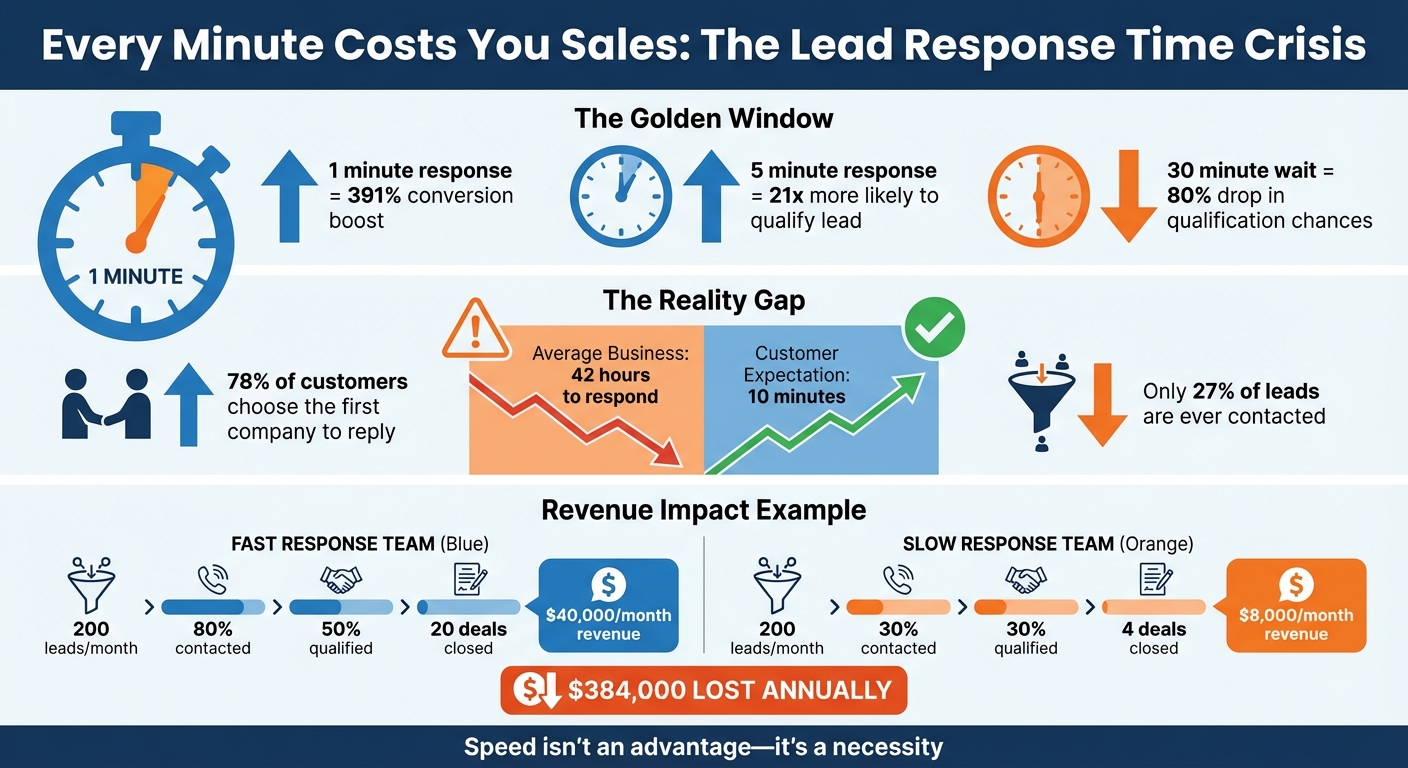
- Responding within 1 minute can boost conversion rates by 391%.
- Waiting 5 minutes slashes your chances of qualifying a lead by 80%.
- The average business takes 42 hours to respond, but 78% of customers choose the first company to reply.
Slow responses waste your marketing dollars and hand opportunities to competitors. AI tools can help you respond instantly, even outside business hours, ensuring no lead is ignored. Businesses that implement faster response systems see higher conversion rates, more revenue, and better customer retention.
Bottom Line: Speed matters. If you’re not responding quickly, you’re losing sales.
Lead Response Time Impact on Sales Conversion Rates
Why Speed Matters: Responding to Leads in Under 1 Minute 🚀
How Slow Lead Responses Cost You Money
Taking too long to respond to leads isn’t just inconvenient – it’s a direct hit to your bottom line. Every minute you delay is money slipping through your fingers.
Response Time Statistics and Conversion Rates
The data doesn’t lie: responding to a lead within five minutes makes you 21 times more likely to qualify that lead compared to waiting 30 minutes. Even a slight delay – responding in 10 minutes instead of five – slashes your chances by a staggering 80%. It’s clear that speed isn’t just an advantage; it’s a necessity.
Let’s put this into perspective. Imagine a business generating 200 leads per month with an average deal size of $2,000. A fast-acting team that contacts 80% of those leads, qualifies 50%, and closes 20 deals could bring in about $40,000 monthly. On the flip side, a slower team that only contacts 30% of leads, qualifies 30%, and closes just 4 deals ends up with a mere $8,000 monthly. That’s a $32,000 difference – per month. Over a year, that adds up to $384,000 in lost revenue, all because of delayed responses.
And here’s the kicker: only 27% of leads are ever contacted by businesses. That means a huge chunk of your lead generation budget is essentially wasted, while competitors swoop in to claim the opportunities you miss.
"A slow lead response time isn’t a minor sales inefficiency; it’s a systemic financial drain that invalidates marketing spend and directly subsidizes your competition." – Kixie
The numbers don’t just tell a story – they sound an alarm.
Examples of Lost Revenue Across Industries
Real-world examples drive this point home. Elite Web Professionals, for instance, cut their response times from hours to under one minute by using an AI-powered receptionist. The result? No more missed calls and a noticeable jump in conversions.
This pattern repeats across industries. In real estate, buyers often contact multiple agents simultaneously, and the first one to respond usually wins the client. In legal services, potential clients won’t wait around – they’ll move on to someone who answers quickly. The same goes for home services, where urgent inquiries demand immediate attention.
The cost of being slow is steep. It’s estimated that sluggish responses can drain 70–80% of your potential revenue. And when leads slip through your fingers, they almost always land with competitors who are quicker to act.
Why Fast Lead Responses Increase Sales
Speed isn’t just about being efficient – it’s about seizing the moment when potential customers are most interested. When someone reaches out to your business, they’re signaling their readiness to engage, and that opportunity is fleeting. A quick response can mean the difference between securing a sale or losing the lead to a competitor.
Studies reveal that nearly 80% of leads go with the first business to respond. Engaging within the crucial five-minute window makes you 100 times more likely to connect with a lead compared to waiting just 30 minutes. Even more striking, reaching out within the first 60 seconds can increase conversions by a staggering 391%.
How Quick Responses Impact Customer Behavior
Fast responses tap into how people naturally think and act. When someone contacts your business, they’re often looking for an immediate solution – a phenomenon known as temporal discounting. A prompt reply shows you’re organized, dependable, and value their time, which helps establish trust right away.
On the flip side, delays can cost you. Even a brief five-minute wait can give leads enough time to explore other options. Research shows that 30% of leads who don’t get a timely response will move on to another provider. In today’s competitive landscape, every second counts.
Response Time Standards by Industry
Customer expectations for response times vary depending on the industry. For example, 82% of consumers expect a reply within 10 minutes for sales or support inquiries. Yet, the reality often falls short. On average, B2B companies take 42 to 47 hours to respond. Here’s a breakdown of response benchmarks across industries:
| Industry | Best-in-Class Response | Industry Average |
|---|---|---|
| Real Estate / Home Services | Under 5 minutes | 42+ hours |
| Healthcare | Under 10 minutes | 2 hours 5 minutes |
| Telecommunications | Under 5 minutes | 16 minutes |
| Financial Services | 15 minutes | 24 hours |
| E-commerce | Instant (Chat/SMS) | 1 hour |
The gap between what customers expect and what businesses deliver creates a huge opportunity. Take the example of a financial services company in June 2025: they implemented an AI-powered lead response system, slashing their average response time from 30 minutes to just 4.5 minutes. The results? A 25% increase in qualified leads, a 15% boost in total revenue, and an impressive $1.2 million in additional revenue within six months, delivering a 350% ROI. These results highlight how technology can transform response times and drive measurable growth.
sbb-itb-2339147
How AI Automation Fixes Slow Lead Response Times
There’s a huge gap between what customers want and what businesses typically deliver, and AI automation steps in to bridge it. Did you know that about 62% of calls go unanswered, and only 0.1% of leads are contacted within five minutes? That’s where AI shines – it engages leads instantly through phone calls, website chats, or text messages, ensuring no opportunity slips through the cracks.
AI Receptionists for Instant Lead Contact
AI receptionists are game changers. They answer calls on the first ring, work around the clock, and can handle multiple calls at once – something human teams simply can’t match. When a call comes in, the AI gets to work immediately, asking qualifying questions, booking appointments straight into Google or Outlook calendars, handling FAQs, and even forwarding urgent matters to the right person.
Take Atlanta-based Elite Web Professionals, for example. Between April and August 2025, they introduced an AI receptionist for their client, Choice Signature Luxury Car Rental. Christopher Williams, the company’s president, customized the AI to ask industry-specific questions, like whether callers had a chauffeur’s license. Over just four months, the AI managed 1,017 calls and converted 778 of them into qualified leads, achieving an impressive 76% lead conversion rate.
"We trained the receptionist to ask what the purpose of the call was. It had different scripts based on rental needs – rideshare, luxury, or daily rentals. For many people, it answered their initial questions until we could call them back."
- Christopher Williams, President, Elite Web Professionals
And it doesn’t stop there. Automated systems also handle follow-ups, ensuring no lead is ever left hanging.
Automated Lead Follow-Up and Qualification
AI doesn’t just make the first move – it stays engaged. These systems qualify leads by asking the same key questions a sales rep would, like budget, timeline, and intent, all in real time. The moment someone submits a form, the AI sends an instant SMS or email acknowledgment, cutting out any wait time when teams are swamped. High-value leads are routed directly to available sales staff, while lower-priority prospects are nurtured until they’re ready to move forward.
Here’s the kicker: 73% of leads never get a manual follow-up. With AI, every lead gets the attention they deserve, boosting conversions and, ultimately, sales.
How to Implement Open Head AI Tools for Faster Lead Responses
Open Head makes integrating AI for quicker lead responses a simple, structured process. It’s broken down into three main steps, guiding you from initial assessment to full implementation while delivering measurable outcomes at every stage. Here’s how Open Head streamlines your lead response system.
Step 1: Free Consultation and ROI Analysis
The journey starts with a free 30-minute consultation. During this session, Open Head evaluates your lead volume, website setup, and CRM data. This analysis identifies areas where revenue might be slipping through the cracks – such as uncontacted leads, which often make up a significant portion. If your response time aligns with typical industry averages, you’re likely missing out on substantial revenue opportunities.
Using a straightforward formula – (Time of first contact – Time of lead creation) ÷ total number of leads – Open Head calculates your current response time. They then compare this with the "Golden Window", the critical five-minute period where you’re 21 times more likely to qualify a lead. By the end of the consultation, you’ll leave with a tailored roadmap, clear KPIs, and ROI projections based on your specific data.
Step 2: Custom AI System Setup
Once you give the green light, Open Head customizes and integrates an AI system into your tech stack. This includes seamless two-way CRM integration, ensuring every interaction – whether it’s a call, text, or email – is automatically recorded. To reduce risk and demonstrate value quickly, the process begins with a pilot use case, like visitor qualification or appointment scheduling.
A key part of this phase involves setting precise rules for when leads should be escalated to a live representative. Open Head also incorporates a deliberate 10–20 second delay in AI responses, making interactions feel more natural and thoughtful. This small adjustment has been shown to boost engagement rates by 30% compared to instant replies. The focus isn’t just on speed but on achieving what Open Head calls "Speed to Intelligent Lead Engagement."
Step 3: Performance Tracking and Improvement
After deployment, the system enters a 4–8 week pilot period where its performance is closely monitored. Metrics like response times, conversion rates, lead drop-off points, and qualification rates are tracked in real-time dashboards, giving you full visibility into how the system is performing.
Data is analyzed in detail, breaking it down by lead source, communication channel, and even individual team members to uncover specific bottlenecks. The AI system continuously improves by running A/B tests on factors like call schedules, response timing, and messaging to optimize results. Median response times are tracked alongside averages to identify and address any outliers causing delays. This ongoing analysis ensures every second saved translates into measurable revenue growth.
Conclusion
Delaying lead responses is like leaving money on the table. If you wait more than five minutes to follow up, your chances of qualifying that lead drop significantly. Shockingly, 55% of companies still take five days – or longer – to respond, and some never respond at all. Acting quickly can recover revenue that might otherwise be lost.
AI automation eliminates the usual delays caused by human limitations. Missed calls during lunch breaks, cold leads over weekends, and the time wasted on manual routing are no longer an issue. Every delay not only costs you money but also gives your competitors a chance to swoop in and win over your prospects.
With tailored AI solutions, you can ensure every lead gets a fast response, maximizing your chances to close the deal. Open Head makes this process simple: they start with a free consultation to identify revenue gaps, integrate custom AI systems into your current tools, and continuously track performance to measure improvements. Quick responses can turn missed opportunities into valuable closed deals.
Your customers expect speed – AI can help you deliver. Use automation to turn delays into growth and keep your revenue moving in the right direction.
FAQs
How can AI tools help businesses respond to leads faster?
AI tools make it possible to respond to leads almost instantly – sometimes in just seconds. With the help of AI-powered chatbots and virtual receptionists, businesses can manage initial inquiries around the clock. Whether a prospect reaches out through a web form, text message, or phone call, these tools are ready to step in. They greet potential customers, gather key details, and even qualify leads before passing them along to a sales representative. This means no lead slips through the cracks, even outside of regular business hours.
But it doesn’t stop there. AI tools can also rank leads using predictive scoring, ensure they’re directed to the right team member, and handle follow-ups via email or SMS automatically. By engaging prospects immediately, these tools not only boost conversion rates but also create a smoother sales process. What might have been a delay is now a chance for quicker, more meaningful customer interactions.
How does a slow lead response affect your sales and revenue?
A slow response to leads can seriously impact your sales. Research indicates that waiting even just an hour to follow up with a lead can slash your chances of converting them by as much as 400%. Considering that businesses often spend around $68 per lead, every delay could mean turning that investment into a missed opportunity.
Responding quickly is key to engaging potential customers while their interest is still high. Prompt replies not only help establish trust but also boost your likelihood of closing the deal, ensuring you make the most of your sales efforts.
What are the best practices for using AI to improve lead management?
To make the most of AI in lead management, focus on three key elements: speed, personalization, and relevance. Start by using AI-powered tools like chatbots or virtual assistants to quickly capture inquiries. These tools can collect essential details – such as a lead’s name, contact information, and intent – and qualify them based on pre-set criteria. Once qualified, AI can instantly route leads to the appropriate team or salesperson, ensuring no opportunity slips through the cracks.
Next, leverage automated and personalized email or SMS sequences to keep the conversation going. These messages can adapt based on the lead’s responses, keeping them engaged even after business hours. Responding to leads within five minutes is especially important, as it dramatically increases the likelihood of turning interest into action. On top of that, AI analytics can help you track response times, conversion rates, and lead quality, giving you the insights needed to fine-tune your approach.
For optimal results, make sure your AI tools are trained to understand industry-specific terminology, seamlessly integrate with your CRM to maintain accurate records, and comply with U.S. privacy laws. Regularly review performance metrics and update your AI models to ensure they remain accurate and effective. By sticking to these practices, you’ll not only simplify lead management but also enhance engagement and drive more conversions.