


Marketing automation saves time, reduces costs, and increases lead generation, while manual marketing relies on personal effort but struggles to scale. Here’s the bottom line: businesses using automation report a 451% increase in qualified leads, a 14.5% boost in sales productivity, and a 12.2% drop in marketing overhead. Meanwhile, manual marketing often results in higher labor costs and inefficiencies as your business grows.
Key takeaways:
- Automation: Handles repetitive tasks, scales efficiently, and delivers measurable ROI (e.g., $5.44 for every $1 spent).
- Manual Marketing: Offers a personal touch but is time-consuming, costly, and limits growth.
Quick Comparison:
| Metric | Marketing Automation | Manual Marketing |
|---|---|---|
| Speed | Instant responses to triggers | Slower, depends on human availability |
| Scalability | Handles growth without extra staff | Requires more staff as leads increase |
| Personalization | Targeted, data-driven messaging | One-on-one, but slower |
| Cost | Lower overhead over time | Higher labor costs |
| Lead Generation | 451% more qualified leads | Limited by team capacity |
Automation empowers teams to focus on high-impact tasks, while manual methods struggle to keep up with growing demands. If your business is missing opportunities due to inefficiencies, automation might be the solution.
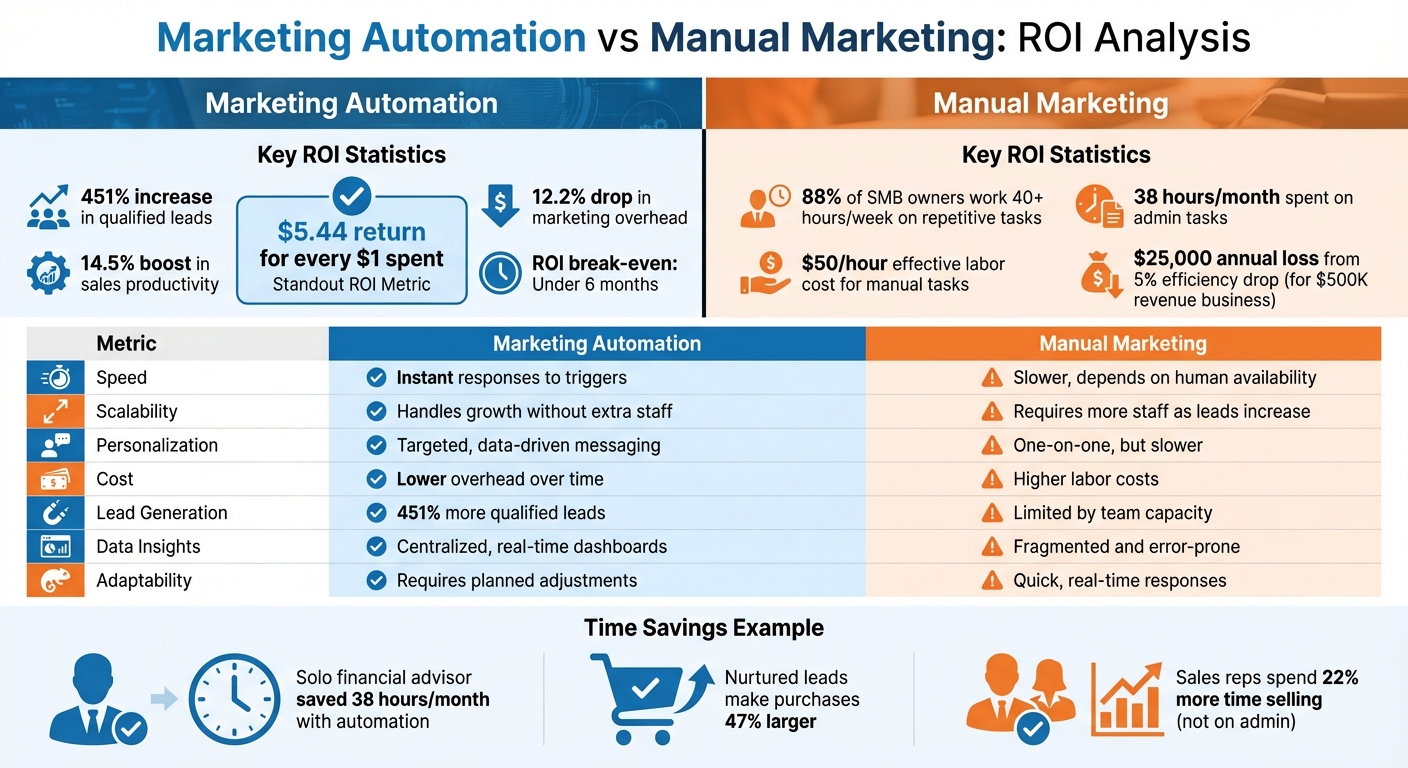
Marketing Automation vs Manual Marketing ROI Comparison
1. Marketing Automation
Time Efficiency
Marketing automation takes over repetitive tasks like email campaigns, social media posts, and updating customer records. Meanwhile, AI-powered chatbots handle FAQs and capture leads around the clock – no breaks, no downtime [8].
One game-changer is automated lead scoring. By assigning points based on actions like visiting pricing pages, opening emails, or attending webinars, the system identifies "hot" leads. Once a lead hits that threshold, sales teams can prioritize closing deals instead of sifting through data. This shift allows sales reps to spend 22% more time selling rather than being bogged down with admin tasks [1][9].
Here’s an example: a solo financial advisor used automation for lead intake, scheduling, no-show follow-ups, and review requests. The payoff? 38 hours saved every month [6]. For small teams, that’s not just time saved – it’s a direct boost to revenue potential.
And it doesn’t stop there. Time efficiency also leads to lower costs and scalable growth opportunities.
Cost and Scalability
The financial benefits of automation are hard to ignore. It enhances sales productivity by 14.5% and scales effortlessly, whether you’re managing 10 or 10,000 customers [2] [8] [5]. Plus, businesses report a 12.2% drop in marketing overhead [2].
Consider this: Oracle estimates that every dollar spent on marketing automation generates an average return of $5.44 within three years, with many businesses breaking even in under six months [7]. Companies that automate lead nurturing see a 451% jump in qualified leads, and those nurtured leads tend to make purchases that are 47% larger than their non-nurtured counterparts [9] [2].
At Open Head, we specialize in helping small and medium-sized businesses implement tailored AI systems for results like these. By focusing on high-impact workflows – like abandoned cart recovery, post-demo follow-ups, and trial-to-paid nudges – we ensure you see quick wins while laying the groundwork for broader automation.
And beyond cost savings, automation takes personalization to the next level, driving better results in lead generation.
Personalization and Lead Generation ROI
Automation allows for highly targeted communication. Triggered workflows send personalized messages based on customer actions – like welcome emails for new subscribers, follow-ups for abandoned carts, or reminders after consultations – all without requiring manual effort [9] [6].
Industries with longer sales cycles see particularly strong results. For instance, real estate firms enjoy email open rates of 41.6% [4]. Medical practices use automation to manage appointment reminders and reduce no-shows, recovering lost revenue [6]. Similarly, law firms and professional services automate lead intake and scheduling, freeing up time for billable client work [6].
The real power lies in integrating automation with your CRM. This creates a complete picture of each customer’s journey, ensuring the right message reaches the right person at just the right moment [5] [2].
2. Manual Marketing
Time Efficiency
Manual marketing eats up precious hours. According to research, 88% of small-to-medium business owners work more than 40 hours a week, with much of that time devoted to repetitive tasks like tracking leads in spreadsheets, sending follow-up emails one by one, and logging notes manually [8]. These activities aren’t strategic – they’re routine tasks that pull your focus away from revenue-generating opportunities.
"If you’re still tracking leads in spreadsheets, relying on manual follow-up, and losing deals due to no-shows… You’re already paying for the lack of ROI. Every day." – Rob Riggs, Marketing, Brief [6]
The cost of this type of work isn’t just time – it’s money. Manual tasks like lead intake, scheduling, and sending reminder emails equate to about $50 per hour in effective labor costs [6]. For solo professionals, these administrative chores can take up 38 hours per month, representing over $2,000 in labor value that could otherwise be spent on billable work or closing deals [6].
When you add it up, this lost time doesn’t just hurt productivity – it inflates operational costs significantly.
Cost and Scalability
The financial strain of manual marketing goes beyond wasted time. As your business grows and leads increase, manual processes demand more staff, which leads to higher overhead [7]. The simple truth is that manual methods don’t scale without adding more people to handle the workload.
And then there are the hidden costs. For example, a business generating $500,000 annually could lose $25,000 per year from just a 5% drop in efficiency caused by slow response times or missed follow-ups [6]. The challenge is even greater when you consider that about 50% of leads are qualified but not ready to buy immediately [2]. Small teams often lack the resources to nurture these leads manually over time, meaning many potential opportunities are lost.
Experts describe manual marketing as "scaling effort" – you’re working harder, not smarter [9]. Every new campaign, every additional lead, and every follow-up adds to the workload. This linear growth model quickly hits a ceiling, limiting your ability to expand without significant strain.
Personalization and Lead Generation ROI
While manual marketing demands a lot of resources, it often falls short when it comes to delivering the speed and consistency required for personalized engagement. The one thing manual methods have going for them is the human touch. Personalized outreach can build trust and foster genuine connections in a way that automated messages sometimes can’t [9]. However, manual processes are too slow and inconsistent to meet modern customer expectations. Managing emails and customer data across multiple tools creates inefficiencies that drag down performance [9][6].
The result? Response times slow down, leads grow cold, and no-show rates increase [6]. Without a centralized system, it’s nearly impossible to track which actions are driving revenue [5].
How To Evaluate The ROI Of Marketing Automation Budget?
sbb-itb-2339147
Advantages and Disadvantages
To wrap up the earlier discussion, let’s break down the key strengths and weaknesses of marketing automation and manual marketing.
Marketing automation focuses on scalable efficiency, while manual marketing thrives on personal, hands-on control. Both approaches influence your bottom line in different ways.
Marketing automation can boost ROI by up to 30%, thanks to its ability to run continuously, respond instantly to customer actions, and manage workflows at scale. Whether you’re handling 100 or 10,000 contacts, automation can do the heavy lifting without requiring additional staff [3] [5] [8]. These systems streamline operations, as seen in the examples provided earlier, improving overall efficiency.
However, automation comes with its challenges. Initial setup costs – such as software subscriptions, training, and data migration – can be steep [10] [11]. Poorly designed workflows or generic automated messages can feel impersonal, making it harder to build trust [10] [11]. Additionally, automation lacks the flexibility to pivot quickly in response to sudden market changes, as adjustments often require prior planning [11].
On the other hand, manual marketing shines in situations where deep personalization is key. It allows for real-time adjustments and genuine, emotional connections with customers [11]. But this approach can be a double-edged sword. It’s labor-intensive, prone to human error, and difficult to scale. As your audience grows, manual processes often demand more staff, driving up costs and limiting growth. Plus, fragmented tools and data can make tracking ROI a real challenge [3] [7] [10].
Here’s a quick comparison of the two approaches:
| Metric | Marketing Automation | Manual Marketing |
|---|---|---|
| Speed | Instant response to triggers | Slower; depends on human availability |
| Scalability | Scales efficiently without extra headcount | Limited by team size and capacity |
| Personalization | Tailored messaging through triggers | Offers deep, one-on-one personalization |
| Human Touch | Can feel robotic without careful management | Builds authentic, emotional connections |
| Data Insights | Centralized, real-time dashboards | Often fragmented and error-prone |
| Adaptability | Requires planned adjustments | Quick, real-time responses to trends |
For most growing businesses, relying solely on manual marketing becomes unsustainable. The high labor costs and missed opportunities make automation a practical choice. But automation isn’t about replacing people – it’s about eliminating bottlenecks so your team can focus on strategy, creativity, and driving revenue [3].
Conclusion
Through our exploration of time efficiency, cost savings, and lead generation, the advantages of automated marketing over manual methods become clear. Studies reveal that marketing automation delivers an impressive $5.44 return for every dollar spent over three years, with most businesses breaking even in less than six months [7]. For small and medium-sized businesses (SMBs) with tight budgets and lean teams, these numbers are hard to ignore.
Manual marketing processes, while effective at smaller scales, struggle to keep up as businesses grow. Labor costs rise, bottlenecks emerge, and opportunities slip through the cracks. If you’re missing leads due to inconsistent follow-ups, drowning in repetitive tasks, or unable to pinpoint which campaigns drive revenue, it’s a sign that automation could be the key to sustainable growth.
As we’ve seen from the metrics and examples discussed earlier, automation isn’t just about efficiency – it drives meaningful results. Start with high-impact workflows like abandoned cart recovery or welcome email sequences, which can yield noticeable improvements within 60 to 90 days. Before diving in, ensure your customer data is clean and organized; duplicate records or incomplete profiles can derail even the most well-planned automation efforts [3]. Additionally, aligning your sales and marketing teams with shared definitions and clear handoff processes ensures no leads fall through the cracks.
"Automation isn’t about replacing people – it’s about empowering them to focus on what matters most: strategy, creativity, and growth." – Reach Marketing [3]
Your team’s time is too valuable to be spent on manual tasks like managing spreadsheets or sending emails one by one. Instead, they should be nurturing relationships, fine-tuning your messaging, and driving revenue. Automation takes care of the repetitive work, freeing your team to focus on what they do best.
At Open Head, we specialize in turning these insights into actionable strategies tailored for SMBs. Let AI-driven automation pave the way for your business’s growth. Schedule a free 30-minute consultation to create a personalized automation roadmap and see projections for your ROI today.
FAQs
How does marketing automation help boost lead generation and sales efficiency?
Marketing automation takes the hassle out of lead generation by handling tasks like capturing contact details, scoring leads based on their actions, and sending tailored follow-ups through email, social media, and web channels. This hands-off approach ensures that leads are nurtured effectively, without constant manual effort, which means more qualified leads and often larger purchase sizes. Many businesses that use automation notice improvements in both lead quality and conversion rates.
On the sales front, automation boosts productivity by streamlining processes such as lead routing and prioritization. This allows sales teams to focus their energy on connecting with the most promising prospects. Companies that embrace automation often experience faster pipeline growth, better sales efficiency, and increased revenue. By taking repetitive tasks off your team’s plate, automation frees them up to concentrate on closing deals, ultimately delivering stronger results across the board.
What are the upfront costs and challenges of adopting marketing automation?
Adopting marketing automation comes with some upfront costs beyond just the monthly subscription fee. These can include the cost of the software license, setup fees for configuring workflows, and the time investment required to clean up and migrate your existing contact data. For small and medium-sized businesses, there might also be additional expenses for staff training or hiring a consultant to customize the system to meet specific business needs.
There are also a few challenges to keep in mind. Integrating the automation platform with your current CRM, email tools, and analytics systems can be tricky, but it’s essential for smooth operation. Ensuring accurate data migration is just as important – errors or duplicate records can throw off automated workflows. Plus, your team may need time to adjust to new processes and feel confident in AI-driven recommendations. Providing clear communication and training can make this transition smoother. Tackling these issues early on can set the stage for faster lead generation, improved engagement, and campaigns that can scale as your business grows.
How does marketing automation combine personalization and efficiency better than manual marketing?
Marketing automation blends personalization with efficiency, making it possible to send the right message to the right person at exactly the right moment – all without requiring marketers to manage each interaction manually. By leveraging AI and data-driven rules, these tools analyze customer behaviors such as email opens, website visits, and purchase history. This data helps segment audiences, assign lead scores, and trigger customized messages like emails, SMS, ads, or chatbot responses instantly.
The result? Businesses can deliver highly tailored experiences to a massive audience, reaching thousands of prospects while staying relevant to each individual. At the same time, automation frees up marketers by handling repetitive tasks like writing initial drafts or scheduling social media posts. Research backs this up – automated workflows have been shown to boost conversion rates by up to 77%, improve sales productivity by 14.5%, and cut marketing costs by 12%. This allows teams to focus on strategic planning and creative work, achieving a level of personalization at a speed and scale that manual efforts simply can’t match.