

Missed calls cost businesses thousands annually, but choosing between a human receptionist and an AI alternative could help reduce those losses. Here’s the deal:
- Human receptionists cost around $46,000 annually (including salary, benefits, and overhead). Add hiring, training, and limited availability, and the expenses grow quickly.
- AI receptionists (like Open Head) start at $15/month per user, with plans scaling based on call volume. They handle calls 24/7 without the overhead of salaries, benefits, or office space.
Quick Comparison
| Feature | Human Receptionist | AI Receptionist (Open Head) |
|---|---|---|
| Annual Cost | $46,000+ | $180–$2,400+ |
| Availability | Limited (business hours) | 24/7 |
| Overhead Costs | Office space, equipment | None |
| Training | Required | Minimal |
| Scalability | Adds hiring complexity | Scales easily |
Switching to AI could save up to 60–95% annually while ensuring no call goes unanswered.
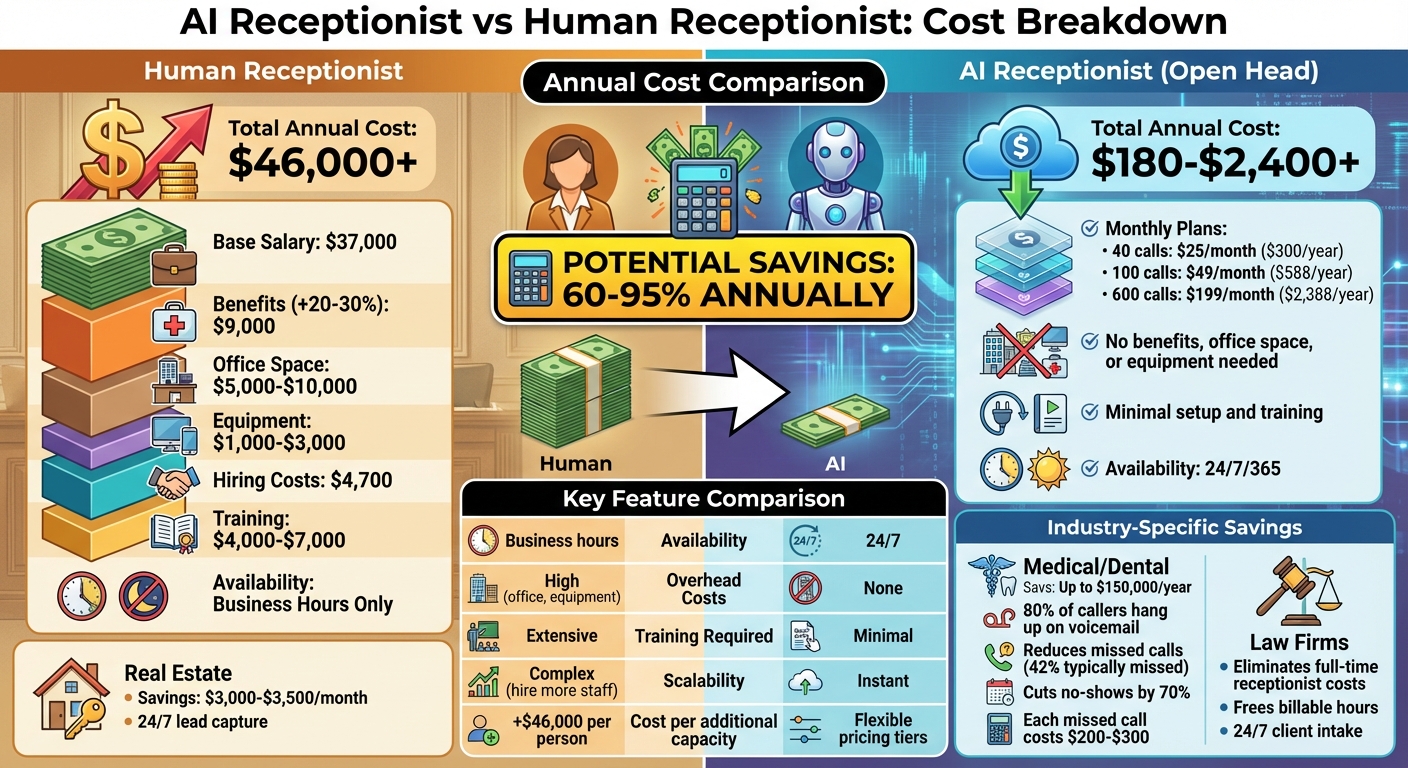
AI vs Human Receptionist Cost Comparison: Annual Savings Breakdown
The ROI Of Hiring An AI Agent VS A Human Receptionist | Which Saves More? #AICallReceptionist
What a Human Receptionist Costs
The cost of hiring a human receptionist goes far beyond just their hourly wage. In the U.S., the median hourly wage for a receptionist is $17.90, which works out to about $37,000 annually before factoring in additional expenses. But salary is just the starting point.
Salary and Benefits
Full-time receptionists typically earn between $30,000 and $55,000 per year, with the median salary landing around $37,000. On top of this, benefits can increase costs by 20–30%. For example:
- Health insurance: $4,000–$7,000 per year
- Retirement contributions: Around $3,000 annually
- Paid time off: Approximately $2,000 annually
This means that a receptionist earning $36,000 in base salary could cost an employer roughly $46,000 when benefits are included. And that’s before considering other operational costs.
Overhead and Operating Expenses
Employers also need to provide receptionists with a dedicated workspace, which includes essentials like a desk, computer, phone system, and office supplies. These overhead costs typically add 25–40% to the base pay. For a $37,000 salary, this brings the total annual cost to around $50,000. Initial investments, such as recruiting and training, push expenses even higher.
Hiring and Training Expenses
Recruiting a receptionist involves costs averaging $4,700 for activities like job postings, interviews, and candidate screening. Once hired, training adds another $4,000–$7,000, with ongoing training requiring about one week’s worth of wages every year. These upfront and recurring costs make hiring a receptionist a substantial financial commitment.
What an AI Receptionist Costs with Open Head
Open Head offers AI receptionist services through a pricing model that skips traditional expenses like salaries, benefits, and office space. Instead, it’s based on a simple monthly subscription that adjusts according to how much you use it.
Setup and Subscription Fees
Here’s how the pricing works. Open Head keeps things straightforward with no hidden setup fees. The base Quo subscription starts at $15 per user per month, and the cost increases depending on your call volume. For example:
- 40 calls: $25/month
- 100 calls: $49/month
- 600 calls: $199/month
If you go over your plan’s call limit, you’ll pay an overage fee ranging from $0.45 to $1.00 per call.
Eliminated Overhead and Benefits
The savings with an AI receptionist come from cutting out costs tied to hiring and maintaining human staff. Traditional receptionist expenses can include not only salaries – typically ranging from $37,000 to $50,000 annually – but also an additional 20–30% in costs for benefits like health insurance, retirement contributions, and paid time off. With Open Head’s AI, you avoid these entirely.
You also save on office-related expenses, such as:
- Office space: $5,000–$10,000 annually
- Equipment: $1,000–$3,000 for desks, computers, and phone systems
Since the AI operates remotely as software, there’s no need for physical infrastructure.
Scaling and Maintenance Costs
One of the biggest advantages is how easily Open Head’s AI receptionist adapts to your business needs. Whether you handle 50 calls or 500 calls a month, the system adjusts without requiring you to hire more staff or expand your office. It runs 24/7, providing constant coverage at a fraction of the cost.
Maintenance is minimal too. Unlike human employees, the AI doesn’t need ongoing training, and you won’t deal with issues like turnover or absenteeism. Plus, as AI technology evolves, you’ll enjoy improved features without seeing your costs rise. This keeps your operations efficient and budget-friendly over time.
sbb-itb-2339147
Side-by-Side Cost Comparison
Looking at costs side-by-side, the differences are striking. Hiring a human receptionist involves more than just a salary – it comes with additional expenses like benefits, office space, equipment, and training. These costs can add up fast. On the other hand, Open Head’s AI receptionist offers round-the-clock service while cutting out most of these recurring expenses.
Annual Cost Comparison Table
| Cost Category | Human Receptionist | AI Receptionist (Open Head) |
|---|---|---|
| Salary & Benefits | Significant ongoing personnel expense | Not applicable |
| Overhead (Office, Equipment) | Additional operational costs | Eliminated |
| Training & Onboarding | Time and cost intensive | Minimal setup effort |
| Service Fee | N/A | Predictable, lower subscription fee |
| Overall Annual Cost | High due to cumulative expenses | Substantially lower – with potential savings of up to 60–95% |
This table highlights the yearly savings, but the real impact becomes even clearer when you consider how these savings grow over time.
1-, 3-, and 5-Year Cost Projections
The financial benefits of AI start showing almost immediately – often within the first month or two. Over the course of one, three, and five years, the savings continue to compound, with costs projected to decrease by an additional 10–20%.
Cost Per Interaction and ROI
Breaking it down further, the cost per interaction makes the case even stronger. For human receptionists, each call carries the weight of overhead, salaries, and benefits. In contrast, AI operates 24/7 at a fraction of that cost. By ensuring no call goes unanswered, Open Head’s AI receptionist not only reduces expenses but also helps boost revenue. This combination delivers a solid return on investment, directly benefiting your bottom line.
Cost Differences by Industry
Looking at industry-specific examples, it becomes clear how switching to AI can lead to substantial savings. Factors like call volume, after-hours service, and the types of inquiries handled play a big role in determining these cost reductions.
Real Estate and Property Management
Real estate agencies and property management firms thrive on being available 24/7 to catch every potential lead. With Open Head’s AI receptionist, tasks like scheduling property showings, providing lease information, and handling maintenance requests are covered around the clock. This eliminates the need for human receptionists, saving businesses between $3,000 and $3,500 per month [5,14]. Plus, the AI solution ensures no inquiry slips through the cracks – even during evenings and weekends.
Medical and Dental Practices
Healthcare offices often face hefty costs for front desk staffing. A single human receptionist typically costs between $30,000 and $50,000 annually, and that figure can climb higher when adding benefits, payroll taxes, and turnover expenses [31,32]. Beyond staffing costs, these practices miss about 42% of incoming calls during business hours, with each missed call potentially costing $200 to $300 in lost revenue – adding up to annual losses of $200,000 to $500,000 [32,33,35]. Open Head’s AI receptionist tackles these challenges by handling scheduling, insurance questions, and patient triage 24/7. This approach reduces front desk costs by 60–80%, saves up to $150,000 annually, and cuts missed appointments by up to 40% while decreasing no-shows by as much as 70% [30,31,32,34].
Law Firms and Legal Services
For law firms, time spent on routine calls takes away from billable hours. Open Head’s AI receptionist simplifies client intake, routes messages, and prioritizes urgent calls [36,38,39]. By replacing the need for a full-time receptionist – along with their salary, benefits, training, and office space – firms can focus resources on legal work and revenue-generating tasks.
These examples highlight how AI can dramatically lower operational costs. Up next, we’ll look at how these savings align with your business goals.
Choosing the Right Solution for Your Business
Deciding between an AI receptionist and a human receptionist ultimately depends on your business’s unique needs, call volume, and budget. For businesses with high call volumes or frequent missed calls, an AI receptionist can be a game-changer. It ensures 24/7 availability while cutting down on recurring costs, as highlighted in earlier sections. This makes it a practical option for businesses focused on reducing expenses while maintaining operational efficiency.
Start by assessing your monthly call volume and identifying the features that matter most to your business. Do you need appointment scheduling? Multilingual support? Smart call routing? For industries like healthcare, compliance requirements such as HIPAA may also play a critical role. If your business regularly handles complex conversations requiring human judgment or needs deep integrations with custom tools, these factors should guide your choice. A trial phase can help confirm whether the solution aligns with your daily operations.
Take advantage of free demos and trials to test the AI solution. This allows you to evaluate its reliability, ease of use, and how well it integrates with your existing systems, such as calendars or CRMs. Look for features like natural-sounding AI voices, transparent pricing without hidden fees, and scalability to ensure the solution grows with your business without unexpected costs or complications.
Missed calls can have a direct impact on client retention. Studies show that 80% of callers hang up when they reach voicemail. Each missed call could mean a lost lead, and those losses add up quickly.
The right choice balances efficiency with customer interaction goals. For instance, Open Head’s AI solution provides consistent, instant responses around the clock, ensuring no call goes unanswered. This not only reduces operational costs but also frees up your team to focus on more complex tasks and revenue-generating activities. For businesses looking to enhance productivity and affordability without sacrificing service quality, the benefits are clear.
FAQs
How does an AI receptionist manage complex customer interactions?
An AI receptionist leverages natural language processing (NLP) and AI algorithms to manage customer interactions with precision. It’s designed to grasp context, interpret subtle questions, and deliver responses tailored to the specific situation.
When faced with more complex inquiries or requests, the AI receptionist can effortlessly pass the conversation to a human agent. This ensures customers experience a seamless transition and professional support. By blending automation with human expertise, businesses can maintain excellent service standards while improving efficiency.
What challenges might arise when switching from a human receptionist to an AI-powered receptionist?
Switching to an AI-powered receptionist isn’t without its challenges. One major concern is whether the AI can manage complex or nuanced inquiries. Human receptionists often shine in interpreting tone, emotion, and context – qualities that can be tricky for AI to replicate. This is especially important in fields like healthcare or legal services, where maintaining a personal and empathetic customer experience is critical.
Another potential hurdle is integrating the AI receptionist with your current systems. This process might require some technical know-how and could temporarily disrupt daily workflows during the setup phase. However, with thoughtful planning and the right support, these obstacles can be addressed and minimized.
How does Open Head protect sensitive business data when using its AI receptionist?
Open Head takes protecting your business data seriously, employing strong security protocols to keep your information safe. From end-to-end encryption to secure data storage and strict access controls, every measure is designed to ensure confidentiality.
We adhere to top-tier standards like GDPR and CCPA, conducting regular security audits to identify and address any risks before they become issues. On top of that, we implement secure authentication methods and enforce detailed data governance policies, prioritizing your privacy and building trust every step of the way.